How to Plan a NestJS Backend: Scope, Architecture, and Delivery
- NestJS
- Node.js
- backend development
- API development
- web applications
- software architecture

How to Plan a NestJS Backend: Scope, Architecture, and Delivery
A NestJS backend project should begin with a business operation, not a repository. Choose a representative journey—creating an account, pricing a quote, placing an order, scheduling a service, moving money, resolving a claim—and trace it from the client request to the authoritative record, external providers, asynchronous work, operator intervention, and final evidence. This exposes the decisions the backend must own.
Write a scope brief that names users and systems, business outcomes, jurisdictions, critical workflows, data classes, service commitments, integrations, traffic assumptions, availability and recovery targets, migration needs, delivery deadline, and explicit exclusions. Add the cost of duplicate processing, stale data, unauthorized action, late response, and provider failure. “Build an API” is not a scope; “accept an order exactly once, reserve inventory, collect payment, and make every uncertain state recoverable” is.
Separate facts from assumptions. Collect current process maps, contracts, data samples, incident history, volume and latency evidence, client capabilities, security requirements, and the people who operate exceptions. Give every unknown an owner and resolution date. The purpose of planning is not to predict every endpoint. It is to make the important boundaries, irreversible choices, and learning sequence visible before code turns guesses into dependencies.
Choose NestJS for Explicit Structure, Not Fashion
NestJS provides a structured application model on Node.js: modules organize related capabilities, controllers handle transport requests, providers hold application behavior and dependencies, and the dependency-injection container assembles them. Modules encapsulate providers by default and expose only deliberate exports. This gives a team vocabulary for boundaries, but the framework cannot decide where the business boundaries belong.
Organize modules around capabilities such as Identity, Accounts, Catalog, Orders, Billing, Scheduling, or Notifications rather than technical folders for all controllers and all services. Keep transport DTOs at the edge; validate untrusted input at runtime; map it into domain commands and values; and return explicit response contracts. A module’s public surface should be smaller than its internal implementation. Circular imports and global modules usually signal an ownership problem, not a missing decorator.
Start with a modular monolith for most new products. It preserves simple transactions, one deployment, direct debugging, and lower operational cost while still enforcing internal boundaries. Extract a service only when scale, availability, release independence, security isolation, data authority, technology, or team ownership supplies evidence. Microservices introduced as a symbol of maturity distribute latency, partial failure, data consistency, testing, deployment, and incident response before the product has earned that complexity.
TypeScript improves refactoring and shared contracts, but compile-time types disappear at runtime and do not validate requests, messages, environment variables, or database records. Nest pipes, schemas, DTO validation, guards, interceptors, and exception filters can make edges consistent. Use them to implement explicit policy—not to hide business rules in a stack of decorators that nobody can trace.
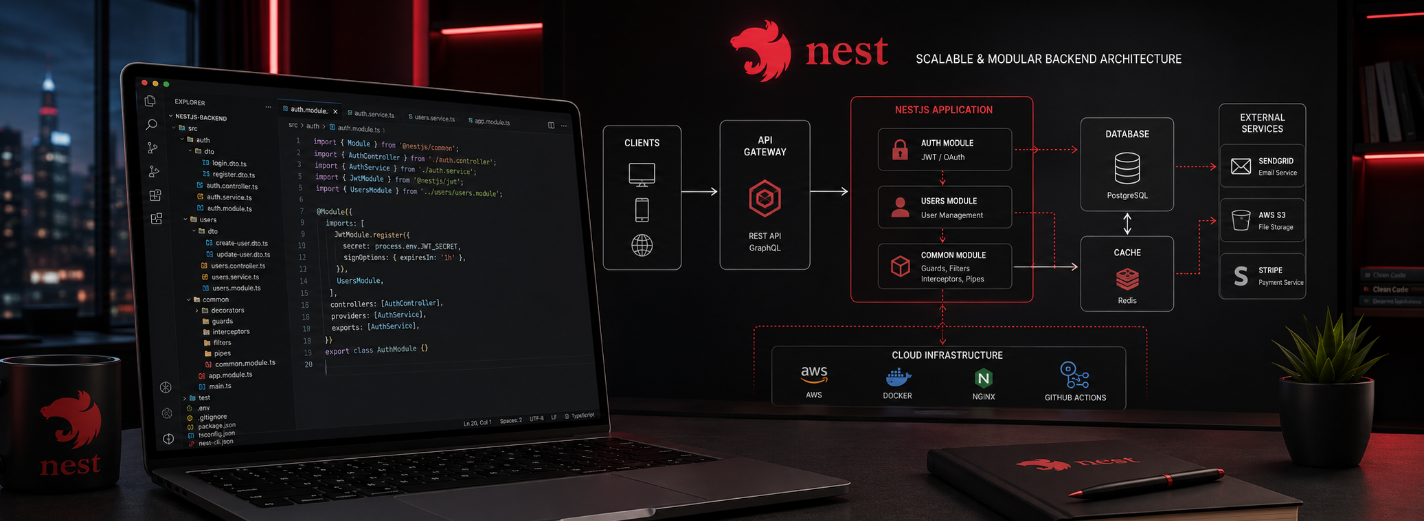
- Business-capability modules with narrow exports, explicit data authority, and ownership that survives team growth.
- TypeScript contracts backed by runtime validation, focused domain rules, compatibility tests, and versioned migrations.
- REST, GraphQL, WebSocket, message, queue, and event transports selected by workflow needs rather than included by default.
- Databases, caches, brokers, and cloud services integrated with timeouts, idempotency, observability, reconciliation, and recovery.
Plan the Backend as a Complete Operating System
Plan services around outcomes rather than a list of endpoints. Product discovery should define actors, permissions, states, transitions, invariants, exceptions, and service levels. API design should cover REST, GraphQL, WebSocket, or message contracts only where each transport fits; versioning, pagination, filtering, error semantics, idempotency, rate limits, deprecation, and consumer ownership belong in the initial contract.
Design data authority before selecting an ORM. Identify transactional boundaries, unique constraints, retention, privacy classification, audit needs, reporting, search, cache ownership, and migration from current records. Keep schema migrations versioned and forward-compatible with rolling releases. Test restore and reconciliation. A repository abstraction is useful when it expresses domain persistence needs; a generic repository that hides every useful database feature is ceremony.
Make identity and authorization part of each operation. Authentication establishes who or what is calling; authorization decides whether that principal may perform this action on this resource in its current state. Model customer, staff, administrator, partner, service account, and delegated access deliberately. Protect account recovery, session and token lifecycle, API keys, privileged actions, tenant isolation, and audit trails. Apply authorization again inside application behavior where a transport guard alone cannot express record-level policy.
Plan asynchronous work by business promise. Use a queue for work that can complete later, needs bounded retries, smooths load, or must survive process failure. Define job identity, idempotency key, ordering, timeout, retry schedule, dead-letter handling, cancellation, visibility, and reconciliation. Never return “completed” merely because a job was accepted. Give users a trustworthy pending state and operators a way to inspect, retry, or resolve stalled work.
Know When NestJS Fits—and When It Does Not
NestJS application development services fit products with substantial TypeScript expertise, evolving business rules, several client applications, role-based operations, integrations, scheduled or queued work, real-time communication, and a team that benefits from consistent structure. FinTech, logistics, healthcare, booking, CRM, commerce, and B2B platforms can fit—but industry alone is not a reason.
Choose a simpler Node.js framework or serverless function when the service is genuinely small, short-lived, and operationally narrow. Choose another runtime when the team’s strongest operational capability, a required library, hard real-time behavior, CPU-intensive work, memory constraints, or platform policy points elsewhere. Nest can use Express or Fastify adapters, several transports, databases, and queues, but optionality has a cost. Select only what the product will own.
Do not equate NestJS with microservices. A well-bounded modular monolith often gives the best first release. Do not equate dependency injection with good architecture either: a giant service injected everywhere remains a giant dependency. The framework is the right choice when its conventions reduce coordination and make policies, testing, and operations more predictable than a lighter approach would.
NestJS creates value when its structure makes business ownership, security policy, integration failure, and production operation easier to see and test—not when decorators merely make the code look organized.— GARNO.TECH Engineering Team
Select a Partner by Evidence and Operating Discipline
Evaluate a provider of NestJS development services through a real decision, not a technology checklist. Give candidates one critical journey, an uncertain requirement, a failed provider scenario, data constraints, and a delivery deadline. Ask them to state assumptions, alternatives, risks, first evidence, and what they would postpone. Strong partners translate technical choices into customer promise, operational load, security exposure, and cost of change.
Inspect recent evidence: module boundaries, API contracts, migration strategy, authorization tests, queue recovery, logs and traces, health checks, deployment pipeline, rollback, database restore, and incident learning. Ask who owns architecture, product clarification, QA, infrastructure, and production support. Confirm whether senior people who shape the proposal will remain involved and how decisions are recorded when teams or vendors disagree.
Commercial structure should reinforce delivery. Define outcomes and acceptance by stage, team composition, availability, intellectual-property transfer, repositories and cloud access, third-party licenses, security reporting, change control, support window, and exit. Avoid a fixed promise built on unknown data and integrations; avoid open-ended billing without measurable checkpoints. The useful contract makes uncertainty visible and allocates responsibility for resolving it.
Deliver in vertical business slices. A first slice should cross request validation, authorization, domain behavior, persistence, one real integration, asynchronous work if needed, observability, deployment, and an operator exception. It may support one user and one operation, but it proves the most important risks in a production-shaped environment. Infrastructure-only or endpoint-only milestones delay the evidence that the pieces work together.
For each stage, define a business outcome, scope, explicit exclusions, acceptance examples, load and failure conditions, security checks, migration impact, operational owner, release method, and rollback. Use contract tests for clients and providers, integration tests for database and infrastructure edges, focused unit tests for rules, and end-to-end tests for critical journeys. Test idempotency, concurrency, timeouts, partial failure, unauthorized records, and recovery—not only valid requests.
Turn the Plan into a Verifiable First Release
Plan production before launch. Emit structured logs with correlation and safe context, distributed traces across external calls and jobs, metrics tied to service promises, and actionable alerts with owners and runbooks. Separate liveness from readiness: a process can be alive while unable to serve because a critical dependency, migration, or resource is unavailable. Enable graceful shutdown and drain requests and workers deliberately.
Define capacity evidence, autoscaling limits, database pools, queue concurrency, provider quotas, secrets, encryption, backups, tested restore, retention, vulnerability response, dependency updates, and incident roles. Dashboards should answer whether customers can complete critical journeys and whether operators can reconcile uncertain work. Infrastructure uptime alone does not prove the service is correct.
A sound NestJS plan ends with named owners and evidence: who owns each module, API, dataset, integration, queue, alert, migration, security policy, and vendor; what the first release changes for a user; how failure is contained; and when the next architectural decision becomes necessary. Keep a short decision log and review assumptions when traffic, regulation, product scope, or team boundaries change.
GARNO.TECH can take a backend from discovery and risk mapping through architecture, implementation, migration, testing, infrastructure, rollout, and knowledge transfer. If you need a NestJS engineering partner, explore our NestJS development services. Bring one critical journey, its participants, data, current evidence, and target outcome; we will turn it into a bounded first slice whose value and operational behavior can be verified.
@Module({
imports: [PaymentInfrastructureModule],
controllers: [PaymentsController],
providers: [AuthorizePayment, CapturePayment, RefundPayment],
exports: [PAYMENTS_PORT],
})
export class PaymentsModule {}Should a NestJS project add architectural complexity early?
Share one critical journey, its data, integrations, constraints, and current evidence. We will define a responsible architecture and the first production-shaped slice.
Our research
Research and development of AI-powered solutions to optimize business workflows and enhance decision-making processes.
Analysis of machine learning models for predictive analytics in finance, e-commerce, and SaaS platforms.
Exploration of natural language processing and computer vision technologies to strengthen automation, personalization, and customer support.