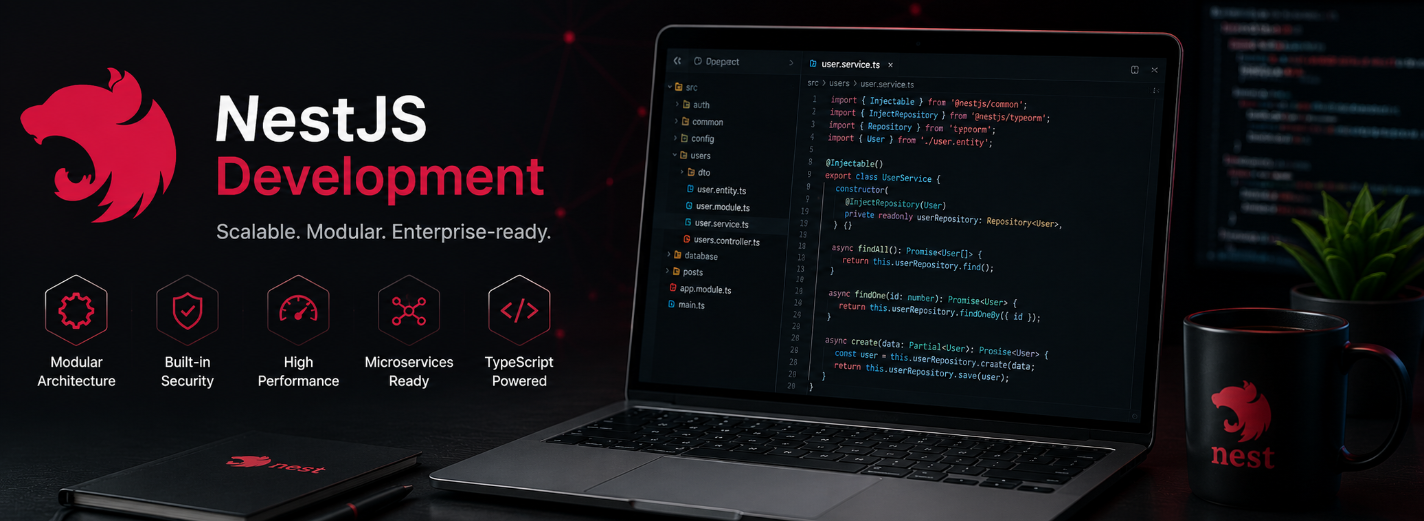
When NestJS Fits SaaS, FinTech, and Enterprise Products
- NestJS
- Backend Development
- Node.js
- API Development
When NestJS Fits SaaS, FinTech, and Enterprise Products
NestJS is often introduced as “Angular for the backend”: TypeScript, decorators, dependency injection, modules, guards, pipes, and a strong preference for explicit structure. The shorthand is useful, but it does not answer the question that matters to a product owner: will this framework make our particular backend easier to change, secure, test, and operate over several years?
For SaaS, FinTech, marketplaces, and enterprise systems, the answer is often yes when the product has a substantial domain, several integrations, multiple roles, a long maintenance horizon, and a team that benefits from shared conventions. NestJS gives those teams a vocabulary for separating transport, application orchestration, business rules, and infrastructure. Its value rises as the number of contributors and change paths grows.
The same structure can be overhead for a short-lived utility, a tiny API, a compute-heavy workload better served by another runtime, or a team with deep expertise in a different ecosystem. A responsible technology decision compares product constraints, talent, libraries, performance characteristics, deployment model, and total ownership cost. NestJS development services are useful when they turn that comparison into an operable system—not when they merely add a fashionable framework to the stack.
Start with Product Fit, Not Framework Popularity
Begin with the product’s hard parts. A multi-tenant SaaS platform may need tenant isolation, metering, plan entitlements, background jobs, audit trails, and safe schema evolution. A FinTech product may care more about idempotent money movement, precise authorization, reconciliation, immutable evidence, and degraded-provider behavior. A marketplace combines identity, catalogue, search, inventory, orders, payouts, disputes, and notifications. Enterprise software adds long-lived contracts, SSO, granular permissions, imports, reporting, and integrations that fail in unfamiliar ways.
NestJS fits these products because a module can gather a capability’s controllers, use cases, policies, and adapters behind a visible boundary. The framework does not discover that boundary. Teams still need to model who owns a rule, which state must remain consistent, which events can arrive twice, and which data another module may read. Organizing folders around technical layers while every service imports every repository produces the appearance of architecture without its protection.
Assess fit with concrete journeys. Trace signup and tenant provisioning, payment and refund, order cancellation, role change, failed webhook, bulk import, and recovery after an external outage. For each journey, record invariants, data owners, latency and availability targets, regulatory evidence, failure compensation, and the team responsible at 02:00. If NestJS modules make those responsibilities clearer and easier to test, the framework is contributing. If the boundaries remain ambiguous, more decorators will not rescue the design.
Use TypeScript as a Contract, Not a Safety Guarantee
- Delivery surfaces: REST, GraphQL, WebSockets, queues, scheduled jobs, and event consumers can share application rules while each boundary validates its own input and failure semantics.
- Product shape: SaaS, FinTech, marketplaces, and enterprise platforms benefit when modules express capabilities, ownership, invariants, and dependency direction rather than technical folders alone.
- Integration load: payment, identity, CRM, ERP, messaging, storage, and partner APIs need bounded adapters, timeouts, idempotency, reconciliation, contract tests, and observable failure—not only SDK wrappers.
- Operating responsibility: choose NestJS when the team will own a long-lived service and can maintain boundaries, runtime validation, migrations, observability, security and upgrades.
Scale the Architecture Only When the Product Demands It
TypeScript improves navigation, refactoring, editor feedback, and collaboration across a large codebase. It can make DTOs, use-case inputs, domain values, and adapter interfaces explicit. It can also support generated OpenAPI clients or shared schema packages so frontend and backend teams detect incompatible changes earlier. These benefits are strongest when types express business meaning—Money, TenantId, ApprovedTransfer—rather than letting primitive strings and loosely shaped objects travel everywhere.
Compile-time types disappear at runtime. Requests, queue messages, database rows, environment variables, webhook payloads, and third-party responses are untrusted until parsed and validated. NestJS pipes and validation libraries can protect HTTP boundaries, but the same discipline must cover message consumers, scheduled jobs, configuration, and integration adapters. Reject invalid input with useful errors; do not silently coerce values that alter meaning.
A shared TypeScript interface is not automatically an API contract. If producer and consumer deploy independently, use a versioned runtime schema, compatibility rules, contract tests, and a deprecation path. Do not share internal persistence entities merely to avoid duplication: that couples release schedules and leaks ownership. Our guide to shared TypeScript contracts explains where generated or shared definitions help and where they become a hidden distributed dependency.
Treat Security as a System of Decisions
Start with a modular monolith when one product team changes the system together and domain boundaries are still maturing. Local calls and transactions are easier to reason about than a network of services, while NestJS modules can preserve ownership and dependency direction. Extract a service only when evidence supports independent scaling, release autonomy, fault isolation, regulatory separation, or a stable capability owned by a different team.
Scaling has several dimensions. More HTTP traffic may require stateless application replicas and bounded connection pools. Slow or bursty work may need queues, idempotent consumers, backpressure, retry limits, and dead-letter handling. Read-heavy paths may benefit from caching with explicit freshness and invalidation. Large reports, media processing, search, and analytics may belong in specialized components. Splitting everything into microservices does not fix an overloaded database, an unbounded query, or a synchronous chain of dependencies.
Establish budgets before traffic forces the issue: request deadlines, queue age, concurrency, payload size, memory, database connections, third-party quotas, recovery time, and acceptable data loss. Instrument latency percentiles, errors, saturation, and business outcomes by route and dependency. Load tests must use representative data and failure conditions. The right architecture is the smallest one that meets measured demand and can be operated by the team that actually owns it.
Test the Risks That Types Cannot See
NestJS supplies useful mechanisms—guards, interceptors, pipes, filters, modules, and metadata—but mechanisms do not define a security model. Start with assets, actors, trust boundaries, abuse cases, and consequences. Separate authentication from authorization: validating a token identifies a principal; it does not prove that the principal may read this tenant, approve this payment, change this field, or act in the resource’s current state.
Enforce deny-by-default authorization close to the operation and its data. Treat tenant context, forwarded identity, and role claims as security-sensitive. Validate every external boundary, limit body and upload sizes, normalize errors without leaking internals, protect secrets, rotate credentials, constrain outbound calls, and audit privileged actions. Rate limits should follow product policy—anonymous IP, account, tenant, API key, route, or cost—not a single arbitrary counter.
FinTech and regulated products need evidence as well as controls: who approved an action, which policy and software version ran, whether the event was duplicated, how a failed provider call was reconciled, and who can retrieve the record without exposing sensitive data. Threat modelling, dependency review, secure delivery, backups, recovery exercises, and incident ownership sit outside any framework. NestJS can make enforcement consistent, but the organization must decide what consistency means.
Choose a NestJS Partner by the Evidence They Leave Behind
Dependency injection makes collaborators replaceable, but a testable codebase still requires deliberate boundaries. Keep domain rules independent of controllers and databases. Test invariants with fast unit tests; test repositories, migrations, queues, caches, and provider adapters against real compatible infrastructure; test public contracts for backward compatibility; and reserve end-to-end tests for critical journeys where assembled behavior matters.
Test failure semantics, not only successful requests. What happens when a payment times out after the provider accepted it, the same webhook arrives three times, a job worker crashes after a side effect, a tenant is disabled during a session, a migration meets old data, or one dependency is slow? Verify idempotency, transaction boundaries, retry safety, ordering assumptions, authorization, partial failure, reconciliation, and observability. Mocks that always return tidy responses conceal precisely the behavior production will expose.
Maintainability is visible in the cost of a safe change. A new rule should have one authoritative home; a new integration should fit behind an adapter; a schema change should include rollout and rollback; an incident should be traceable across request, job, and external call. Review dependency direction and module coupling as the system evolves. High coverage cannot compensate for tests that assert implementation details, and a clean module diagram cannot compensate for an application no one can diagnose.
NestJS creates value when its conventions make ownership, change, and failure easier to reason about. The framework provides the structure; the team must supply the decisions.— GARNO.TECH
The Decision: Where NestJS Earns Its Place
A capable partner should leave the product easier for its owners to understand and change. Ask for the decision record behind the architecture, a map of module and data ownership, explicit non-functional requirements, versioned contracts, a threat model for critical journeys, migration and rollback plans, and operating dashboards. These artifacts reveal whether the team is solving the product or only assembling framework features.
Evaluate delivery through thin, production-shaped slices. A credible early slice might authenticate a user, enforce tenant authorization, execute one valuable use case, persist data, publish an idempotent job, expose telemetry, and deploy through the intended pipeline. It tests the hardest assumptions sooner than months of horizontal “foundation” work. Require code review, automated checks, dependency policy, environment parity, and knowledge transfer from the start.
Commercial scope should name outcomes and evidence: journeys delivered, integrations proven, performance budgets met, risks retired, documentation transferred, and incidents the team can handle. Beware estimates that omit data migration, provider uncertainty, security review, observability, release engineering, and post-launch stabilization. The cheapest build can create the most expensive ownership model if every change depends on the original vendor.
Turn the Framework Choice into an Operating Model
NestJS earns its place when a TypeScript team is building a long-lived backend with meaningful domain rules, many change paths, external integrations, multiple delivery surfaces, and a need for consistent architecture. It is especially useful when conventions reduce coordination cost: developers can locate responsibilities, review dependency direction, test use cases, and apply cross-cutting policy without inventing a new pattern in every feature.
Choose differently when the workload, ecosystem, latency profile, library requirements, hiring reality, or operational environment strongly favors another technology. Even when NestJS fits, begin with the minimum topology: clear modules, one deployable where possible, real runtime validation, owned data, reliable jobs, observable integrations, and deployment discipline. Add brokers, services, caches, and gateways in response to measured constraints.
The framework should disappear behind product outcomes. Customers do not benefit from decorators; they benefit from correct invoices, protected data, predictable fulfilment, resilient integrations, and features that arrive without destabilizing yesterday’s behavior. Judge the choice by those results and by the team’s ability to sustain them after the initial launch.
Need to test the fit on a real product? Explore our NestJS development services for architecture discovery, delivery, modernization, and operational readiness.
A Four-Stage Path from Product Risk to Operable NestJS
- /01Model Capabilities and OwnershipTrace critical journeys, invariants, data owners, integrations, failure consequences, and team responsibilities. Define module boundaries before selecting distributed infrastructure.
- /02Deliver One Production-Shaped SliceProve identity, authorization, runtime validation, persistence, one risky integration, telemetry, migration, deployment, and rollback through a valuable end-to-end journey.
- /03Harden Contracts and Failure PathsAdd contract and integration tests, idempotency, deadlines, bounded retries, reconciliation, load evidence, dependency controls, and incident diagnostics around observed risks.
- /04Transfer Operations and Improve by EvidenceGive the owning team dashboards, alerts, runbooks, architecture decisions, access, and recovery exercises. Use production behavior to refine budgets and topology.
@Injectable()
export class CreateOrderHandler {
  constructor(private readonly orders: OrderRepository) {}

  async execute(input: CreateOrderDto) {
    const order = Order.create(input);
    await this.orders.save(order);
    return { id: order.id };
  }
}


What evidence should determine whether NestJS fits a product?
What evidence should determine whether NestJS fits a product?
Test NestJS Against Your Real Product Constraints
Share the critical journeys, current architecture, integrations, security obligations, traffic profile, team shape, and delivery risks. We will define the smallest useful assessment or production-shaped slice and the evidence required for a responsible decision.
Publications
Our research
Research and development of AI-powered solutions to optimize business workflows and enhance decision-making processes.
Analysis of machine learning models for predictive analytics in finance, e-commerce, and SaaS platforms.
Exploration of natural language processing and computer vision technologies to strengthen automation, personalization, and customer support.
NestJS Architecture for Scalable Backends: Boundaries Before Throughput
A practical architecture guide for NestJS backends: business modules, application services, domain rules, data ownership, reliable integrations, scaling decisions, and modular-monolith evolution.

8 min read
07 Sep 2026
NestJS Authentication: Access Tokens, Refresh Rotation, and Session Revocation
Design production NestJS authentication with verified short-lived access tokens, server-owned refresh sessions, atomic rotation, replay detection, browser protections, device logout, and incident-ready revocation.

9 min read
08 Sep 2026
Designing Reliable REST APIs with NestJS
Design NestJS REST APIs with durable resource semantics, bounded validation, deterministic pagination, idempotency, concurrency control, safe errors, compatibility policy, and verified OpenAPI.

10 min read
08 Sep 2026
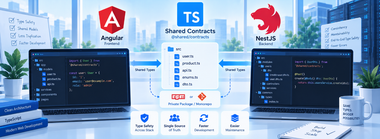
Shared TypeScript Contracts Between Angular and NestJS
Choose a shared package, OpenAPI generation, or schema-first contracts for Angular and NestJS without coupling the browser to backend entities or mistaking static types for runtime safety.
9 min read
08 Sep 2026
Modular Monolith with NestJS: A Practical Architecture Guide
Design a NestJS modular monolith with business boundaries, small public APIs, owned data, local transactions, reliable events, enforceable dependencies, and an evidence-based path to service extraction.

8 min read
08 Sep 2026