NestJS Architecture for Scalable Backends: Boundaries Before Throughput
- NestJS
- NestJS architecture
- backend architecture
- modular monolith
- TypeScript
- domain boundaries
- repositories
- microservices
NestJS Architecture for Scalable Backends: Boundaries Before Throughput
A backend becomes scalable when growth does not turn ordinary change into a system-wide negotiation. Traffic is only one dimension. Feature count, data volume, regulatory obligations, integration failures, release frequency, and the number of engineers all apply pressure. Adding replicas may increase throughput, yet it cannot repair shared ownership, hidden transactions, circular dependencies, or a payment callback whose uncertain state nobody can reconcile.
NestJS helps because it gives a team a visible application graph: modules group capabilities, providers hold behavior and dependencies, and exports define what another module may use. Those mechanisms are valuable only when they reflect business authority. A technically tidy folder tree can still hide a system in which every feature reaches the same tables and every change crosses five teams.
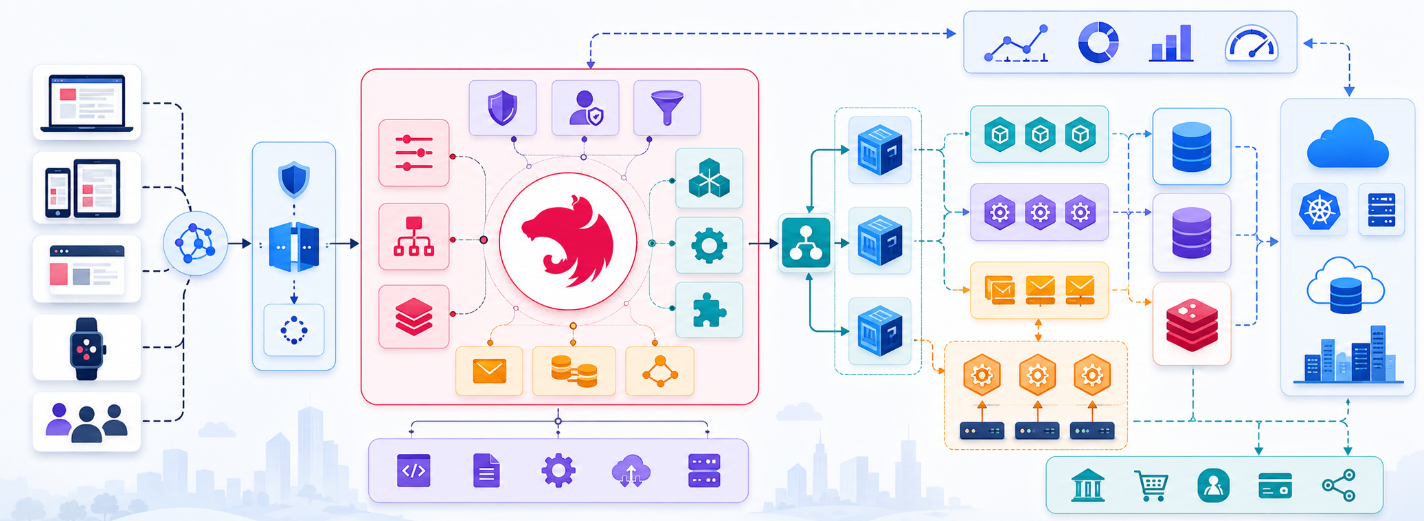
The strongest starting point for many products is a modular monolith: one deployable system with explicit internal boundaries. It preserves simple local calls and transactions while the domain is still being learned. This guide explains how to make those boundaries real, how to operate the application under failure, and what evidence should exist before a module becomes an independently deployed service. Our NestJS development services use the same approach for new platforms and difficult modernizations.
Design Modules Around Business Authority
Draw modules around capabilities that make independent promises: Identity verifies a principal, Orders accepts and advances a purchase, Billing owns charges and refunds, and Fulfillment owns dispatch. Give each module a named owner, authoritative data, invariants, use cases, and a deliberately small public API. Other modules should ask for an outcome through that API, rather than reading its repositories or tables.
Nest encapsulates providers by default; the providers named in exports form the module’s public interface. Treat that array as an architectural decision. Export application-level capabilities or stable tokens, not every repository and helper. Keep the root module focused on composition. Reserve global modules for truly application-wide infrastructure such as configuration or telemetry, because implicit business dependencies disappear from the import graph and make tests less honest.
Circular imports and repeated forwardRef() calls are design signals. The two modules may share a missing concept, a workflow may deserve its own coordinator, or one direction can become an event. Do not erase a cycle with a utility module that owns nothing. Record which module may call which, prohibit cross-module repository access with lint or dependency rules, and test public contracts. The architecture then survives team growth because the allowed path is clearer than the shortcut.
export const ORDERS_PORT = Symbol('ORDERS_PORT');

@Module({
  imports: [OrderPersistenceModule],
  controllers: [OrdersController],
  providers: [PlaceOrder, CancelOrder],
  exports: [ORDERS_PORT],
})
export class OrdersModule {}
Give Every Layer One Kind of Decision
A controller owns transport mechanics: it authenticates the channel, validates runtime input, maps it to a command, invokes one use case, and turns the result into an HTTP, GraphQL, WebSocket, or message response. It should not calculate discounts, coordinate three repositories, or decide whether an order may ship. Those rules become invisible when they live among status codes and decorators.
An application service coordinates a business operation. It loads the required state, invokes domain behavior, defines the transaction boundary, records durable side effects, and returns a stable result. Domain objects protect rules that must remain true regardless of transport or storage. Ports describe what the use case needs; adapters implement those ports with SQL, a queue, object storage, or a vendor API. Injection tokens keep the dependency direction pointing inward.
Apply this separation in proportion to risk. A read-only reference table does not need an elaborate aggregate and five pass-through classes. A money movement, capacity reservation, entitlement change, or regulated decision does. The practical test is whether an engineer can explain and verify the operation without booting an HTTP server or learning an ORM’s lifecycle. Keep query models simple when no invariant is at stake, but make commands explicit where concurrency, authorization, or recovery can change the outcome.
- Transport adapter: authenticates the channel, validates runtime input, calls one use case, and maps a stable result to HTTP, GraphQL, WebSocket, or a message.
- Application service: coordinates the operation, authorization context, transaction, durable side effects, and explicit outcome without depending on transport details.
- Domain model: protects business invariants and state transitions in plain TypeScript that can be understood and tested without NestJS or an ORM.
- Infrastructure adapter: implements a narrow port for persistence, messaging, storage, or a provider while containing retries, mapping, telemetry, and vendor-specific failure semantics.
Engineer Integrations for Uncertain Outcomes
An external provider can accept a request and lose the response, time out after completing the work, deliver a webhook twice, reorder events, or change behavior behind an unchanged endpoint. Model that uncertainty instead of hiding it behind a generic client. Give each integration a narrow port, a typed internal result, explicit timeouts, bounded retries, concurrency limits, idempotency rules, correlation identifiers, and a documented degraded state.
Retries are safe only when the operation is idempotent or the provider supplies a reliable idempotency key. A timeout means the outcome is unknown; it does not prove failure. Persist an operation record before the call, store the provider reference and every transition, and reconcile ambiguous cases by querying the provider or processing a signed webhook. Operators need a searchable timeline and a controlled replay path, while users need an honest pending state instead of a premature success or failure.
When a local transaction must lead to a durable message, write the business change and an outbox record in the same database transaction. A worker later publishes the event; consumers deduplicate by a stable event or operation ID. This closes the gap between committing data and sending a message. In-process events can decouple local handlers, but they do not survive a crash by themselves. The same discipline applies to BullMQ background jobs: define job identity, ownership, retries, dead-letter handling, visibility, cancellation, and reconciliation before relying on a queue.
@Injectable()
export class PlaceOrder {
  constructor(
    private readonly unitOfWork: UnitOfWork,
    @Inject(ORDER_REPOSITORY) private readonly orders: OrderRepository,
    private readonly outbox: Outbox,
  ) {}

  execute(command: PlaceOrderCommand) {
    return this.unitOfWork.transaction(async () => {
      const order = Order.place(command);
      await this.orders.save(order);
      await this.outbox.add(OrderPlaced.from(order));
      return { orderId: order.id, status: order.status };
    });
  }
}
Scale the Bottleneck You Can Measure
Measure the constrained resource before changing topology. Separate request latency into application time, database time, external calls, queue delay, and serialization. Track throughput, error rate, saturation, event-loop lag, connection-pool pressure, slow queries, lock waits, queue age, worker utilization, provider quotas, and the success rate of critical journeys. A system that is fast at the median but loses orders during retries is not healthy.
Keep HTTP instances stateless so replicas can be added and replaced safely. Put durable work in a queue, share session state when sessions are unavoidable, paginate unbounded reads, and cap concurrency. Optimize queries, indexes, data shape, and connection pools before assuming the framework is the bottleneck. Cache only after identifying a stable read pattern, and define ownership, invalidation, staleness tolerance, and failure behavior before the first cache key.
Nest providers are singleton-scoped by default, which fits most services. Request scope creates instances per request and propagates upward through dependent providers, so a seemingly small choice can recreate a large dependency tree. Pass request context explicitly or use a controlled context store when that is sufficient. For high-traffic NestJS APIs, compare runtime and HTTP adapter choices with representative payloads and middleware. Architecture quality appears in profiles, load tests, recovery drills, and customer outcomes—not in an isolated hello-world benchmark.
Let Evidence Decide When to Extract a Service
Keep a modular monolith while one deployment, one operational model, and local transactions remain useful. Enforce module-owned data, prevent cross-module repository access, communicate through public application services or durable events, and place migration ownership beside the module. These constraints create options: a boundary can be tested inside one process today and moved across a network later without rewriting the business language.
Extract a service when evidence demands independent ownership, deployment cadence, security isolation, recovery objectives, geographic placement, technology, or a materially different scaling profile. Write the expected benefit and the new permanent costs: versioned contracts, authentication between workloads, timeouts, duplicate messages, eventual consistency, tracing, deployment coordination, on-call ownership, and data reconciliation. “The module receives heavy traffic” is incomplete until measurements show why isolated scaling is cheaper than optimizing or replicating the whole application.
Before extraction, prove the boundary in the monolith. Remove shared writes, identify the system of record, define commands and events, test compatibility, and establish telemetry. Then rehearse failure: the new service is slow, unavailable, behind in event processing, or returns an ambiguous result. If the product cannot express a degraded state and the operators cannot reconcile it, the team is not ready to add a network boundary. NestJS supports multiple transports and hybrid applications, but transport support does not supply service ownership or distributed consistency.
A Review That Exposes Architectural Risk
- Authority: Does every module own a recognizable business promise, its rules, authoritative data, maintainers, migrations, and a deliberately small public API?
- Dependency direction: Can business commands be tested without HTTP or a real provider, and do automated rules prevent cross-module repository and table access?
- Consistency: Are transaction boundaries, concurrency behavior, idempotency, outbox publication, consumer deduplication, migrations, and ambiguous outcomes explicit and tested?
- Operations: Do logs, traces, metrics, readiness, alerts, runbooks, restore tests, capacity evidence, and reconciliation tools reveal whether customers can complete critical journeys?
- Evolution: Is each proposed cache, broker, shared library, request scope, or service extraction tied to measured pressure, a named owner, acceptance evidence, and a rollback path?
Does NestJS make a backend scalable by itself?
Does NestJS make a backend scalable by itself?
Should a repository return ORM entities?
Should a repository return ORM entities?
When is a global NestJS module appropriate?
When is a global NestJS module appropriate?
When should a NestJS module become a microservice?
When should a NestJS module become a microservice?
Turn a NestJS Architecture Concern into Evidence
Share one critical journey, its modules, authoritative data, integrations, failure history, and current measurements. We will identify the smallest responsible boundary or runtime change and define how to verify it.
Publications
Our research
Research and development of AI-powered solutions to optimize business workflows and enhance decision-making processes.
Analysis of machine learning models for predictive analytics in finance, e-commerce, and SaaS platforms.
Exploration of natural language processing and computer vision technologies to strengthen automation, personalization, and customer support.
When NestJS Fits SaaS, FinTech, and Enterprise Products
Evaluate NestJS against product complexity, team skills, security, integrations, scale, delivery pace, and operating costs before choosing it for a business backend.

9 min read
31 Jul 2026
When a Custom NestJS Backend Is Worth the Investment
A build-versus-buy framework for deciding when distinctive domain rules, integrations, data ownership, security, performance, and product economics justify a tailored NestJS backend.

8 min read
05 Aug 2026
Angular with NestJS: Production Full-Stack Architecture
Design Angular and NestJS around clear authority, generated API contracts, secure authentication, recoverable errors, state consistency, SSR boundaries, end-to-end observability and compatible releases.

9 min read
08 Sep 2026