/ 01
The Domain Logic Creates Value
Pricing, permissions, workflows, transactions or decisions differentiate the product or control material risk, and standard tools cannot model them without damaging compromises.
A custom backend is justified by a business boundary that the market cannot satisfy safely or economically—not by a preference for owning code. The boundary may be a distinctive pricing or approval model, a regulated transaction, orchestration across unreliable providers, data control, a performance envelope, or a product capability that creates revenue. Building without that boundary replaces subscription constraints with engineering, security, operations and lifecycle obligations.
Start from the current process and decision. Define users, critical outcomes, volumes, data classes, rules, integrations, failure consequences, service objectives, deadline, internal capability and expected useful life. Establish the baseline cost of licenses, manual work, errors, delay, support, risk and lost opportunities. Then compare process change, buying, configuration, integration, a focused custom extension and a fully tailored system. The right answer may combine standard identity, payments or communications with custom domain logic that remains under product control.
A backend is truly custom where it owns rules, state or coordination unique to the business. Model those elements precisely: entities and invariants, allowed transitions, actors and permissions, effective and recorded time, calculation and rounding, evidence, exceptional paths, correction and audit. A generic form plus CRUD endpoints is not a domain model. It often pushes the real rules into spreadsheets, support conversations and individual memory while the new system merely stores their consequences.
Draw a boundary map. Keep commodity capabilities behind well-governed providers when their contracts, economics and exit terms fit; build adapters around proven variation; and retain internal authority for the workflows that differentiate the product. Avoid a universal abstraction before multiple integrations demonstrate the need. Document systems of record, data ownership, synchronization direction, consistency and repair. This boundary also shapes the NestJS delivery model: in-house, agency and freelance roles must remain compatible with product ownership and architecture.
Build when the value of a capability and control over its evolution plausibly exceed the lifetime cost of creating and operating it. Strong signals include repeated manual decisions at meaningful volume, standard software that forces harmful process compromises, provider combinations that require explicit orchestration, data or audit duties that cannot be delegated, and a differentiated customer or partner experience central to revenue. The case strengthens when the organization has a long planning horizon and an accountable team to own the result.
Do not build because a commercial product feels inelegant, one license price is annoying, or engineers prefer a new stack. A standard system may be better for common CRM, accounting, identity, content or support workflows, especially when requirements are immature and operating capacity is limited. Configuration or an integration layer may remove most friction. Consider switching and exit terms, data export, vendor roadmap, extension limits, availability, security assurance and the cost of running parallel systems before rejecting the market.
Build a lifecycle model for each credible option. The custom path includes discovery, product and service design, engineering, data migration, integrations, security and compliance evidence, infrastructure, CI/CD, observability, release, training, change management, support, on-call, hosting, dependencies, upgrades, incident response, retention, backup and eventual replacement. Buying includes implementation, customization, per-user or transaction growth, integration, consulting, premium tiers, data export, price change and switching cost. Keeping the current process includes labor, delay, defects, risk and foregone growth.
Quantify the baseline and range: transactions, minutes per case, loaded labor, error and support cost, gross margin, conversion, working capital, risk exposure, demand growth, adoption and time to value. Use payback, net present value or another decision metric appropriate to the business while keeping assumptions visible. Count saved time as cash only when workload or staffing can change. Assign a risk owner and evidence that will narrow every material uncertainty.
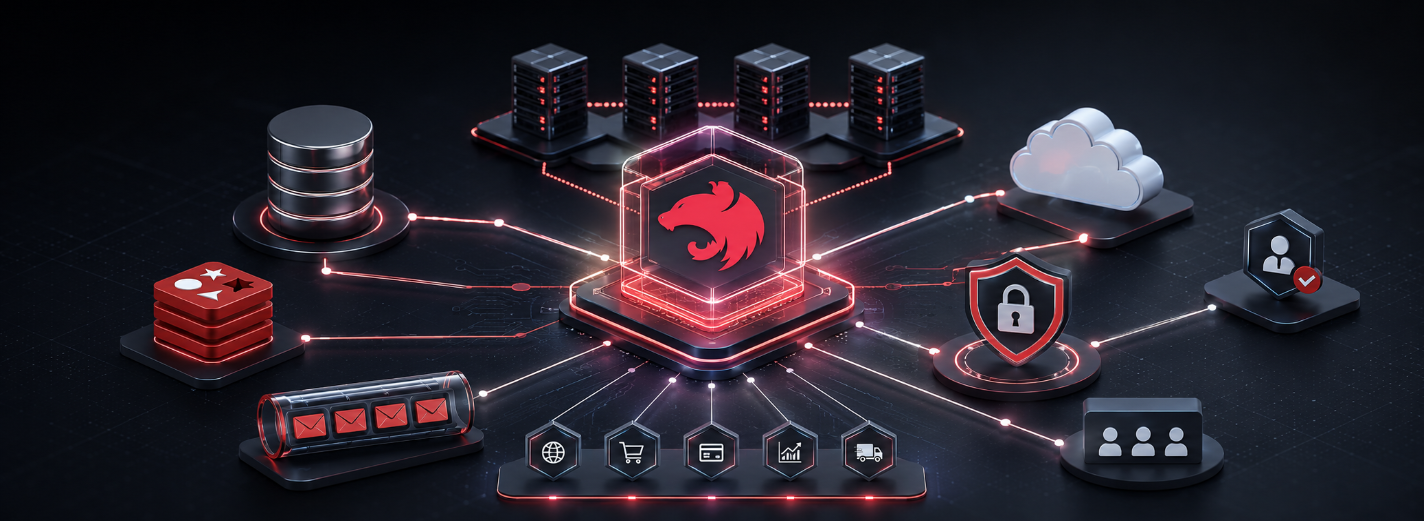
NestJS provides modules, dependency injection, guards, pipes, interceptors, transport support and testing seams that can express a tailored backend cleanly. Organize modules around business capabilities rather than database tables or framework layers. Keep controllers and message handlers thin, application services responsible for use cases, domain rules close to the state they protect, and provider or persistence details behind adapters. The framework offers structure; the team must still choose narrow interfaces, dependency direction and ownership.
Use one operation across HTTP, GraphQL, jobs and messages so validation, authorization, idempotency and audit do not diverge by transport. Model long work and provider outcomes as explicit asynchronous state with correlation, bounded retry, dead-letter handling and reconciliation. Start with a modular monolith unless independent scaling, failure isolation, deployment cadence, security or stable team boundaries justify a service. NestJS is valuable when it makes business responsibility and production failure easier to see and test.
Custom software creates value when it improves a business capability worth owning and leaves the organization able to operate, measure, and change it.— GARNO.TECH Engineering Team
Fund stages that purchase evidence. Discovery maps the process, data, rules, users, alternatives, dependencies, nonfunctional needs and operating model. A prototype tests language and workflow; a technical proof tests the most uncertain integration, data or performance assumption; a production-shaped vertical slice delivers one outcome through authorization, persistence, external calls, telemetry, deployment, support and recovery. Define the question, maximum investment, acceptance evidence and stop condition before each stage.
Prioritize by value, risk and dependency rather than screen count. Make the first release a coherent operating boundary with access administration, audit, exception handling, observability, backups and support for the chosen transaction. Defer breadth, not integrity. Reforecast from what the team learns and remove work when evidence changes. A long fixed specification creates false certainty and spends the budget before the highest-risk assumptions are tested.
Match architecture to the present stage and a credible growth path. A modular monolith is often faster and cheaper than premature microservices while retaining clear domains that can later be extracted. Invest early in automated tests, contract checks, infrastructure as code, managed identity, secrets control, migrations, versioned artifacts, staged deployment, rollback, telemetry, capacity evidence, documentation and recovery exercises. These capabilities make later change safe; distributed infrastructure alone does not.
Track delivery and product evidence together: lead time, rework, escaped defects, change failure, recovery, service objectives, transaction outcomes, manual exceptions, support demand, infrastructure and provider cost, and internal ownership. Review architecture when workload, regulation, team boundaries or economics change. Control technical debt by linking it to a measurable product or operating consequence rather than maintaining an undifferentiated list of code preferences.
A credible partner should ask whether custom development is necessary, which standard components should remain, and how the smallest custom boundary can prove value. Evaluate production evidence in domain modeling, NestJS architecture, data, integration, security, delivery, cloud and operations. Review actual artifacts and a short paid exercise based on sanitized context. Confirm the named team, allocation, senior review, continuity, subcontracting and how the partner behaves when assumptions fail.
Compare proposals on the same lifecycle scope: discovery, product support, environments, migration, quality, security, observability, release, support, knowledge transfer, licenses and cloud cost. Require assumptions, exclusions, ranges, dependencies and change rules. Retain client ownership of repositories, accounts, data, domains, keys, infrastructure, telemetry and production approval. Define internal co-owners, decision authority, incident participation, documentation acceptance, renewal and exit from the start.
Use a bounded first engagement to verify both the solution and the working relationship. Good outputs include a process and domain map, option comparison, target boundary, risk register, production-shaped proof, staged roadmap, lifecycle estimate and explicit acceptance measures. During delivery, track time to first useful change, unresolved decisions, access exceptions, review rework, knowledge concentration and outcome movement. A successful partner leaves the client able to deploy, observe, recover and continue the backend without preserving the supplier relationship by necessity.
Define governance for change after launch. Product owners should prioritize domain outcomes; technical owners should maintain boundaries and supported versions; data owners should approve meaning, access, retention and correction; security and operations should own controls, incidents and recovery. Keep architecture decisions, API and event contracts, data dictionaries, threat models, dashboards, runbooks and dependency inventories current through normal work. Schedule capacity, restore, upgrade and provider-exit exercises. Without this operating capability, a tailored backend becomes a private product whose roadmap, risks and repair knowledge live with the original builders.
Looking for a NestJS engineering partner? Explore our NestJS Development Services. Bring the process constraint, domain rules, data, integrations, volumes, security and compliance assumptions, current systems, team and economic baseline. We can compare buy, configure, integrate and build options, test the riskiest boundary, and shape a platform whose custom code is limited to capabilities worth owning.
The first conversation should produce decisions, not a generic estimate. Expect the team to identify which assumptions need evidence, which capabilities can remain standard and which boundaries create strategic value. A useful proposal connects scope to measurable business outcomes, names the largest uncertainties, assigns ownership and describes how the architecture can change if the evidence contradicts the initial plan. That clarity is an early test of whether the partner can turn complexity into a manageable investment.
Share the workflow, rules, integrations, data, risk and current economics. We will compare credible options and shape the smallest custom NestJS boundary that can prove value.
Research and development of AI-powered solutions to optimize business workflows and enhance decision-making processes.
Analysis of machine learning models for predictive analytics in finance, e-commerce, and SaaS platforms.
Exploration of natural language processing and computer vision technologies to strengthen automation, personalization, and customer support.
A production guide to Angular forms for long, permission-sensitive workflows: typed models, layered validation, dynamic sections, draft protocols, authorization, server errors, conflicts, accessibility, and testing.

11 min read
Evaluate NestJS against product complexity, team skills, security, integrations, scale, delivery pace, and operating costs before choosing it for a business backend.
9 min read
A practical guide to planning Azure applications from workload evidence: architecture, migration, identity, delivery automation, reliability, operations and cost.

8 min read