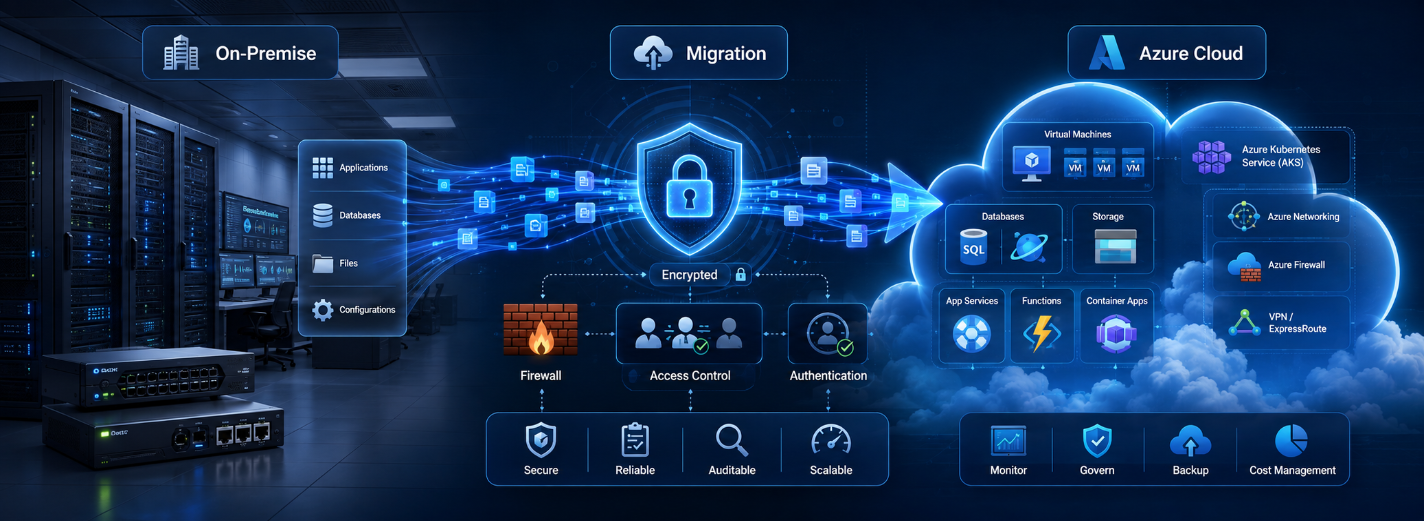
Azure Migration Architecture: A Safe Path from Estate to Operations
- Microsoft Azure
- cloud migration
- cloud architecture
- cybersecurity
- DevOps
- infrastructure modernization
Planning a Secure Azure Cloud Migration
An Azure migration is a change to a business system, not a relocation of servers. Applications, data, identities, networks, integrations, support processes, and contractual obligations must continue to work while responsibility moves across technologies and teams. A credible Azure migration architecture explains both the target platform and the transition: what moves, what changes, what remains, how coexistence works, and how the organization returns to safety when an assumption fails.
Begin with the outcome the move must enable. It may be an expiring data center, stronger recovery, faster market entry, regulatory separation, acquisition integration, capacity, or lower change cost. Give each outcome a baseline, target, owner, deadline, and guardrail. “Move to Azure” is an activity; it cannot tell a steering group whether downtime, risk, lead time, customer experience, or total cost actually improved.
Migration is complete only after the receiving teams can deploy, observe, secure, restore, support, and pay for the workloads. A capable Microsoft Azure engineering team therefore carries an approved design through infrastructure code, application and data change, rehearsals, production cutover, stabilization, documentation, and knowledge transfer.
Assess the Estate Before Choosing Azure Services
Inventory the estate at the level required to make a cutover decision. Record business capabilities and owners; applications and versions; compute, storage, and databases; inbound and outbound network paths; user, workload, and administrative identities; certificates, secrets, schedules, queues, files, reports, and third parties. Combine configuration and discovery data with interviews, traffic, incidents, billing, deployment history, and an observed business cycle. A diagram that omits a month-end job or a partner allowlist is not a migration map.
Classify every workload by critical journeys, data sensitivity and residency, availability, recovery time and recovery point, latency, throughput, seasonality, licences, vendor support, technical condition, change rate, and accountable owner. Map dependencies by direction, protocol, authentication, data volume, timing, and failure behavior. This evidence reveals clusters that should move together, temporary hybrid paths, unsupported components, controls that must be replaced, and systems that should be retained or retired rather than migrated.
Capture the baseline before changing it: user success, performance percentiles, error and incident rates, deployment and recovery, capacity, support effort, infrastructure and licence cost, and current recovery evidence. State confidence and gaps. Where the estate is poorly understood, instrument and test a representative period instead of inventing precision. These boundaries also shape Azure security architecture for FinTech and SaaS, where identity, keys, network isolation, auditability, and data location must remain coherent across old and new environments.
- Map the working system: connect business journeys to applications, data, networks, identities, schedules, third parties, owners, and the failure behavior of each dependency.
- Classify consequence: record criticality, data sensitivity and residency, availability, recovery time and recovery point, downtime tolerance, compliance, and customer impact.
- Establish the economic baseline: include compute, storage, traffic, licences, facilities, support, people, migration overlap, modernization, and decommissioning—not only a cloud calculator.
- Define proof and ownership: assign an accountable business and technical owner, acceptance and recovery evidence, unresolved assumptions, and the decision each finding will support.
Design the Azure Landing Zone as an Operating System
The landing zone is the governed foundation on which workloads can be placed repeatedly. Define tenant and identity boundaries, management groups, subscriptions, resource organization, approved regions, naming and tags, policy, role assignment, budgets, central logs, connectivity, private name resolution, shared services, backup, recovery, and the path from code to production. Separate platform-wide controls from workload configuration, and express both as reviewed infrastructure code with protected state, tested modules, change history, drift detection, and an emergency path that is later reconciled.
Subscription and network topology should follow isolation, ownership, quota, billing, and failure requirements. Design ingress and egress deliberately: public exposure, private endpoints, firewalls, web application protection, DNS, routing, inspection, partner connectivity, on-premises links, and break-glass access must form one testable path. Avoid a single flat network and avoid elaborate segmentation that the team cannot operate. Decide how temporary hybrid connectivity will be monitored and removed.
Governance should prevent costly or unsafe states without blocking every useful change. Use a small set of enforceable policies for region, encryption, public access, diagnostic settings, identities, resource types, and required metadata; test exemptions, assign an owner and expiry, and record why they exist. The landing zone is ready when a product team can provision a compliant environment, understand its responsibilities, and recover it—not when a reference diagram has been copied.
Choose Azure services from workload evidence and the team’s ability to operate them. A stable packaged system may belong on a virtual machine. A web application may fit Azure App Service; event-driven work may suit Functions; a database may benefit from a managed offering; containers may need Container Apps or Kubernetes only when their scheduling, networking, portability, or control requirements justify the platform. Compare functional fit, service limits, availability model, maintenance, observability, security, regional support, portability, skills, and full lifecycle cost.
Managed service does not mean managed outcome. Document which resilience, patching, backup, scaling, key management, access, data consistency, and recovery duties stay with Microsoft and which remain with the organization. Prove quotas and throttling under representative traffic, including dependency failure. Favor the simplest service that satisfies material requirements and preserves an exit or recovery route. Complexity is justified by evidence, not by the number of cloud-native products in the target diagram.
Make Identity and Data Protection Part of Every Wave
Security begins with identity and trust boundaries. Federate workforce access, require phishing-resistant strong authentication for privileged roles where feasible, use just-in-time elevation, separate routine and administrative identities, and maintain tested emergency accounts. Give workloads managed identities instead of embedded credentials. Assign least privilege at the narrowest practical scope, review inheritance and group membership, log privileged actions, and design access revocation before cutover.
Classify data and trace it through source, transfer, staging, target, backups, logs, caches, analytics, and support tools. Define encryption and key ownership, secret rotation, retention and deletion, masking, residency, integrity reconciliation, and access evidence. Secure migration channels and temporary stores; remove them after acceptance. A backup is only a promise until the team restores it within the required time, verifies application consistency, and demonstrates that destructive credentials cannot erase both the service and its recovery copies.
Build prevention and detection into the platform: policy enforcement, secure defaults, vulnerability and dependency management, endpoint protection where applicable, central security logs, actionable alerts, incident routes, and evidence retention. Threat-model the transition itself. Hybrid connectivity, duplicate identities, broad migration accounts, old certificates, data copies, and hurried firewall rules often create more exposure than the final design. Every temporary exception needs a named owner, monitoring, expiry, and removal test.
A secure Azure migration starts by defining trust, ownership, and recovery. Copying the first virtual machine is an execution step, not an architecture.— GARNO.TECH Engineering Team
Choose a Migration Strategy Workload by Workload
Decide a treatment for each workload rather than applying one slogan to the estate. Retire systems with no defensible value; retain workloads whose constraint or economics do not support a move; replace commodity capability with a product when migration would preserve unnecessary custom code. Rehost can reduce immediate transition work but carries existing operational weaknesses. Relocate moves a compatible platform with little application change. Replatform adopts selected managed capabilities. Refactoring changes boundaries or behavior and can improve changeability and resilience at the highest delivery risk.
Score the options against the migration outcome, deadline, technical condition, dependencies, data gravity, downtime tolerance, compliance, skills, licence terms, target run cost, modernization value, reversibility, and opportunity cost. Keep assumptions visible and assign acceptance criteria. A workload may use a sequence—for example, rehost before a data-center exit, stabilize, then replatform a database after evidence is available. Do not hide two risky transformations inside one cutover unless the combined change is necessary and can be rehearsed.
Modernize where it removes a measured constraint. Useful changes can include repeatable deployment, immutable artifacts, externalized configuration, managed identity, centralized telemetry, supported runtimes, managed databases, queues, caching, asynchronous boundaries, horizontal scaling, and compatible schema evolution. Each change needs a business or operating hypothesis, an owner, a test, and a recovery path. A broad microservice or Kubernetes program is not a migration prerequisite.
Treat data movement as a product change. Select bulk copy, backup and restore, replication, dual run, change data capture, or staged synchronization according to volume, write rate, tolerated loss, downtime, consistency, and source capability. Define authoritative ownership during every phase; prevent conflicting writes; rehearse duration; reconcile counts, checksums, balances, relationships, and business invariants; and retain an auditable decision for final cutover. If rollback would lose accepted writes, call it a forward-recovery plan and design it honestly.
Prove, Migrate, and Stabilize in Controlled Waves
Use a representative, recoverable workload to validate the migration system before moving the most critical estate. The pilot should exercise real identity, connectivity, infrastructure code, deployment, data transfer, observability, backup and restore, security response, performance, support, and cost allocation. Choose something meaningful enough to expose platform gaps but bounded enough to recover without unacceptable harm. Record every manual intervention; repeated heroics are defects in the migration method.
Build later waves around dependency clusters and operational capacity. For each wave, name business and technical owners, scope and exclusions, prerequisites, freeze rules, maintenance window, communication, acceptance and stop thresholds, data reconciliation, rollback or forward recovery, support coverage, and time-boxed stabilization. Rehearse with production-shaped volume and failure. Confirm that DNS, certificates, queues, scheduled jobs, integrations, monitoring, and user access change together rather than validating only the application’s start page.
Make the cutover a controlled decision. Use a shared timeline, explicit authority to proceed or abort, observable checkpoints, and evidence that all parties interpret the same way. After traffic moves, watch critical journeys, data integrity, latency, saturation, errors, security signals, support demand, and cost by environment and version. Keep the old path only for the agreed recovery period, restrict change, and decommission it through a verified plan so temporary duplication does not become permanent risk and expense.
Stabilization ends when the service meets its objectives and the receiving team can operate it through routine and exceptional conditions. Hand over dashboards, alerts, runbooks, architecture and decision records, inventories, support and escalation paths, access procedures, recovery results, known risks, budgets, and ownership. Run an incident exercise and a timed restore. Close temporary accounts, routes, data copies, exceptions, licences, and source infrastructure only after evidence confirms they are no longer required.
Measure actual Azure cost by workload, environment, owner, and useful transaction. Investigate idle resources, oversized capacity, premium tiers without evidence, unattached storage, excessive logging, long retention, cross-region or outbound transfer, reservation coverage, and non-production schedules. Optimize against service objectives and engineering time, not the lowest monthly bill. Review the original migration outcomes after 30, 60, and 90 days; turn gaps into owned improvements rather than declaring success at cutover.
Judge the Migration by the System You Can Operate
A sound Azure migration architecture joins business intent, estate evidence, platform governance, workload design, identity, data, recovery, cost, and operating ownership. It reduces risk by making assumptions testable and by moving bounded groups of dependencies through a rehearsed path.
The durable result is not an Azure subscription filled with resources. It is a platform and team that can release safely, see user impact, withstand failure, restore data, control access and spend, and improve the system after the migration program leaves. Judge every architectural choice by whether it strengthens that capability.
A Four-Stage Evidence-Led Azure Migration
- /01Map Dependencies, Outcomes, and RiskInventory the operating estate, observe critical journeys, establish performance, recovery and cost baselines, expose unknowns, and group dependencies before choosing services or waves.
- /02Build and Prove the Landing ZoneImplement identity, subscriptions, network paths, policy, logging, budgets, backup, recovery, and deployment as reviewed infrastructure code; test controls and exemptions with a representative workload.
- /03Migrate a Bounded Dependency WaveRehearse data movement and cutover with production-shaped volume, explicit authority, acceptance and stop thresholds, reconciliation, communication, rollback or forward recovery, and staffed stabilization.
- /04Validate Operations and Remove the Old PathConfirm service objectives, security evidence, timed restoration, support readiness, ownership and actual cost; then close temporary access, exceptions, data copies, connectivity, licences, and source infrastructure.
Should every workload move in one Azure migration wave?
Should every workload move in one Azure migration wave?
Plan an Azure Migration You Can Operate
Share the business deadline, estate and dependency evidence, critical journeys, data and compliance boundaries, current recovery posture, target outcomes, team capability, budget, and known constraints. GARNO.TECH can define the smallest responsible assessment, landing-zone architecture, workload treatments, migration waves, security and data controls, acceptance, recovery, stabilization, decommissioning, and knowledge transfer.
Publications
Our research
Research and development of AI-powered solutions to optimize business workflows and enhance decision-making processes.
Analysis of machine learning models for predictive analytics in finance, e-commerce, and SaaS platforms.
Exploration of natural language processing and computer vision technologies to strengthen automation, personalization, and customer support.
How to Scope an Angular Migration Without Hiding the Risk
A practical guide to Angular migration assessment, version and build updates, optional modernization, migration boundaries, regression evidence, responsibilities, engagement models, risk pricing, and knowledge transfer.

9 min read
08 Sep 2026
Angular Signals vs RxJS: How to Choose the Right State Model
Choose Angular Signals, RxJS, or a deliberate combination by separating current state from events over time, defining ownership, and testing cancellation, lifecycle, and failure semantics.
9 min read
08 Sep 2026
Angular with NestJS: Production Full-Stack Architecture
Design Angular and NestJS around clear authority, generated API contracts, secure authentication, recoverable errors, state consistency, SSR boundaries, end-to-end observability and compatible releases.

9 min read
08 Sep 2026