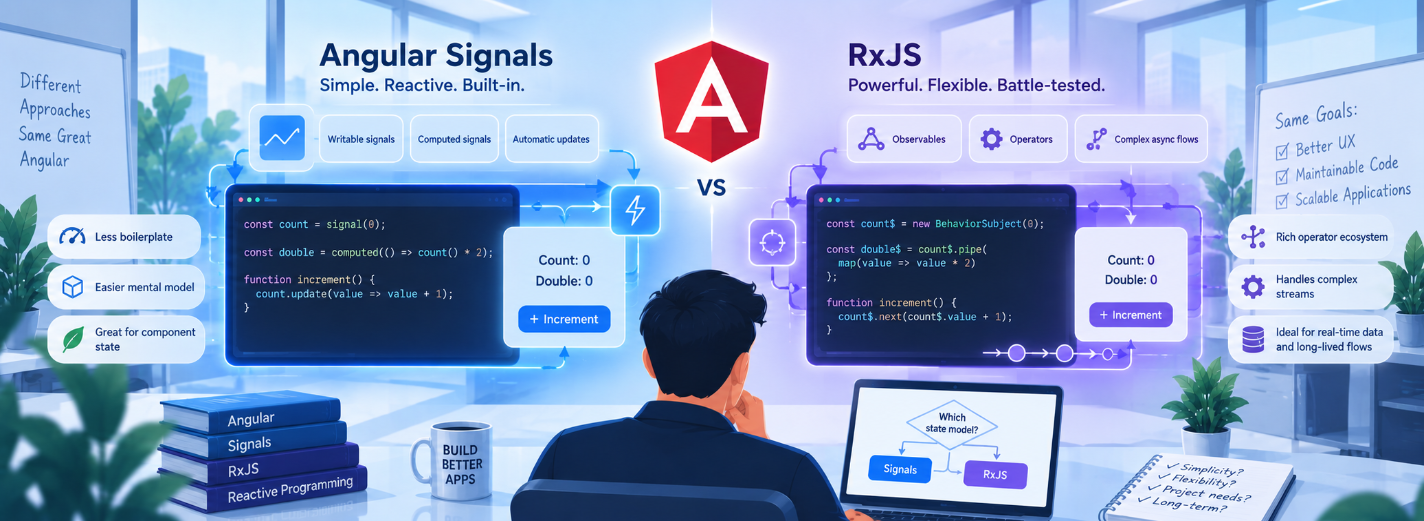
Angular Signals vs RxJS: How to Choose the Right State Model
- Angular Signals vs RxJS
- Angular state
- toSignal
- toObservable
- reactive programming
Angular Signals vs RxJS: How to Choose
Signals and RxJS are complementary tools with different promises. A Signal answers, “What is the current value when I read it?” An Observable describes values or events that arrive over time, with rules for subscription, ordering, cancellation, errors, and completion. A sound Angular architecture starts from those semantics rather than declaring one tool the winner.
The practical choice is often local. A feature may use RxJS to coordinate a search request, expose the latest result and request status through Signals, and derive the visible view with computed values. The design succeeds when every boundary has one owner and preserves the behavior the user depends on. It fails when conversion becomes habitual and hides duplicate subscriptions, lost events, or competing state.
This guide provides criteria for that decision and complements our discussions of state management in complex Angular products, performance in data-heavy applications, and the broader question of when Angular fits a platform.
Choose from Behavior, Not Fashion
Begin with the behavior. Does a consumer need one current value, or every event in order? Can work be cancelled when a newer intent arrives? May operations overlap? Do errors become data, terminate a stream, or trigger recovery? Does completion carry meaning? These questions usually identify the model before syntax enters the conversation.
Use Signals when consumers pull a current, synchronously available value and Angular should track where it is read. Use RxJS when the sequence itself matters: user events, network responses, retries, WebSocket messages, timers, or commands whose ordering and cancellation change the outcome. Use an explicit bridge when a temporal workflow needs to present a current view.
Write the choice beside the feature’s acceptance criteria. Name the state owner, lifetime, initial state, concurrency rule, error representation, and evidence for teardown. Revisit the boundary when the workflow, traffic, or ownership changes. This is especially important for real-time Angular features, where the transport can remain connected while the displayed state is already stale.
Use Signals for Current Synchronous State
Signals fit state that always has a meaningful current value: a selected tab, filter text, expanded rows, feature settings, form-adjacent UI state, or a snapshot owned by a feature. Place writable Signals at intentional ownership points and expose read-only Signals to consumers. An update method makes allowed transitions visible and keeps components from mutating shared state arbitrarily.
Use computed Signals for pure derivation: filtered rows, permissions derived from identity and policy, totals, validation summaries, or view models assembled from smaller values. Computed values are lazy and memoized, and Angular tracks only dependencies read during the latest evaluation. Keep derivations deterministic so any read of the same inputs produces the same output.
A read-only Signal prevents callers from using set or update, but it does not make an object deeply immutable. Prefer immutable updates when reference identity drives change, and choose custom equality only after measuring redundant work. An expensive deep comparator can cost more than the rendering it avoids and can conceal a state model that mutates objects in place.
Use RxJS When Time Is Part of the Meaning
RxJS is valuable when time changes meaning. Search input produces obsolete requests; a save queue must preserve order; login clicks should not start overlapping exchanges; telemetry may allow bounded concurrency; a live feed needs reconnect and gap recovery. Observable operators let the implementation state these temporal rules instead of scattering flags and nested subscriptions.
Select flattening operators from product semantics. switchMap cancels an obsolete inner subscription, concatMap queues work in order, exhaustMap ignores new triggers while one operation is active, and mergeMap permits concurrency that must be safe. These are business decisions whenever cancellation can discard a command or overlap can create a duplicate charge.
Model error and completion deliberately. A failed HTTP request may become a recoverable view state; a terminated shared stream may need recreation; completion may be expected for a finite workflow and suspicious for a live feed. Define retry eligibility, delay, jitter, limits, and cancellation. RxJS offers composition, but the application must still decide what failure means to the user.
Keep Effects Out of Computed State
A computed function should calculate, not perform. HTTP calls, storage writes, analytics, navigation, timers, and mutation inside a derivation make evaluation timing observable and fragile. Because computed values are lazy, an unread value may never run; because they may re-evaluate, a side effect may happen more than expected. Keep computed state pure.
Use effect for a genuine bridge to an imperative, non-reactive API: synchronizing selected preferences to storage, updating a charting library, adding specialized DOM behavior, or emitting carefully governed diagnostics. Prefer computed for derived values and explicit command methods for user actions. Copying one Signal into another with an effect usually indicates misplaced ownership.
Every effect needs lifecycle reasoning. Know whether it belongs to a component, feature service, or application root; register cleanup for timers, listeners, and long-running work; and avoid accidental dependencies from incidental reads. If an asynchronous action can outlive the triggering value, define cancellation or stale-result protection rather than assuming a later run makes the earlier work harmless.
Treat Server Data as More Than a Value
Server data is not merely the latest payload. It has a query identity, loading and refreshing states, failure history, freshness, authorization context, cache policy, invalidation rules, and sometimes optimistic changes. Represent those semantics explicitly so the UI can distinguish “never loaded,” “refreshing with usable data,” “stale,” “unauthorized,” and “failed.”
Choose the request mechanism from the workflow. RxJS remains strong for debounced queries, dependent calls, retries, polling, shared streams, and explicit concurrency. Angular resource APIs can present asynchronous dependencies through Signals with value, status, loading, and error state. A resource is suited to reads; mutations need explicit command semantics, idempotency, reconciliation, and user feedback.
Give caching an owner. Define the cache key, scope, freshness window, eviction, invalidation after writes, authorization changes, and behavior when offline. Do not let a component-level Signal accidentally become a second cache beside a shared Observable or data library. Expose a current read model to the view while the data layer retains responsibility for acquisition and consistency.
Create Narrow Interop Boundaries
Convert at a deliberate feature or service boundary, not repeatedly inside components. toSignal subscribes to its Observable immediately, so create it once and reuse the returned Signal. State the initial value, allow undefined until the first emission, or use requireSync only when synchronous emission is a real invariant. Know where the subscription is destroyed and how an Observable error appears when the Signal is read.
toObservable represents a Signal as a stream of stabilized state. It uses an effect, so updates after subscription are asynchronous, and several synchronous Signal writes may produce only the latest value. That is correct for state but wrong for an audit trail or command sequence. If every occurrence matters, model events as events rather than converting mutable state after the fact.
A good boundary hides the mechanism. Components read a small set of Signals and invoke intent methods; a facade may coordinate Observables, resources, and commands internally. Avoid returning both writable Signals and Subjects for the same concern. Document whether the boundary represents durable state, transient notification, or an operation, because their error and replay behavior should differ.
Keep One Source of Truth
Mirroring the same fact in a BehaviorSubject and writable Signal creates a distributed transaction inside the browser. Update order becomes observable, one write path is eventually forgotten, and debugging depends on which copy a component read. Name one authoritative owner and derive or adapt every other representation in one direction.
Separate source state, derived state, events, and commands. Source state is written by its owner. Derived state is calculated and never independently patched. Events report that something happened and may be transient. Commands express intent and can succeed, fail, or be cancelled. Many “Signals versus RxJS” debates disappear once these categories stop sharing one generic store.
When local state depends on another source but remains user-adjustable, model the reset rule explicitly rather than synchronizing two stores with effects. State what happens when the parent identity changes, whether a user override survives, and which value wins during initialization. Ownership is a product rule: code should make it visible rather than resolve races by timing.
Test Semantics and Lifecycle
Test Signal derivations synchronously with meaningful state transitions, including conditional dependencies and equality behavior. Assert what the user can observe rather than the private arrangement of Signals. For effects, control the lifecycle and verify cleanup as well as the external interaction. A final value alone cannot reveal an unintended intermediate write or repeated side effect.
Test Observable workflows with controlled time and all relevant races: rapid input, slow earlier response, duplicate trigger, cancellation, retry exhaustion, completion, destruction, and resubscription. Verify how many underlying requests or sockets are created. A test that waits for one happy-path result can pass while production leaks subscriptions or applies stale responses.
Finish with a critical user journey in a production-shaped environment. Measure request duplication, cancellation, stale-result suppression, change-detection and rendering cost, memory after navigation, error recovery, and accessible status announcements. Review ownership in code, not only diagrams. The right model is the one whose semantics remain clear during failure, maintenance, and the next release.
- Start with semantics: decide whether consumers need a current value, every ordered event, cancellation, controlled concurrency, error recovery, or meaningful completion.
- Own Signal state: place writable Signals behind one owner, expose read-only state, use pure computed derivation, and avoid deep mutation that bypasses reference changes.
- Express time with RxJS: select switchMap, concatMap, exhaustMap, or mergeMap from the product rule, then define retry, error, completion, sharing, and teardown behavior.
- Contain side effects: keep computed values pure, use effects only at imperative boundaries, register cleanup, and protect asynchronous work from stale completion.
- Model server state: include query identity, loading, refreshing, error, freshness, cache, invalidation, authorization, optimistic changes, and reconciliation.
- Bridge once and test the lifecycle: convert at a service boundary, document initial value and error semantics, preserve events that must not be coalesced, and verify cancellation, destruction, resubscription, and resource count.
What should we decide first when choosing Signals or RxJS?
What should we decide first when choosing Signals or RxJS?
Can Signals replace RxJS in an Angular application?
Can Signals replace RxJS in an Angular application?
What is the main risk when combining Signals and RxJS?
What is the main risk when combining Signals and RxJS?
Should Angular computed values make HTTP requests?
Should Angular computed values make HTTP requests?
How should Signals and RxJS be tested together?
How should Signals and RxJS be tested together?
Make the Angular State Model Reviewable
Share the critical workflows, current Signals and Observables, ownership boundaries, request lifecycles, failure history, and performance constraints. Our Angular specialists will turn them into a practical state model and an incremental implementation plan.
Publications
Our research
Research and development of AI-powered solutions to optimize business workflows and enhance decision-making processes.
Analysis of machine learning models for predictive analytics in finance, e-commerce, and SaaS platforms.
Exploration of natural language processing and computer vision technologies to strengthen automation, personalization, and customer support.
Angular State Management: Model Ownership Before Choosing a Store
A production guide to Angular state management across local UI state, business workflows, server cache, normalized entities, RxJS concurrency, persistence, debugging, and testing.

11 min read
08 Sep 2026
Angular Performance Optimization for Data-Heavy Applications
Optimize data-heavy Angular applications through representative profiling, bounded DOM and computation, deliberate state updates, virtualization, chart control, route budgets, leak prevention, and field evidence.

9 min read
08 Sep 2026
Angular Architecture for Large Applications: Boundaries That Scale
A practical guide to structuring large Angular applications with business domains, dependency rules, lazy routes, scoped state, platform adapters, team ownership, and automated architecture checks.

8 min read
07 Sep 2026