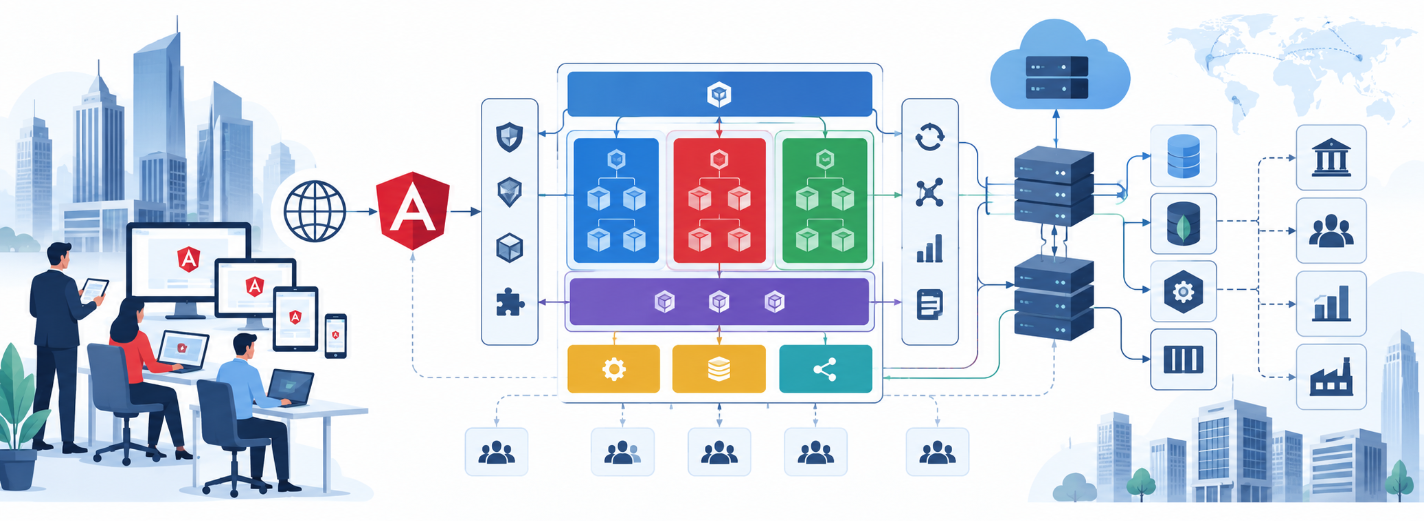
Angular Architecture for Large Applications: Boundaries That Scale
- Angular architecture
- large Angular application
- domain boundaries
- lazy loading
- frontend governance
Angular Architecture for Large Applications: Boundaries That Scale
A large Angular application becomes difficult when the code no longer reveals who owns a business decision, which parts may depend on one another, or how a change reaches production. More folders, libraries, stores, and diagrams do not solve that problem by themselves. Architecture must reduce the cost of understanding and changing the product while preserving user journeys, security, accessibility, and operational control.
Begin with the business map: capabilities, actors, critical workflows, data authority, team ownership, release constraints, and failure consequences. Then decide boundaries for routes, public APIs, state, infrastructure, and deployment. Angular supplies standalone components, routing, dependency injection, signals, and build tooling; those mechanisms implement a model rather than replace one.
This guide focuses on decisions that can be enforced and reviewed. It complements our guidance on scaling enterprise Angular applications, state management for complex Angular products, and Angular design-system governance. The goal is a codebase in which a team can locate responsibility, predict impact, test risk, and change one capability without negotiating with the entire application.
Organize the Application by Business Capability
Group code by a business capability that users and product owners can name: onboarding, catalog, ordering, claims, billing, administration. Keep its routes, screens, orchestration, state, data access, and domain types together. The official Angular style guide likewise recommends feature areas instead of top-level folders such as components, services, and directives.
Give every capability a narrow public entry point and keep implementation paths private. Export route configuration, intentional facade types, and stable integration contracts; do not expose internal components or store structure for convenience. Use language from the business so a folder still makes sense when Angular APIs and team members change.
Validate a boundary with one end-to-end change: locate the code, modify a rule, update the API contract, test the journey, observe it, and release it. If unrelated domains must be edited or several teams must approve internal details, the boundary is aspirational. Record the owner and revisit it when product responsibility or data authority moves.
Make Dependency Direction an Enforced Rule
Define dependency direction in business terms. A feature may use design-system primitives and platform ports; platform code must not import a feature; one domain may consume another only through an approved public contract. Distinguish compile-time reuse from runtime collaboration. Two capabilities can exchange data through navigation or an application contract without importing each other’s internals.
Encode the rule with TypeScript path boundaries, lint restrictions, workspace tags, project-graph constraints, and cycle detection. Ban deep imports that bypass a package entry point. Generate a dependency graph in continuous integration and fail on newly forbidden edges. Architecture enforced only during review will erode under deadline pressure.
Allow time-bound exceptions when delivery evidence justifies them. Each exception needs an owner, reason, affected edge, risk, expiry, and removal task. Review whether a proposed shared type actually carries identical meaning in both domains; matching fields do not prove shared semantics. Translate at the boundary when meanings can diverge.
Align Lazy Routes with Product Boundaries
Use lazy loading at independently navigable product boundaries. Angular routes can load a standalone component with loadComponent or a child route set with loadChildren. A route boundary can also scope providers and state. This makes the loading decision align with navigation, ownership, authorization, and cleanup rather than an arbitrary file count.
Measure initial JavaScript, route chunks, duplicate dependencies, parse and execution time, navigation latency, data waterfalls, and performance on representative devices. A smaller first bundle can still create a poor journey if the next route triggers several sequential chunks and API calls. Preload only from observed navigation value and network conditions.
Design loading, denial, timeout, offline, and retry states at the route boundary. Preserve navigation intent after authentication and make chunk-load failure recoverable after a deployment invalidates cached assets. Test deep links, browser history, guards, resolvers, role changes, and refresh—not only navigation from the application home page.
Keep Shared Code Small and Semantically Stable
Shared code should be boring, stable, and free of hidden business authority. Good candidates include accessible design primitives, formatting with explicit locale, generic validation mechanics, telemetry ports, and transport utilities. A helper named around a business concept belongs in that domain even if two screens currently call it.
Split shared areas by purpose and ownership instead of building one dependency magnet. A design-system package can own components and tokens; a platform package can own application-facing ports; small utility packages can own pure functions. Give each a public API, change policy, maintainer, and consumer tests. Avoid wildcard barrels that expose accidental internals.
Before moving code into shared, ask whether consumers need the same behavior, release timing, and semantic meaning. Duplication can be cheaper than premature coupling. Promote only after repeated use reveals a stable abstraction, and move it with compatibility tests. Track fan-in: a small change with dozens of consumers deserves stronger review than its line count suggests.
Place State at the Narrowest Useful Lifetime
Classify state before selecting a library: local presentation state, form or workflow state, route state, authenticated session, client cache of server data, and durable business state. For each, name the authority, readers, writers, lifetime, reset trigger, persistence, synchronization, and recovery. Keep authoritative business records on the server unless the product explicitly supports offline ownership.
Use component signals for local synchronous state and computed values for derivation. Scope workflow services or stores to the route when their lifetime follows that route. Introduce an application-wide store only for state with genuinely application-wide readers, writers, and lifetime. A single global store turns unrelated release decisions into one schema migration.
Define concurrency and failure behavior: cancel stale searches, prevent duplicate submission, reconcile optimistic changes, expire caches, handle refresh, and clear sensitive state on logout or role change. Test navigation away and back, two tabs, slow responses, retries, rejected writes, and out-of-order completion. State architecture is proved by reset and recovery, not by a tidy diagram.
Put Browser and Infrastructure Detail Behind Ports
Features should express application intent rather than browser or vendor mechanics. Define typed ports for identity, telemetry, storage, feature flags, time, files, notifications, and backend operations. Implement those ports with adapters using Angular dependency injection. Tests can then supply deterministic fakes, and infrastructure can change without rewriting domain behavior.
Choose provider scope deliberately. Application providers suit true singletons; route providers suit capability configuration and route-lifetime state; component providers suit isolated instances that should disappear with the component. Angular’s hierarchical injectors make scope powerful, but an accidental provider level can duplicate sessions, retain state too long, or hide which implementation is active.
Normalize errors and telemetry at the adapter boundary without erasing useful detail. Attach correlation, operation, and domain context; redact sensitive values; and distinguish unavailable, unauthorized, invalid, conflict, and unknown failure. Test server rendering or non-browser execution where relevant. Direct access to window, storage, or a vendor SDK inside features makes those environments and tests fragile.
Scale Team Ownership with the Architecture
Assign an owning team to every domain and platform area. Ownership includes roadmap input, reviews, production health, vulnerabilities, dependency updates, migrations, documentation, and support—not just permission to merge. Publish the public API and service expectations so consumers know how to request change and how quickly incidents will be handled.
Match repository structure to collaboration. A monorepo can expose the dependency graph and share tooling, but it does not create autonomy if every change requires a central team. Use code owners, affected-project checks, distributed maintainers, explicit release rules, and escalation paths. Keep platform governance focused on compatibility and outcomes rather than stylistic gatekeeping.
Measure flow and ownership: review latency, build duration, flaky tests, cross-domain changes, dependency age, change failure, recovery time, bundle regressions, and unowned alerts. Watch for knowledge concentration and rotate incident and release duties. A team boundary is healthy when it enables safe local decisions and clear escalation, not when it protects territory.
Turn Architecture Diagrams into Executable Checks
Turn important architecture statements into fast checks: allowed imports, no cycles, public entry points, package tags, route ownership, bundle budgets, supported browsers, and forbidden infrastructure access. Run them locally and in continuous integration with messages that explain the violated rule and a legitimate path forward.
Use the smallest test that proves each risk. Pure domain rules need focused unit tests. Components need tests of template and class together where rendering or interaction matters. Adapters need contract and failure tests. Critical journeys need browser tests for authorization, accessibility, slow networks, recovery, and observability. A component creation test does not prove user behavior.
Review the rules quarterly and after major product or team changes. Remove checks that no longer protect an outcome, tighten rules after a proven incident, and migrate violations in bounded slices. Track exceptions and architecture fitness trends. The objective is not a permanently pure diagram; it is a system whose constraints remain visible, useful, and affordable to change.
- Group routes, UI, orchestration, state, data access, and domain types by an owned business capability with a narrow public API.
- Define allowed domain and layer relationships, then enforce imports, public entry points, cycles, and exceptions in continuous integration.
- Place lazy routes around independently navigable capabilities and verify bundle, navigation, data, failure, and recovery behavior on real devices.
- Share stable primitives, design-system elements, and platform ports; keep changing business meaning inside its owning domain.
- Keep state at the narrowest scope that matches its authority, readers, writers, lifetime, reset, persistence, and recovery needs.
- Expose typed application-facing ports and keep browser, vendor, transport, telemetry, and storage mechanics in replaceable adapters.
What should be decided first in a large Angular architecture?
What should be decided first in a large Angular architecture?
How should Angular architecture be tested?
How should Angular architecture be tested?
What is the largest implementation risk?
What is the largest implementation risk?
Does every Angular product need the same structure?
Does every Angular product need the same structure?
When is an external architecture review useful?
When is an external architecture review useful?
Make Your Angular Architecture Enforceable
Turn domain boundaries, dependency risks, state lifetimes, and delivery constraints into a staged plan with our Angular engineering team.
Publications
Our research
Research and development of AI-powered solutions to optimize business workflows and enhance decision-making processes.
Analysis of machine learning models for predictive analytics in finance, e-commerce, and SaaS platforms.
Exploration of natural language processing and computer vision technologies to strengthen automation, personalization, and customer support.
Enterprise Angular Delivery: From Workflow to Operable Product
A practical guide to delivering enterprise Angular applications through workflow modeling, feature boundaries, integration contracts, team ownership, measurable quality, incremental releases and production operations.

9 min read
01 Aug 2026
Angular State Management: Model Ownership Before Choosing a Store
A production guide to Angular state management across local UI state, business workflows, server cache, normalized entities, RxJS concurrency, persistence, debugging, and testing.

11 min read
08 Sep 2026
Angular Design Systems: Build a Product, Not a Component Catalogue
A production guide to Angular design-system architecture and governance: ownership, semantic tokens, primitives, accessibility contracts, stable APIs, versioning, documentation, contributions, adoption, exceptions, and measurable outcomes.

10 min read
08 Sep 2026