
How to Scope an Angular Migration Without Hiding the Risk
- Angular migration
- Angular modernization
- migration assessment
- legacy frontend
- Angular upgrade
How to Scope an Angular Migration Without Hiding the Risk
An Angular migration begins with uncertainty, not a target version. The current repository may contain unsupported framework and Node.js combinations, abandoned libraries, custom builders, global styling assumptions, brittle tests, hidden operator workflows, and release steps known by one person. A useful scope identifies what prevents safe product change and which evidence will show that the constraint has been removed.
Define the business reason first: security support, browser obligations, dependency compatibility, build speed, developer lead time, performance, maintainability, hiring, a hosting change, or preparation for product work. Record critical journeys, release and recovery expectations, product deadlines, parallel roadmap demand, and change tolerance. Then choose the smallest migration that restores a supported, operable path. New Angular features are options, not automatic scope.
Start with a Reproducible Migration Assessment
Inventory Angular, CLI, TypeScript, RxJS, Node.js, Angular Material or CDK, state and form libraries, testing tools, builders, schematics, SSR, service workers, localization, browsers, monorepo tooling, private packages, and platform dependencies. Capture lockfiles, peer conflicts, deprecated APIs, CommonJS assumptions, custom webpack hooks, patches, forks, and packages with no viable release.
Run the application through clean install, development, production build, lint, unit, component and end-to-end tests, SSR or prerender where used, deployment, smoke checks, and rollback. Measure build duration, bundle and route chunks, browser errors, key journey performance, flaky tests, release effort, and incident history. Static analysis cannot reveal whether permissions, drafts, exports, background refresh, deep links, or operational tools still behave correctly.
The assessment should produce a reproducible baseline, supported target path by major version, compatibility matrix, code and dependency findings, test gaps, architectural constraints, proposed workstreams, risks, assumptions, acceptance evidence, sequence, range estimate, and owners. Prove the riskiest step on a branch when schematics, builders, SSR, proprietary libraries, or a large version gap make effort uncertain. A fixed quote before this evidence merely moves uncertainty into change requests.
Separate Required Upgrade Work from Optional Modernization
Upgrade work restores supported versions and required compatibility: Angular and CLI steps, TypeScript and Node.js ranges, RxJS, Material or CDK, builders, test infrastructure, linting, polyfills, dependency replacements, compiler errors, and mandatory migrations. Follow supported major-to-major paths, use the official Update Guide and ng update, commit each step, and inspect every automated change.
Modernization work changes design choices: standalone APIs, signals, built-in control flow, signal inputs or queries, lazy routes, a new build system, zoneless compatibility, state redesign, component boundaries, design-system cleanup, SSR strategy, or test migration. Angular provides incremental migrations for many features, but automation can skip code it cannot analyze and still requires build, test, and behavior review.
Keep the workstreams visible even when delivered together. Required compatibility should not depend on completing every desired refactor, and optional modernization needs its own hypothesis and acceptance. Avoid combining framework upgrade, visual redesign, backend contract change, state rewrite, and build-platform migration in one unobservable release. Sequence changes so a regression has a small search space and each stage can be retained or rolled back independently.
Choose the Smallest Safe Migration Boundary
An in-place migration is usually best when the application can reach the target through supported steps and the team can keep the mainline releasable. Use short-lived branches, automated checks, dependency isolation, feature controls, and small production releases. This keeps one product and one data flow, but requires discipline to prevent migration and roadmap changes from colliding.
A route, shell, library, or application boundary can support incremental replacement when a legacy area cannot move safely, teams need independent release, or the product cannot pause. Define navigation, authentication, authorization, shared state, browser storage, styling, events, analytics, errors, accessibility, and deployment across that boundary. A strangler route is useful only when old functionality can actually be retired.
A parallel rewrite creates two products until migration is complete. It duplicates defect fixing, design decisions, data and permission logic, analytics, tests, and support, while a changing legacy system moves the finish line. Choose it only when an in-place path is demonstrably unsafe or strategically wrong. Prove one representative workflow end to end, define traffic or user migration, data authority, rollback, and deletion of the old path before funding the full rewrite.
Define Acceptance as Product and Operating Evidence
“The application builds” is a checkpoint, not acceptance. Define supported browsers and devices, critical journeys, roles and permissions, forms and validation, drafts, uploads, downloads, exports, deep links, localization, accessibility, analytics, integrations, background behavior, error and offline states, and operator workflows. Preserve data and business semantics even when internal APIs change.
Add engineering evidence: clean install, production build, bundle budgets, route loading, hydration where applicable, performance thresholds, memory stability, unit and interaction checks, focused end-to-end journeys, security review, dependency policy, telemetry, deployment, staged rollout, rollback, and incident diagnostics. Compare against a recorded baseline; “no complaints” cannot prove that low-frequency workflows or assistive-technology paths survived.
Attach every milestone to reviewable artifacts and a named approver. Automated tests should cover stable behavior; exploratory review should target risk and changed boundaries. Run production-shaped data and accounts through the migrated slice, inject dependency and network failures, and rehearse recovery. Acceptance should distinguish known debt from regressions so the project does not become an unlimited cleanup programme.
Clarify Decisions, Access, and Operational Ownership
Build a responsibility matrix for architecture, product decisions, domain clarification, repository and package access, environments, secrets, test data, dependency licences, security approval, UX and accessibility review, backend contracts, release, incident response, and final acceptance. Name one accountable client owner for the business outcome even when delivery is external.
Migration delays often come from waiting rather than coding: unavailable domain experts, slow access approval, unresolved package ownership, shared environment collisions, or an undecided release window. Track decisions and dependencies with due dates and escalation. Give the delivery team the rights needed to produce evidence, while client-controlled identities, repositories, pipelines, signing material, telemetry, and production authority preserve ownership.
Define who supports mixed versions, fixes roadmap conflicts, triages regressions, maintains temporary adapters, and responds after release. Reserve internal review and pairing capacity rather than assuming it appears around other work. A supplier cannot own an outcome without timely decisions, and a client cannot claim control without people capable of reviewing, deploying, observing, and recovering the application.
Match the Engagement Model to Uncertainty
A bounded assessment fits high uncertainty and should end with evidence and options, not an obligation to award implementation. A milestone project fits a defined outcome with stable acceptance and dependencies. An embedded team extension fits evolving scope when the client already owns product, architecture, priority, review, and operations. A hybrid model can pair specialists with internal engineers until capability transfers.
Fixed price works when boundaries, inputs, acceptance, responsibilities, and change rules are stable. It is expensive theatre when proprietary dependencies, weak tests, unknown workflows, or provider constraints remain unresolved. Time and materials handles discovery better but needs outcome milestones, transparent backlog, rate and capacity rules, evidence, forecast updates, and stop conditions. Do not let contract type replace delivery governance.
Compare providers on the same assessment pack. Ask for team composition, analogous evidence, assumptions, exclusions, dependency handling, test and release method, security, accessibility, reporting, knowledge transfer, transition, and ownership. Interview the engineers doing the work. A credible proposal identifies information it still needs and shows how early work will narrow the range.
Price Risk Explicitly and Retire It with Evidence
Maintain a risk register with cause, consequence, likelihood, impact, evidence, mitigation, contingency, owner, trigger, and retirement condition. Typical risks include unsupported libraries, custom builders, untested business paths, AngularJS coexistence, global state, browser storage, SSR, micro frontends, private registries, design-system coupling, weak CI, data-dependent tests, unavailable experts, and a fixed product deadline.
Separate base effort, uncertainty range, and management reserve. Normalize supplier estimates for the same scope, environments, quality attributes, support, rollout, and transfer. Link contingency to named risks and release it when evidence retires them. Do not consume it silently for added features. Update the forecast after version proofs, dependency decisions, test discovery, and the first migrated slice.
Track whether risk is declining: unsupported packages removed, clean builds reproducible, critical journeys covered, warnings and TODOs resolved, bundle and performance budgets passing, rollback rehearsed, and internal ownership increasing. If uncertainty remains flat while spend rises, narrow the boundary or change the plan. Sunk cost is not evidence that a rewrite or modernization should continue.
Make Knowledge Transfer an Acceptance Condition
Transfer knowledge throughout delivery through pairing, code and architecture review, decision records, migration notes, dependency rationale, build and release documentation, dashboards, alerts, runbooks, and recorded demonstrations. Explain why a schematic changed code, which TODOs remain, how new reactivity or rendering behaves, and which compatibility constraints still apply. Documentation without context decays quickly.
Test transfer as behavior. Internal engineers should perform a clean setup, upgrade a dependency, diagnose a failed build and production error, release a change, inspect telemetry, roll back, and handle a representative incident. Rotate ownership before the final milestone and measure unresolved questions, review dependence, and time to restore. A final presentation cannot substitute for practice.
Define the transition package and exit rights at contract start: client-owned source and infrastructure, architecture and risk records, dependency and licence inventory, open issues, test evidence, credentials returned or revoked, support window, and named maintainers. Migration is complete when the product is supported and releasable, critical behavior is proven, temporary paths have owners and retirement dates, and the client can operate the result without undocumented expertise.
- Inventory the real system: versions, dependencies, builders, private packages, custom patches, SSR, browsers, critical journeys, release, incidents, and operational ownership.
- Record a baseline: reproduce install, build, tests, deployment, rollback, bundle, performance, errors, accessibility, and business workflows before changing them.
- Separate workstreams: required compatibility, build migration, optional Angular modernization, product refactoring, and visual change need distinct outcomes and acceptance.
- Choose a controlled boundary: use in-place steps, a route or shell boundary, or a rewrite only when its retirement, data, identity, release, and rollback model is proven.
- Normalize cost and risk: compare the same assumptions, exclusions, environments, evidence, support, transfer, and lifecycle obligations; update ranges at evidence gates.
- Accept ownership: require client-controlled artifacts, tested journeys, observability, rollout and rollback, exercised runbooks, internal-led release, and a clean exit package.
What should an Angular migration assessment deliver?
What should an Angular migration assessment deliver?
Should an Angular migration use a fixed price?
Should an Angular migration use a fixed price?
Is a rewrite part of Angular migration services?
Is a rewrite part of Angular migration services?
How should we compare Angular migration vendors?
How should we compare Angular migration vendors?
Can product development continue during an Angular migration?
Can product development continue during an Angular migration?
Scope the Angular Migration Before Committing
Share the repository and version inventory, critical journeys, browser and hosting obligations, build and test evidence, proprietary dependencies, release process, incident history, roadmap constraints, and target outcomes. GARNO.TECH can produce a reproducible assessment, safe sequence, risk-based range, production-shaped proof, acceptance plan, ownership model, and knowledge-transfer path.
Publications
Our research
Research and development of AI-powered solutions to optimize business workflows and enhance decision-making processes.
Analysis of machine learning models for predictive analytics in finance, e-commerce, and SaaS platforms.
Exploration of natural language processing and computer vision technologies to strengthen automation, personalization, and customer support.
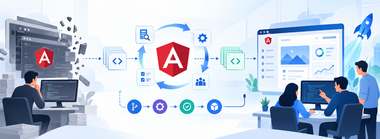
How to Upgrade Angular Without Stopping Product Development
A practical version-by-version Angular migration plan using dependency evidence, parallel delivery rules, focused compatibility work, regression gates, staged releases, rollback, and debt closure.
10 min read
08 Sep 2026
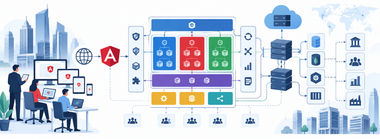
Angular Architecture for Large Applications: Boundaries That Scale
A practical guide to structuring large Angular applications with business domains, dependency rules, lazy routes, scoped state, platform adapters, team ownership, and automated architecture checks.
8 min read
07 Sep 2026
How to Create a Technical Roadmap That Guides Decisions
Build a technical roadmap from business outcomes, system evidence, sequencing, decision rights, delivery capacity, risk controls and explicit review criteria.

8 min read
08 Sep 2026