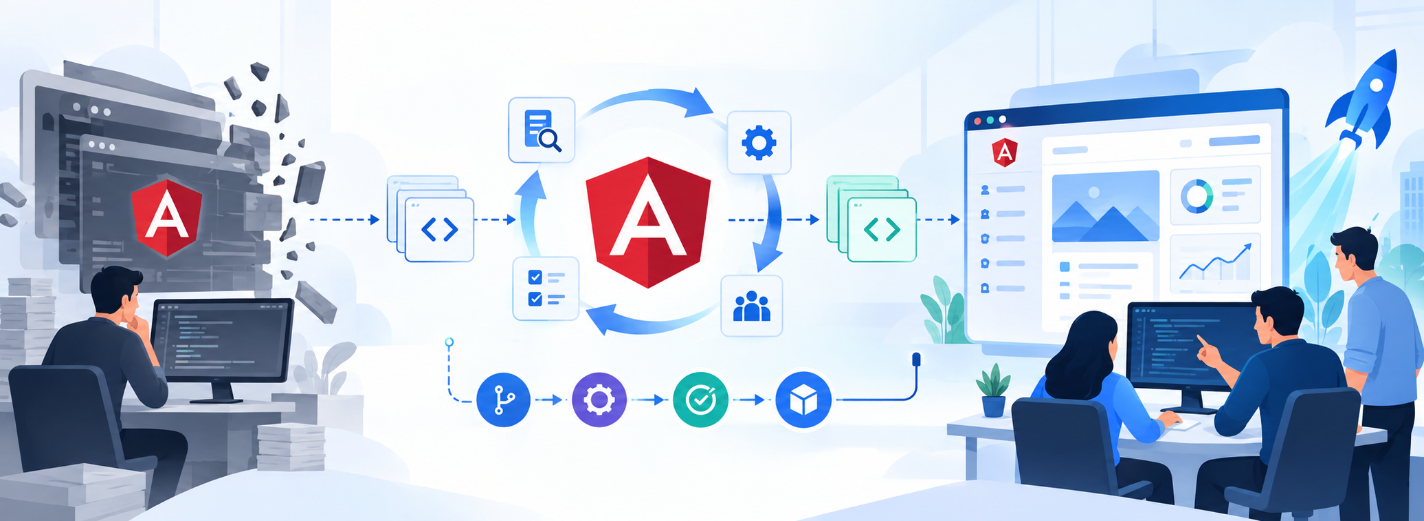
How to Upgrade Angular Without Stopping Product Development
- Angular upgrade
- incremental Angular migration
- ng update
- Angular modernization
How to Upgrade Angular Without Stopping Product Development
An Angular upgrade competes with product work only when it is treated as a single technical event. A safer program turns it into a sequence of small production releases. Each step has a known compatibility target, a narrow change set, regression evidence, an owner, and a rollback condition. Product teams continue shipping because the upgrade lane defines how new code remains compatible with both the current and next state.
The plan begins with evidence, not an aspirational target version. Inventory the workspace, dependencies, builders, browser promises, server rendering, design system, internal libraries, tests, deployment path, monitoring, and critical journeys. Then map a supported route through each Angular major. The official Update Guide and ng update migrations help with framework changes, but they cannot decide whether a replaced component preserves accessibility, whether an export still works, or whether the business can tolerate a release freeze.
This guide explains how to maintain momentum while reducing uncertainty at every step. For a broader scope and delivery model, see our Angular migration planning guide and Angular engineering services.
Audit the Real Upgrade Surface
Capture the exact starting state from a reproducible checkout: Angular core and CLI, Node.js, TypeScript, RxJS, package manager and lockfile, builders, schematics, test runners, SSR, service worker, localization, browser targets, CI images, deployment scripts, and custom webpack behavior. Build and test with a clean dependency install. If today’s version cannot be reproduced, an upgrade result cannot be trusted.
Build a compatibility matrix for every intended Angular major. Use Angular’s official table for supported Node.js, TypeScript, and RxJS ranges, then add each first- and third-party library’s peer requirements. Mark packages as compatible, upgradeable, replaceable, forked, or blocking. Include hidden coupling in internal libraries and design-system packages; a green application manifest can conceal incompatible transitive assumptions.
Baseline what users and operators experience before changing versions: startup and route timings, bundle budgets, memory, API error handling, authentication, permissions, forms, tables, uploads, exports, offline behavior, accessibility, analytics, and browser coverage. Record flaky tests separately from genuine failures. Give every unknown an owner and date; estimates without a dependency owner or acceptance evidence are scheduling wishes.
Move One Major Version at a Time
Upgrade to the latest patch of the next major, not directly to the final target. Angular’s supported process runs ng update one major at a time, preserving the migrations and guidance created for that transition. Align core and CLI, use the matching runtime toolchain, commit the clean pre-update state, and capture migration output so manual exceptions remain reviewable.
At each major, restore the same evidence ladder: clean install, type check, production build, unit and integration suites, critical journeys, accessibility, supported browsers, SSR or hydration if used, bundle budgets, and a production-shaped smoke environment. Review new warnings rather than suppressing them wholesale. A warning may be the only early evidence of a future blocker, CommonJS dependency, invalid template, or changed builder assumption.
Keep a transition record with commands, changed files, migration names, incompatible packages, manual fixes, test results, bundle deltas, open risks, and rollback instructions. Tag or release the stable intermediate state before continuing. When a later regression appears, this record narrows the search to one version boundary instead of turning several years of framework, toolchain, and library changes into one investigation.
Separate Compatibility Work from Redesign
Separate work required to cross a version boundary from improvements that merely become possible afterward. Compatibility work includes supported dependencies, removed APIs, builder configuration, TypeScript errors, and behavior needed to restore the baseline. Optional modernization includes standalone conversion, new control flow, signals, redesigned state, component rewrites, or a new test stack unless the target version makes one unavoidable.
Land preparation before the version bump: repair trusted tests, remove already-deprecated APIs, isolate browser globals, document custom builders, expose implicit environment assumptions, and add missing budgets or journey checks. Keep each change reviewable and releasable on the current version. This reduces the upgrade diff without combining new framework behavior with a broad architectural rewrite.
Schedule modernization as named follow-up slices with their own product reason and evidence. Angular’s official migrations can convert features incrementally and often accept a path limit; use that to learn on a bounded area. Do not let “temporary” mixed styles become invisible: document what is allowed, where new patterns begin, and when the old pattern will be removed.
Keep Feature Delivery Compatible
A long-lived migration branch turns normal feature work into repeated conflict resolution and postpones integration risk. Prefer trunk-based, short-lived slices that pass the current release gates. When a change must differ by version, place it behind a small compatibility adapter or configuration seam, name its removal condition, and avoid scattering version checks through product components.
Publish temporary contribution rules for teams shipping features: supported APIs, packages that may not be introduced, files with coordinated ownership, browser and accessibility requirements, and how to request an exception. Add automated dependency and lint checks where possible. A rule that exists only in the migration team’s chat will fail as soon as another team merges urgent work.
Plan capacity rather than pretending the migration is free. Assign an upgrade owner, reviewers from affected domains, and a predictable share of each iteration. Keep feature scope negotiable around high-risk transitions, but avoid an indefinite freeze. A weekly integration rhythm, visible blockers, and a shared definition of done let product and migration work make decisions from the same evidence.
Replace Dependencies Through Explicit Contracts
Classify every blocking dependency by business role, maintainer health, release cadence, peer ranges, security posture, browser behavior, accessibility, bundle effect, and coupling depth. The options are to upgrade, configure, wrap, fork temporarily, replace, or remove. “Find an alternative” is not a plan until the team knows which user behavior and extension points the alternative must preserve.
Put vendor APIs behind an application-owned facade before replacement. Define the smallest contract the product needs, build characterization tests against current behavior, and run a spike with difficult cases: keyboard navigation, localization, time zones, large datasets, printing, uploads, and error recovery. Compare maintained upgrade, fork, and replacement options with a dated ownership and exit decision.
Replace one dependency category at a time and release it independently when risk warrants. Preserve analytics events, validation semantics, focus order, visual states, and error messages as explicit acceptance criteria. Remove the old package, configuration, adapter branch, styles, tests, and licenses after rollout. A replacement is incomplete while two implementations silently remain in the bundle or support playbook.
Turn Regression Evidence into Release Gates
Build gates from the failures the product cannot afford. Unit tests protect concentrated rules; component and integration tests cover templates, forms, routing, state, and adapters; contract tests protect API expectations; end-to-end tests prove critical journeys. Add focused checks for authentication, authorization, payment, search, exports, uploads, deep links, refresh, localization, and recoverable errors rather than chasing an indiscriminate coverage percentage.
Test the platform boundary as well as application logic. Run supported browser and device combinations, keyboard-only flows, screen-reader smoke checks, contrast and focus behavior, service-worker updates, SSR or hydration, CSP, source maps, analytics, and production configuration. Compare route and interaction timings, memory, request count, bundle budgets, and error rates with the recorded baseline using representative data.
Make the gate deterministic enough to guide release decisions. Quarantine known flaky tests with an owner and expiry instead of rerunning until green. Define allowed deltas, required reviewers, evidence retention, and an exception process. A compile success is only one signal; a release candidate passes when the team can explain functional, accessibility, performance, security, and operational evidence together.
Release Every Stable Intermediate Version
Put each stable major into production before stacking the next transition. Production reveals browser extensions, enterprise policies, network conditions, data scale, uncommon roles, and workflows that staging cannot reproduce. A releasable intermediate version also keeps rollback understandable: restore the previous artifact and compatible server contract instead of reversing several framework generations at once.
Use a staged rollout appropriate to the product: internal users, a tenant cohort, a region, a percentage, or a separately addressed deployment. Watch journey completion, JavaScript errors, API failures, latency, support contacts, conversion, and accessibility reports by release. Define the observation window and automatic stop conditions before exposure; otherwise the team will debate noisy signals during an incident.
Prepare rollback as an executable path: immutable artifact, compatible API and data changes, feature flags where behavior must be disabled, cache and service-worker considerations, monitoring annotation, and named authority to stop rollout. After stability, capture defects and operational surprises in the next major’s plan. Evidence from one release should reduce risk in the following transition.
Close Migration Debt Before Declaring Victory
Maintain a migration ledger from the first day. Track deprecated APIs, temporary adapters, suppressed warnings, compatibility flags, forks, skipped tests, duplicate implementations, old builders, unsupported packages, manual deployment steps, and documentation gaps. Every entry needs a reason, owner, target state, removal evidence, deadline, and consequence if it remains.
Close the ledger in small releases, prioritizing security exposure, unsupported runtime, release friction, false test confidence, and code that invites new coupling. Use Angular’s optional migrations only when their benefit and acceptance evidence are clear. For example, a build-system migration deserves its own validation of SSR, scripts, styles, assets, source maps, budgets, and deployment output rather than hiding inside the final version bump.
Declare completion only when the target version is supported, production evidence is stable, temporary paths are removed or deliberately accepted, documentation and local setup are current, CI uses the supported toolchain, dependency ownership is clear, and the next routine update has a cadence. The lasting outcome is not a version number; it is a product that can upgrade again without another rescue program.
- Reproduce the baseline: clean install, build, tests, critical journeys, browsers, accessibility, bundles, deployment, telemetry, and rollback must work before dependency changes begin.
- Cross one boundary: move to the latest patch of the next Angular major with its supported Node.js, TypeScript, RxJS, migrations, peer dependencies, and recorded exceptions.
- Keep the diff causal: land test repair, deprecated API removal, and tooling preparation separately; schedule optional standalone, signal, template, state, or builder redesign as named follow-up work.
- Protect parallel delivery: use short-lived branches, compatibility seams, published contribution rules, automated dependency checks, shared file ownership, and a predictable migration capacity allocation.
- Own dependency exits: compare upgrade, facade, fork, replacement, and removal against user parity, accessibility, security, maintenance, bundle cost, release risk, and a dated exit plan.
- Release and learn: pass functional and nonfunctional gates, deploy the intermediate major to a controlled cohort, observe customer journeys, retain an executable rollback, and feed findings into the next step.
What should an Angular upgrade team decide first?
What should an Angular upgrade team decide first?
Can we skip Angular major versions during an upgrade?
Can we skip Angular major versions during an upgrade?
How can feature development continue during the migration?
How can feature development continue during the migration?
Should modernization be combined with the Angular version upgrade?
Should modernization be combined with the Angular version upgrade?
When is an Angular migration complete?
When is an Angular migration complete?
Turn the Angular Version Gap into a Release Plan
Share the current workspace, target constraints, dependency inventory, release cadence, and critical journeys. We will map the supported version path, blockers, evidence gates, staged releases, rollback, and ownership.
Publications
Our research
Research and development of AI-powered solutions to optimize business workflows and enhance decision-making processes.
Analysis of machine learning models for predictive analytics in finance, e-commerce, and SaaS platforms.
Exploration of natural language processing and computer vision technologies to strengthen automation, personalization, and customer support.
How to Scope an Angular Migration Without Hiding the Risk
A practical guide to Angular migration assessment, version and build updates, optional modernization, migration boundaries, regression evidence, responsibilities, engagement models, risk pricing, and knowledge transfer.

9 min read
08 Sep 2026
Angular Testing Strategy: Allocate Evidence by Product Risk
A production guide to Angular testing across pure logic, components, accessibility, API contracts, critical E2E journeys, test data, time, flakiness, and staged CI feedback.

11 min read
08 Sep 2026
Angular Performance Optimization for Data-Heavy Applications
Optimize data-heavy Angular applications through representative profiling, bounded DOM and computation, deliberate state updates, virtualization, chart control, route budgets, leak prevention, and field evidence.

9 min read
08 Sep 2026