/ 01
A Shared Architecture Vocabulary
Modules, providers, dependency injection, and request-pipeline primitives help teams express capability boundaries, ownership, composition, and policy in a consistent, reviewable form.
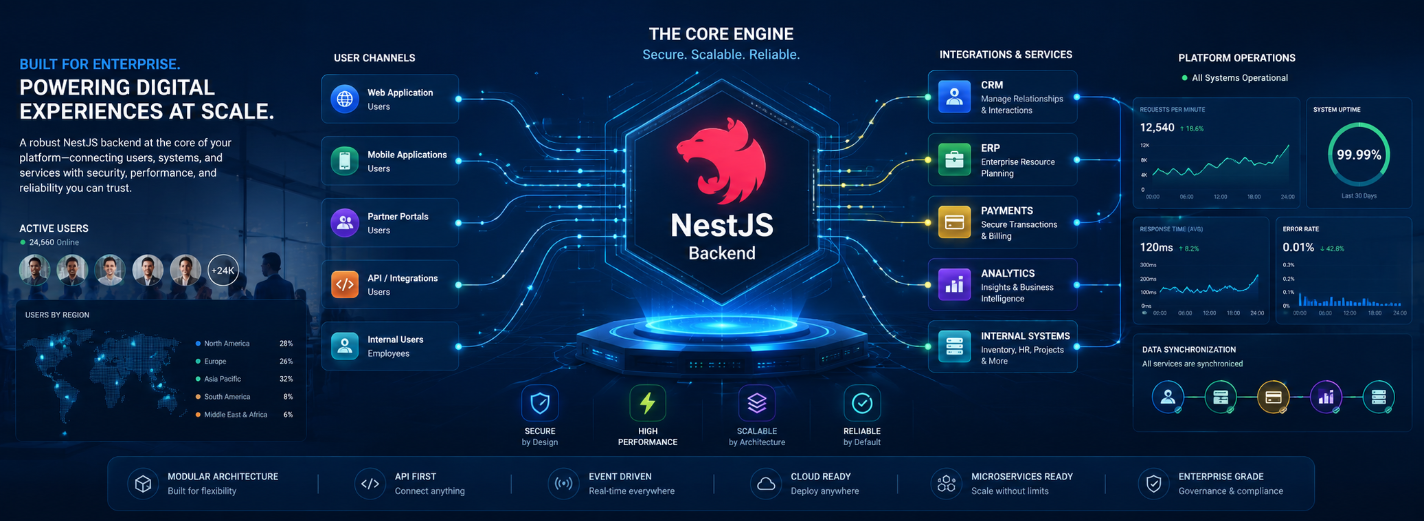
NestJS is a strong enterprise backend choice when a TypeScript team needs consistent application structure across many business capabilities, transports, integrations, and engineers. Modules, providers, dependency injection, guards, pipes, interceptors, filters, and adapters give the organization a shared vocabulary for composition and policy. They do not make a system secure, scalable, or maintainable by themselves; they make sound decisions easier to express, review, test, and repeat.
Start with the product and operating model. Map critical journeys, domain language, data ownership, permissions, integrations, service objectives, regulatory or contractual obligations, expected demand, team topology, deployment constraints, and failure cost. NestJS fits APIs, SaaS platforms, internal systems, workflow products, marketplaces, fintech services, WebSocket gateways, background workers, queues, and selected distributed services when the Node.js runtime and available libraries suit the workload.
It is less compelling for a tiny short-lived endpoint, sustained CPU-heavy computation better served by another runtime, a product that primarily configures a maintained platform, or a team unwilling to own framework upgrades and production operation. Validate one representative vertical slice with real identity, authorization, persistence, an important integration, telemetry, deployment, and recovery. The decision should follow evidence about change and operation, not the number of decorators in a demo.
Organize modules around cohesive business capabilities and lifecycle, not horizontal folders named controllers, services, and repositories. A module owns rules and data, publishes a narrow interface, and keeps internal providers private. Imports express deliberate dependencies. Architecture tests can reject cycles, forbidden imports, and access to another module’s persistence before convenient shortcuts become permanent coupling.
Keep controllers and transport handlers thin: authenticate and validate protocol input, call an application use case, and map the result. Application services coordinate work and transaction boundaries; domain code owns invariants that should remain testable without HTTP or an ORM; adapters translate databases and providers. Dependency injection is most valuable at volatile or owned boundaries such as repositories, clocks, payment gateways, message publishers, and identity services. An interface for every class adds ceremony without substitutability.
Use TypeScript to strengthen contracts, not to pretend runtime data is safe. Validate external input and configuration, distinguish domain types where mistakes have consequence, narrow nullable and error states, and prevent ORM entities from becoming public API contracts. Shared packages should contain truly stable primitives or platform capabilities, not a route that lets every domain depend on every other one.
A modular monolith is often an enterprise architecture, not a temporary embarrassment. It keeps transactions, local development, releases, tracing, and recovery simpler while product boundaries mature. Internal interfaces can later become network contracts if measured deployment, scaling, isolation, technology, or team ownership needs earn the permanent cost.
Security begins with identity and resource-specific authorization. Establish user, workforce, partner, service, and privileged identities through trusted lifecycles. Guards can authenticate and enforce reusable policy, but the application operation must still evaluate the actor, tenant or organization, target resource, state, requested action, delegation, and separation-of-duties rules. Client-side hiding and a role name alone are not authorization.
Validate syntax and shape with pipes at the boundary; enforce business invariants in application or domain code. Limit payloads and uploads, use parameterized data access, protect outbound requests, apply rate and concurrency limits, and return stable errors without stack traces, secrets, or provider details. Multi-tenant applications must derive tenant context from trusted identity and propagate it through queries, caches, jobs, storage paths, events, logs, exports, and administrative tools.
Protect the software lifecycle as well as the request. Separate environments and duties, use short-lived delivery identities, keep secrets outside source and images, rotate keys, scan dependencies and artifacts, review infrastructure changes, and produce traceable builds from reviewed source. Define vulnerability triage, patch deadlines by consequence, exception expiry, and ownership of the NestJS, Node.js, language, container, operating-system, and provider upgrade chain.
Audit sensitive business actions with actor, authority, resource, previous and resulting state, reason, correlation, and time while minimizing exposed personal data. Centralize logs and detections, name alert responders, rehearse incident communication, and test backup restoration and service recovery. Security frameworks and certifications can organize evidence; they do not replace tested controls or operation-specific threat modelling.
Scale from production-shaped evidence. Trace critical journeys and measure endpoint and job percentiles, useful throughput, errors, event-loop delay, CPU, memory, garbage collection, database plans and locks, connection pools, queue age, cache behavior, downstream quotas, and cost per successful result. Use representative data volumes, tenant distribution, payloads, cache state, background work, normal peaks, bursts, and dependency degradation. Averages and one synthetic endpoint can hide the real constraint.
Common improvements are smaller than a redesign: correct indexes and queries, bounded pagination, fewer round trips, batching, explicit timeouts, asynchronous work, idempotent consumers, concurrency limits, backpressure, cache ownership and invalidation, horizontal replicas, and workload isolation. Size application concurrency, pools, queues, and dependency capacity together. Moving contention from the app to the database is not scaling.
Extract a service only when a cohesive capability repeatedly needs independent deployment, scaling, isolation, recovery, technology, or team ownership. First assign module and data ownership, narrow the interface, remove circular dependencies, establish contract tests, and measure the constraint. Distribution adds networks, partial failure, versioned contracts, eventual consistency, service identity, telemetry, deployment pipelines, and on-call; the benefit must exceed that permanent operating cost.
During extraction, publish compatible APIs or events, establish one authoritative data owner, handle retries, duplicates, ordering, timeouts, and reconciliation, correlate both paths, canary a controlled slice, and retain a tested fallback. Stop when the next boundary does not earn its cost. A modular NestJS core with a few independent services and managed providers is a normal enterprise architecture.
NestJS earns its enterprise role when its conventions make ownership, policy, and change easier to govern. The framework is a force multiplier for disciplined engineering; it is not a substitute for it.— GARNO.TECH Engineering Team
Enterprise integrations are contracts with operational consequences. Whether NestJS connects ERP, CRM, identity, payments, logistics, document systems, data platforms, or partner APIs, define the business meaning, authoritative owner, schema, versioning, authentication, authorization, quotas, latency, timeout, retry, idempotency, ordering, reconciliation, degraded mode, monitoring, cost, support, data obligations, and exit route.
Choose synchronous calls only when the caller truly needs an immediate answer and both sides can share the availability promise. Use queues or events for temporal decoupling, burst absorption, and durable work, but design for at-least-once delivery unless an end-to-end guarantee proves otherwise. Consumers need idempotency, bounded retries with delay and jitter, poison handling, correlation, replay rules, backpressure, and an operator path. Couple database change and event publication through an outbox or another proven consistency mechanism where loss matters.
Generated OpenAPI or GraphQL schemas document shape, not complete semantics. State concurrency behavior, pagination, error codes, deprecation, compatibility windows, and consumer responsibilities. Contract tests and sandbox examples protect integrations, while traces and reconciliation prove outcomes in operation. Wrap critical provider behavior behind an interface owned by the product, but avoid ceremonial adapters that only rename an SDK.
Testing follows consequence. Unit tests protect dense domain rules; integration tests verify NestJS composition, authorization, repositories, database transactions, serialization, migrations, queues, and provider adapters; contract tests protect consumers; end-to-end tests cover a small number of critical journeys and failure paths. Override providers at owned seams rather than mocking framework internals everywhere. A realistic database or broker test often gives more confidence than mocks that reproduce the implementation.
Make releases compatible and observable. Use expand-migrate-contract for schema evolution, version public contracts, separate deployment from exposure where helpful, and promote one traceable artifact from reviewed source through representative environments. Automate infrastructure and configuration with the same change. Define normal, emergency, rollback, roll-forward, and decommission paths; observe releases by version; and stop exposure on agreed health thresholds.
Operate what is built. Correlate requests, jobs, messages, deployments, database calls, and providers through structured logs, metrics, and traces. Define user-centered service objectives, owned alerts, runbooks, capacity headroom, backup restoration, incident review, dependency and framework upgrades, and cost per useful outcome. Maintain architecture decisions, module and data maps, contracts, provider limits, and operational knowledge close to current code. Maintainability means the team can change and recover the system safely, not merely read it.
A strong NestJS partner understands product decisions, domain modelling, databases, distributed failure, security, delivery, cloud, observability, incidents, cost, and organizational ownership—not only framework APIs. Give candidates one real constraint and ask them to compare options. Good answers state assumptions, rejected alternatives, failure modes, acceptance evidence, migration, operational work, and the smallest responsible change.
Review production-shaped evidence: architecture decisions, module and data maps, authorization and contract tests, compatible migrations, pipeline and release controls, traces and dashboards, load-test conclusions, incident reviews, restore exercises, upgrade history, and handover material. Confirm that the named senior engineers produced comparable work and will participate. A generic technology list, certification, or polished architecture diagram cannot substitute for operating judgement.
Define the engagement around an outcome and operating boundary. Agree product and technical owners, decision rights, repositories and cloud access, architecture and quality expectations, communication, service responsibility, on-call and support, budget assumptions, subcontractors, intellectual property, documentation, acceptance, exit, and the handling of bad news. Demonstrate complete vertical slices with representative data and connect spend to accepted behavior and reduced risk.
Plan capability transfer from the first week. Internal engineers participate in decisions, reviews, releases, incidents, and operational exercises. Source, infrastructure definitions, artifacts, schemas, tests, dashboards, runbooks, provider contacts, and decision records remain accessible. A partner succeeds when the client can understand, operate, recover, and evolve the backend without permanent dependence.
GARNO.TECH helps teams evaluate NestJS, design new enterprise backends, strengthen modular boundaries, modernize existing Node.js systems, secure data and integrations, resolve performance and reliability constraints, and extract services when evidence supports the move. Explore our NestJS development services or begin with a focused assessment of the critical journeys, domain and data boundaries, current architecture, service evidence, team, target outcome, risks, and ownership.
Research and development of AI-powered solutions to optimize business workflows and enhance decision-making processes.
Analysis of machine learning models for predictive analytics in finance, e-commerce, and SaaS platforms.
Exploration of natural language processing and computer vision technologies to strengthen automation, personalization, and customer support.
Design a NestJS modular monolith with business boundaries, small public APIs, owned data, local transactions, reliable events, enforceable dependencies, and an evidence-based path to service extraction.

8 min read
A practical guide to planning a NestJS backend around business capabilities, API contracts, data ownership, security, integrations, background work, operations, and measurable delivery stages.

8 min read
A practical field guide to assessing workloads, designing an Azure landing zone, choosing migration strategies, executing safe cutovers, and operating the platform with security, reliability, and cost control.

11 min read