
What Comes After MVP? From Validation to a Scalable Product
- MVP
- SaaS development
- product scaling
- software architecture
- product development
- digital platforms
From a Validated MVP to a Scalable Product
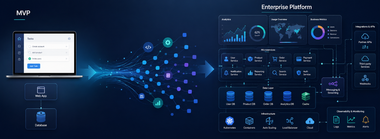
An MVP is created to test assumptions, understand user demand, and confirm that a product solves a meaningful problem. It is not the final version of the platform. Once early customers begin using the solution, the business must decide what comes after MVP: which features deserve investment, which technical limitations must be removed, and how the product should support future growth.
The transition is a sequence of decisions, not a standard “scale-up phase.” One product must still prove retention; another must make onboarding repeatable; a third must fix permissions or billing before enterprise sales; a fourth has reached a measurable capacity limit. The right investment follows the current constraint on durable customer value.
Read product, commercial and operational evidence together. Activation without retention may signal weak recurring value. Revenue with extensive manual work may conceal poor margins. Strong usage with frequent incidents may justify reliability work before new acquisition. Define the next uncertainty, the smallest credible response, a measurable threshold, an owner, a budget and a review date. This keeps growth reversible while the business is still learning.
Confirm That the Product Is Truly Validated
Before increasing the development budget, the team should analyze actual user behavior rather than rely only on positive feedback. Important signals include repeated usage, customer retention, paid conversions, completion of key workflows, and willingness to recommend the product. If users register but do not return, adding more functionality may not solve the underlying problem.
Define the behavior that would justify further investment for a specific segment and natural usage cycle. A workflow product might track whether invited teams import real data, complete the core job, invite a colleague and repeat the job within thirty days. A marketplace may need successful matches, repeat transactions and positive contribution margin. Aggregate signups alone cannot answer either question.
Separate acquisition, activation, retention and monetization. Interview both retained and lost users, inspect failed sessions and support conversations, and compare stated enthusiasm with behavior and payment. Product analytics shows how often a pattern occurs; research explains why; operational data reveals what it costs to deliver. Validation is credible when these sources support a coherent claim and the team knows which evidence could disprove it.
- Identify which workflows deliver the main value and are used most frequently.
- Measure retention, conversion, activation, support requests, and reasons for customer loss.
- Separate evidence-based customer needs from individual feature requests.
- Confirm that the business model can support acquisition, development, and operating costs.
Create a Post-MVP Development Roadmap
Post-MVP development should focus on measurable business outcomes rather than the size of the feature list. Priorities may include improving onboarding, removing obstacles from a critical workflow, increasing conversion, reducing manual operations, or supporting a customer segment that has demonstrated strong demand. Every major feature should have a clear reason, expected result, and success metric.
Convert the evidence into a short decision memo. Record the chosen segment, current baseline, interpretation, remaining uncertainty, next constraint, proposed change, success and stopping thresholds, accountable owner, budget and review date. This document is more useful than a long backlog because it connects each investment to a decision the company needs to make.
Express the roadmap as outcomes and learning steps. “Reduce the time for a new finance team to complete its first reconciliation from two days to two hours” gives product, design and engineering a common target. “Build onboarding v2” does not. Ship the smallest coherent slice, observe it for a defined period and revisit the priority with new evidence rather than treating annual plans as commitments to assumptions.
The question what is after MVP does not have one universal answer. Some products require deeper functionality, while others need better usability, stronger integrations, or a revised business model. A roadmap should balance customer value, revenue potential, technical risk, and implementation effort instead of automatically prioritizing the most visible requests.
Score opportunities by expected customer and business value, confidence, cost, time to evidence and risk reduced. Include reliability, security, data quality, support tooling and migration work alongside visible features; they compete for the same capacity and may unlock more growth. Treat a large prospect’s request as evidence about a segment, not an automatic promise.
Protect a small capacity allowance for urgent defects and learning, then limit simultaneous work. Too many parallel initiatives slow feedback, increase handoffs and leave half-finished changes throughout the system. A good roadmap clearly states what the team will defer, which assumption caused that choice and when the decision will be reviewed.
Strengthen the Architecture Before Rapid Growth
Scaling an MVP does not mean rewriting it immediately or introducing microservices before they are needed. The team should first identify real constraints in the database, application code, integrations, infrastructure, and deployment process. A modular monolith with clear boundaries is often sufficient for a growing product and is less expensive to operate than a premature distributed architecture.
Inventory shortcuts by consequence rather than aesthetics. Trace critical journeys through identity, tenant and data ownership, billing, integrations, error handling, migrations, tests, telemetry, deployment, backup, recovery and support. Include spreadsheets, manual scripts and knowledge held by a founder or one engineer. Missing authorization boundaries or non-idempotent billing deserve attention before an inelegant administration screen used once a month.
Strengthen the existing system incrementally. Put tests around risky behavior, make module and data ownership explicit, bound external calls, introduce safe schema changes and remove one measured bottleneck at a time. A rewrite is justified only when the current design demonstrably blocks essential progress and a staged replacement has a credible data migration, coexistence and rollback plan.
SaaS platform scaling usually begins with database optimization, caching, background processing, monitoring, automated deployment, and horizontal application scaling. Architecture should evolve according to measured traffic, transaction volume, data growth, and team needs. Individual services can be separated later when independent deployment or scaling creates clear value.
Model the workload before choosing technology: active tenants, request and transaction peaks, data distribution, background jobs, external limits, latency objectives, recovery targets and cost per useful unit. Test with realistic data and concurrency. Autoscaling cannot repair a slow query, a serialized workflow or an exhausted vendor quota, and added infrastructure may only make the cause harder to see.
Separate a component when there is evidence for independent scale, fault or regulatory isolation, a stable interface, a distinct operating profile or genuine team autonomy. Budget for distributed failure, versioning, observability and on-call ownership. Until those benefits exceed the coordination cost, clear internal modules and explicit data boundaries preserve future options more economically.
The goal after MVP is not to build everything. It is to turn validated customer value into a reliable and repeatable product.— GARNO.TECH Product Team
Improve Reliability, Security, and Delivery
An MVP may tolerate manual deployments, limited monitoring, and temporary technical compromises. A growing commercial platform cannot. The next stage should introduce automated tests, CI/CD, centralized logs, metrics, alerts, backups, controlled database migrations, access management, and incident procedures. These practices reduce release risk and make product growth more predictable.
Define healthy service behavior before selecting tools. Track successful completion of critical journeys, latency, errors, saturation, queue age and dependency health against explicit objectives. Route a small number of actionable alerts to a named responder with severity and repair guidance. Restore representative backups, rehearse a bad deployment and verify that an operator can follow telemetry from a customer report to the failing dependency.
Security should grow with consequence. Use least privilege, strong authentication, controlled secrets, dependency and image scanning, audit trails and tested incident communication. Map collection, access, export, retention and deletion for sensitive data. Certifications and cloud defaults may support assurance, but they do not validate the product’s authorization, configuration or recovery behavior.
Build the Team and Processes Around Product Growth
As the platform becomes more important to customers, development can no longer depend on knowledge held by one person. Documentation, code reviews, ownership rules, product analytics, quality assurance, and regular planning create a repeatable delivery process. The team should remain small enough to move quickly but include the engineering, product, QA, and DevOps expertise required for reliable operation.
Assign ownership around outcomes and services, with a clear product decision maker and engineering authority. Each critical capability needs someone responsible for customer behavior, technical health, cost and incident response. Record consequential architecture and product decisions, keep runbooks close to the system and rotate operational work so knowledge becomes a team asset.
Hiring should follow the next constraint. More developers do not solve unclear priorities, missing product discovery or an unowned production system. A small cross-functional team with sufficient product, design, engineering, quality and operational capability can often learn faster than several specialized groups connected by tickets. Add roles when the workload and decision boundaries are stable enough to benefit from them.
When to Invest in a Full SaaS Platform
A company may decide to order a SaaS platform when the MVP has confirmed demand, the business model is understandable, and existing technical limitations restrict sales or operations. Before expanding the system, the team should define tenant management, subscriptions, billing, permissions, integrations, reporting, security, support, and expected scale. This prevents the next version from becoming an expensive collection of disconnected features.
A platform investment is justified when several customers need a coherent repeatable capability and the economics improve when it is standardized. Define the product model before the architecture: tenants and organizations, user and administrator roles, entitlement and pricing rules, trial and cancellation behavior, invoicing, data boundaries, integrations, service commitments, support levels and regional obligations.
Build one complete path through signup or provisioning, identity, the core workflow, payment where relevant, administration, telemetry and support. This production slice exposes cross-cutting gaps earlier than building each layer in isolation. Keep customer-specific configuration separate from shared product behavior; otherwise each sale adds a branch that raises testing, support and upgrade cost for everyone.
What comes after MVP is a disciplined transition from experimentation to repeatable product development. The business must validate demand, prioritize outcomes, strengthen architecture, improve reliability, and build processes that support continuous delivery. When these steps are completed in the right order, an MVP can evolve into a scalable platform without unnecessary complexity or uncontrolled technical debt.
Measure growth as one product system. Connect retained paying customers or completed valuable transactions to acquisition quality, activation, repeated use, price, expansion, churn, infrastructure and support cost, service availability and incident load. Segment enough to reveal a valuable niche or an expensive customer class. Every metric needs a definition, source, owner, freshness expectation and a decision it informs.
Set product, service, cost and risk guardrails before an experiment or release. A change can improve engagement while increasing refunds, fraud, support contacts, latency or cloud spend. Compare results with a baseline over the product’s natural cycle, then choose the next constraint. Responsible scaling means the organization can repeatedly learn, deliver, operate and recover as more of the right customers depend on it.
A Four-Step Path from MVP to Scalable Product
- /01Interpret the EvidenceCombine activation, retention, payment, interviews, support, incidents and delivery cost. Separate weak demand from onboarding, trust, reliability or economics.
- /02Choose the Next ConstraintName the bottleneck to durable customer value and define a measurable threshold, owner, budget, stopping rule and review date.
- /03Strengthen the Exposed FoundationImprove ownership, permissions, data, integrations, tests, observability, deployment and recovery in proportion to observed use and consequence.
- /04Release, Compare and ReassessShip a reversible slice with product, service, cost and risk limits. Compare it with the baseline, learn and select the next constraint.
Does a successful MVP need a rewrite or microservices?
Does a successful MVP need a rewrite or microservices?
Leadership should match the decisions ahead. A product that needs a durable technology strategy, stronger engineering management or an accountable modernization plan may compare fractional and full-time CTO models. A focused mandate should begin with evidence and ownership; this guide to the first 30 days of fractional technology leadership shows how to assess the product, team, architecture and operating risks before promising a transformation.
GARNO.TECH can help interpret post-MVP evidence, define the next constraint, assess the architecture, strengthen delivery and reliability, or plan a bounded platform increment through our fractional CTO services. The engagement should leave a clear decision register, measurable outcomes, client-controlled assets and a team able to own the next stage.
Turn Post-MVP Evidence into a Focused Growth Decision
Share the critical journey, customer and revenue evidence, architecture, incidents, delivery flow, operating cost and team constraints. We will identify the next bottleneck and define a measurable, bounded and reversible step.
Publications
Our research
Research and development of AI-powered solutions to optimize business workflows and enhance decision-making processes.
Analysis of machine learning models for predictive analytics in finance, e-commerce, and SaaS platforms.
Exploration of natural language processing and computer vision technologies to strengthen automation, personalization, and customer support.
Azure Application Architecture: Development, Delivery, and Operations
Design Azure applications as an operating system: governed landing zones, workload-led service choices, secure identities, incremental modernization, infrastructure as code, progressive delivery, observability, resilience, and cost ownership.

9 min read
05 Aug 2026
How to Scope an Angular Migration Without Hiding the Risk
A practical guide to Angular migration assessment, version and build updates, optional modernization, migration boundaries, regression evidence, responsibilities, engagement models, risk pricing, and knowledge transfer.

9 min read
08 Sep 2026
Scaling a NestJS Application from MVP to Enterprise
Evolve a NestJS MVP through modular boundaries, data and contract evolution, security, testing, observability, capacity, reliable delivery, and evidence-based service extraction.
9 min read
05 Aug 2026