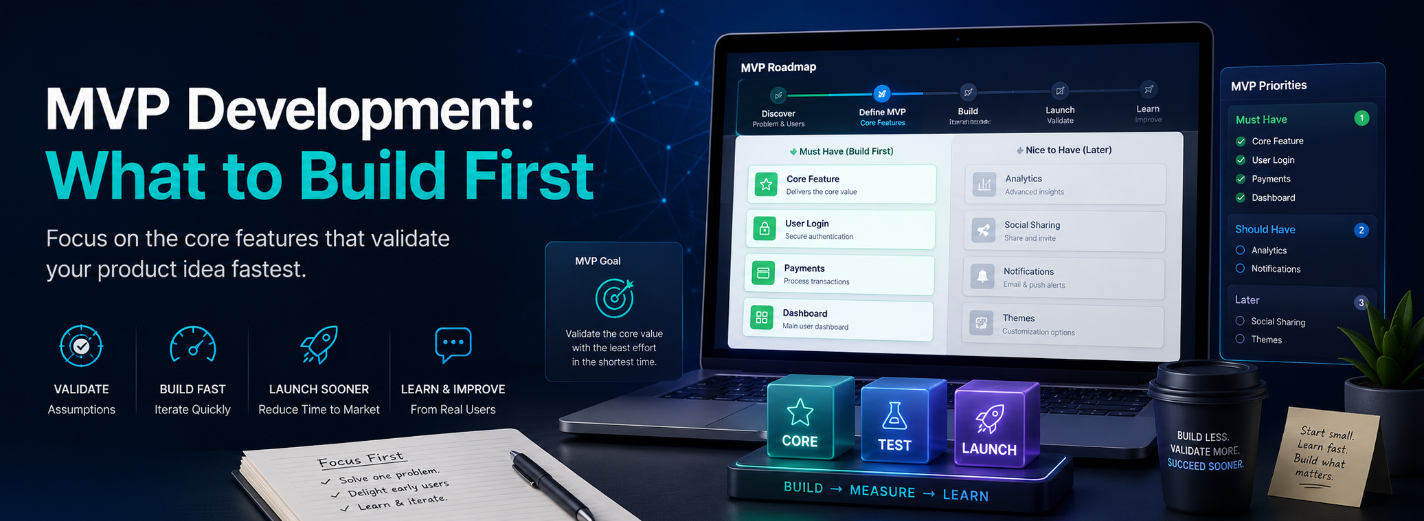
MVP Development: What to Build First and What to Learn
- mvp development
- mvp development company
- startup software development
- MVP planning
- startup product development
An MVP is a learning instrument delivered through a usable product. It is not the complete roadmap squeezed into a small budget, a disposable mock-up presented as software, or the first arbitrary set of features a team can finish. Its job is to reduce a consequential uncertainty: whether a specific person has an important problem, understands the proposed solution, reaches the promised outcome, and behaves in a way that supports a viable business.
That purpose changes what “minimum” means. A release with three disconnected screens may be small but incapable of teaching anything. A narrower product that carries one user from need to meaningful result can be viable even if some work happens manually behind the interface. Scope should be minimal relative to the decision, while the experience, data, and measurement must be credible enough that the evidence deserves trust.
Before writing a backlog, state the decision the MVP must support. Will you invest in a full product, change the audience, revise the value proposition, test pricing, seek regulatory advice, or stop? Then name the assumption that most threatens that decision. If you cannot connect a feature to the core journey, safe operation, or evidence collection, it probably does not belong in the first release.
Start with the Decision, Not the Feature List
Write the product problem in observable terms: who encounters it, in which situation, how often, what they do now, and what the current approach costs in money, time, risk, delay, or lost opportunity. “People need a better dashboard” is a solution claim. “Regional operations managers spend six hours every Monday reconciling three exports and still miss exceptions” is a problem that interviews and observation can test.
List the assumptions behind the business: the problem is frequent and costly; the target person can adopt the product; the workflow fits existing constraints; the outcome is valuable; a buyer can approve and pay; a channel can reach them; required data and providers are available; and the economics can work. Rank assumptions by consequence and uncertainty. The first experiment should address the one that can invalidate the plan most cheaply and early.
Software is not always the first experiment. Interviews, observation, a landing-page test, a prototype, a manual concierge service, or a paid pilot may answer desirability or pricing questions sooner. Build an MVP when functioning software is required to observe real behavior, integration feasibility, repeat use, operational cost, or willingness to entrust the workflow to the product. The fastest useful learning may prevent months of polished implementation.
Choose the First User Precisely
“Small businesses” or “everyone who manages projects” is not a first segment. Choose people who share a concrete context, urgent problem, current workaround, ability to adopt, and reachable feedback channel. A useful definition might include role, organization size, industry, geography, workflow maturity, triggering event, tools already used, and authority to decide. The strongest pain is more valuable than the largest theoretical market during early learning.
Distinguish the user, buyer, approver, administrator, beneficiary, and any operator who fulfils work behind the scenes. In B2B products these may be different people with different evidence of value. A user may save time while security, procurement, finance, and a department head determine whether adoption is possible. Include another role only when the core transaction cannot complete without it; otherwise interview or simulate that dependency until it becomes the next uncertainty.
Recruit the first cohort before the build is finished. Confirm access, motivation, device and environment, onboarding constraints, data availability, permission to observe, and the cadence for feedback. Friendly interest is not participation. A named group willing to try the workflow, provide relevant inputs, and discuss the result makes the release testable. Document who is excluded so feedback is not generalized beyond the people actually observed.
Build One Complete Path to Value
Map the shortest end-to-end journey from a real trigger to a result the target user values. It usually includes entry, understanding the promise, providing the minimum input, completing the central action, receiving a result, recovering from an expected mistake, and knowing what happens next. The release needs a coherent beginning and end; a catalogue of partially working capabilities cannot reveal whether the product changes behavior.
Define the “thin slice” through every necessary layer: interface, business rules, data, identity, integration, operations, support, and measurement. Thin does not mean fake. If a customer believes a result is immediate while staff manually fulfils it, make the service expectation honest and protect the data. Concierge work, manual review, no-code operations, or a single provider can be sensible ways to test value before automation, provided the process is safe, repeatable, and measured.
Design unhappy paths deliberately. What happens when input is incomplete, payment fails, an integration times out, an operator cannot fulfil the request, or a user needs help? You need not automate every exception, but the team must detect it, preserve state, communicate clearly, and recover. One vertical journey with responsible handling yields more evidence than a broad happy-path demo.
Prioritize by Learning Value and Necessity
For every candidate feature, write the assumption it tests, the step of the core journey it enables, the evidence it collects, and the consequence of omission. Keep it now when users cannot reach the promised outcome without it, the experiment would become misleading, safety or legal obligations require it, or the team cannot operate and observe the release. Everything else competes with the learning deadline.
Separate needs from preferred implementations. The MVP may need to confirm identity without building a custom identity platform; collect payment without supporting every plan and currency; notify a user without a full preference centre; administer exceptions without an elaborate back office. Use reliable services and deliberate manual work where they reduce time without hiding the tested value or creating unacceptable lock-in and risk.
Create explicit “now,” “later if evidence supports it,” and “not for this experiment” lists. Typical deferrals include extensive customization, secondary personas, rare integrations, advanced reporting, social features, elaborate role models, native applications for every platform, and automation of low-volume operations. Review scope whenever a new request appears: which decision changes if it ships? If nobody can answer, protect the experiment and defer it.
Reduce Scope Without Sacrificing Responsible Quality
Minimum scope does not justify careless handling of users, money, or data. The quality baseline depends on consequence: accurate core rules, appropriate authentication and authorization, privacy and consent, validation, accessible critical actions, protected secrets, backups where data matters, supported dependencies, a repeatable deployment, useful logs and metrics, an incident contact, and a recovery path. Regulated or safety-sensitive products require specialist review before exposing real people.
Avoid both extremes. Disposable code can make the second iteration slower than the first and corrupt the evidence through outages or inconsistent data. Premature platform engineering can consume the experiment with multi-region infrastructure, generalized frameworks, microservices, and automation for volume that does not exist. Choose the simplest architecture that preserves important domain boundaries, data ownership, change safety, and observability for the next likely decision.
Define non-functional acceptance for the actual cohort and journey: supported devices, expected concurrency, response targets, availability window, data retention, accessibility needs, recovery expectation, and known limitations. Test the critical behavior and failure modes. Record shortcuts with an owner and trigger for review. Responsible MVP development creates a safe base for learning without pretending the first architecture must support the final company.
Define the Evidence Before Development
Define success, failure, and ambiguity before seeing the results. Choose a small set of measures tied to the assumption: eligible users who begin and complete the core journey, time to first value, repeated use after the natural interval, successful paid commitment, task accuracy, manual effort per outcome, support demand, or a verified improvement over the current method. Downloads, registrations, page views, and compliments are weak when the decision concerns sustained value or payment.
Specify the event definitions, denominator, cohort, observation window, segment, data source, and threshold. Instrument the journey end to end, validate analytics, preserve privacy, and supplement behavior with interviews and observation. A funnel can show where people stop; it cannot by itself explain why. Operational data also matters: fulfilment time, exceptions, provider failures, cost per result, and the work hidden behind an apparently automated experience.
Treat thresholds as decision aids, not manufactured certainty. A small or biased cohort cannot support broad market claims, and novelty may inflate early engagement. Record recruitment method, missing data, confounders, and limitations. Decide in advance what evidence would justify continuing, revising the proposition, changing the segment, running another focused test, or stopping. This prevents the team from redefining success after every result.
Make the First Release Produce a Decision
The best MVP is not the one with the fewest screens or the most features delivered before a deadline. It is the smallest responsible system that exposes a risky assumption to reality and produces evidence strong enough for a specific decision. It carries a defined user through a complete value path, handles foreseeable failure honestly, protects what must be protected, and measures behavior and operating cost.
At the end of the observation window, review evidence by cohort and compare it with the pre-agreed thresholds. Separate product problems from acquisition, onboarding, reliability, or measurement problems. Read support conversations, failed journeys, manual work, and non-use alongside dashboards. Then write a decision record: what was learned, how confident the team is, what remains uncertain, which risk now leads, and what investment follows.
The next step may be to deepen the core journey, test retention, charge a realistic price, automate an expensive manual operation, address a reliability constraint, change the audience, or stop. It should not automatically be “add more features.” A disciplined MVP leaves the organization with better knowledge, usable product assets, and a clearer choice. That is the return on the first release—even when the original idea does not survive it.
From Risky Assumption to Evidence-Producing MVP
- /01Name the Decision and Leading RiskWrite the business decision, map its assumptions, and choose the uncertainty whose early answer would most change investment, audience, proposition, feasibility, or direction.
- /02Design One Complete Value JourneyChoose a precise first user and take that person from a real trigger to a meaningful outcome, including necessary operations, measurement, and honest recovery from expected failure.
- /03Set Evidence, Thresholds, and QualityDefine events, cohort, observation window, success, failure, ambiguity, and non-functional acceptance before development; protect users and data according to consequence.
- /04Release, Observe, and DecideRecruit the cohort, validate instrumentation, observe behavior and operations, review evidence against thresholds, record limitations, and choose the next risk instead of automatically adding features.
How small should an MVP be?
How small should an MVP be?
Define the First Release Around the Decision It Must Support
Share the target user, current problem, risky assumptions, required outcome, constraints, available cohort, and decision deadline. We will shape the smallest responsible journey, evidence model, quality baseline, and delivery boundary for the MVP.
Publications
Our research
Research and development of AI-powered solutions to optimize business workflows and enhance decision-making processes.
Analysis of machine learning models for predictive analytics in finance, e-commerce, and SaaS platforms.
Exploration of natural language processing and computer vision technologies to strengthen automation, personalization, and customer support.
Angular BFF Architecture: A Practical Decision Guide
Learn when an Angular backend-for-frontend improves security, contracts, rendering, and delivery—and when its extra hop and ownership cost are unjustified.

10 min read
09 Sep 2026
What Comes After MVP? From Validation to a Scalable Product
Turn MVP evidence into a focused plan for product value, architecture, reliability, team ownership, SaaS capabilities, unit economics and controlled growth.

10 min read
05 Aug 2026
Azure Migration Architecture: A Safe Path from Estate to Operations
Plan an Azure migration around business outcomes, workload evidence, landing-zone governance, identity, data integrity, recovery, controlled waves, and sustainable cloud operations.
10 min read
05 Aug 2026