/ 01
Governed, Usable Landing Zones
Define hierarchy, ownership, identity, networking, policy, logs, tags, budgets and automation before workloads multiply; give teams a fast paved path and reviewed exceptions.
Cloud architecture is the set of technical and operating decisions that lets a workload create value repeatedly. Moving the same servers to Azure changes a billing model; it does not automatically improve release speed, security, recovery, performance or cost. Those outcomes appear when resource organization, identity, networking, application boundaries, data, automation, observability and ownership are designed together around explicit business requirements.
Start with the workload: users and critical journeys, data classes and residency, expected and peak demand, integrations, availability and recovery objectives, compliance, release cadence, budget and the team that will operate it. Evaluate tradeoffs across reliability, security, cost optimization, operational excellence and performance efficiency rather than maximizing one pillar invisibly at the expense of another. Our Azure cloud engineering joins application development, platform controls, CI/CD and production operations in one reviewable delivery model.
An Azure landing zone establishes the environment in which workloads can be deployed safely. Define Microsoft Entra tenant and billing ownership, management-group and subscription hierarchy, resource organization, regional policy, network topology, DNS, identity and privileged access, policy enforcement, security monitoring, logs, backup, recovery, tagging, budgets and platform automation. Separate platform responsibilities from workload responsibilities: a central team supplies guardrails and shared capabilities while product teams own their service inside them.
Make the paved path faster than exceptions. Provision subscriptions and environments through versioned templates; apply sensible defaults; expose documented modules and self-service workflows; and record approved deviations with owner, reason and expiry. Policies should prevent or audit material risk without forcing every workload into the same topology. Keep development, test and production boundaries proportionate to data and operational risk. A landing zone succeeds when teams can deliver autonomously inside clear controls, not when governance produces an impressive diagram and a queue of manual tickets.
Choose services after mapping execution model, state, protocols, latency, throughput, scaling pattern, deployment unit, failure modes, network exposure, identity, data consistency, recovery and operator skill. App Service may fit a managed web application; Container Apps may fit independently scaled container revisions and background workers; Functions may fit event-driven work whose trigger, duration and state model suit the platform; AKS may fit an organization that already needs and operates Kubernetes. Managed databases, queues, caches and storage can reduce undifferentiated operations when their constraints match the workload.
Evaluate the complete path rather than each service in isolation. A stateless API may still depend on limited database connections, a regional provider, a slow queue consumer and DNS or identity services. Model quotas, cold start, timeout and retry alignment, message delivery semantics, private connectivity, zone and region availability, backup and restore, version support, data egress, observability and exit. Validate uncertain behavior with a production-shaped proof before committing an entire estate.
Prefer the least complex managed service that satisfies the workload and the team can operate. Every cluster, service mesh, custom controller, self-managed database or multi-region topology adds patching, security, deployment, observability, incident and staffing obligations. Complexity can be justified by isolation, portability, regulatory, performance or recovery needs, but should carry an owner and measurable benefit. A managed platform with clear application boundaries often offers a stronger business result than a sophisticated foundation the team cannot safely change.
Record each service decision with alternatives, assumptions, limits, cost drivers, failure behavior, acceptance evidence and a trigger for review. Run cost and capacity scenarios for normal demand, peak, growth and failure. Confirm availability in required regions and tiers and distinguish a feature on a product page from a configuration proven in the deployed environment. Architecture is a portfolio of reversible decisions, not a permanent endorsement of particular Azure products.
Azure application development may combine web and mobile APIs, workers, scheduled tasks, event processing, real-time channels, data pipelines and partner integrations. Use managed identities for runtime access where supported, keep secrets in protected stores, grant narrow data-plane roles, authenticate every boundary and propagate correlation without exposing sensitive data. Design commands and events for idempotency, bounded retry and reconciliation. Separate synchronous user response from long work when the product can represent pending state honestly.
Make application and infrastructure boundaries agree. If one domain requires independent scaling or recovery, its data ownership, deployment, telemetry and on-call responsibility must support that separation. Avoid distributing a monolith across a network while retaining a shared database and release train. Start with a modular deployment and extract components only when traffic, failure isolation, security, cadence or stable team ownership creates measurable value.
Modernization should reduce a current constraint and leave production safer after every stage. Inventory workloads, dependencies, data, interfaces, business criticality, support status, operational knowledge and retirement conditions. Establish a baseline for user outcomes, reliability, release flow, cost and risk. Then choose among rehost, replatform, targeted remediation, refactoring, replacement and retirement per component rather than applying one strategy to the estate.
Use compatibility layers, routing, events, data replication or a strangler approach to move one bounded capability at a time. Plan data ownership, dual-write risk, reconciliation, cutover, rollback and legacy decommissioning before migration begins. Run the old and new paths together only for a defined evidence window. A migration is complete when traffic, data, schedules, identities, monitoring, support and cost have moved and the obsolete system is safely removed—not when a new service first answers a request.
Azure architecture creates value when teams can release safely, observe the real workload, recover on demand, and understand the cost and risk of every important tradeoff.— GARNO.TECH Engineering Team
DevOps in digital transformation is a delivery and operating model, not the name of one Microsoft product. Application, platform, security, quality and operations teams share versioned work, automated evidence, feedback and recovery. Represent infrastructure, policy and configuration in reviewed code using Bicep, Terraform or another suitable declarative system. Rebuild environments from source rather than repairing drift by hand, and separate reusable platform modules from workload-specific composition.
Use distinct identities for people, pipelines and runtime. Prefer workload identity federation or managed identity over stored deployment credentials, scope RBAC to the required environment and action, require protected review for production and retain an auditable deployment history. Pin tools and dependencies, protect artifact provenance and promote the same immutable build through environments. Pipeline access is production access; design and monitor it accordingly.
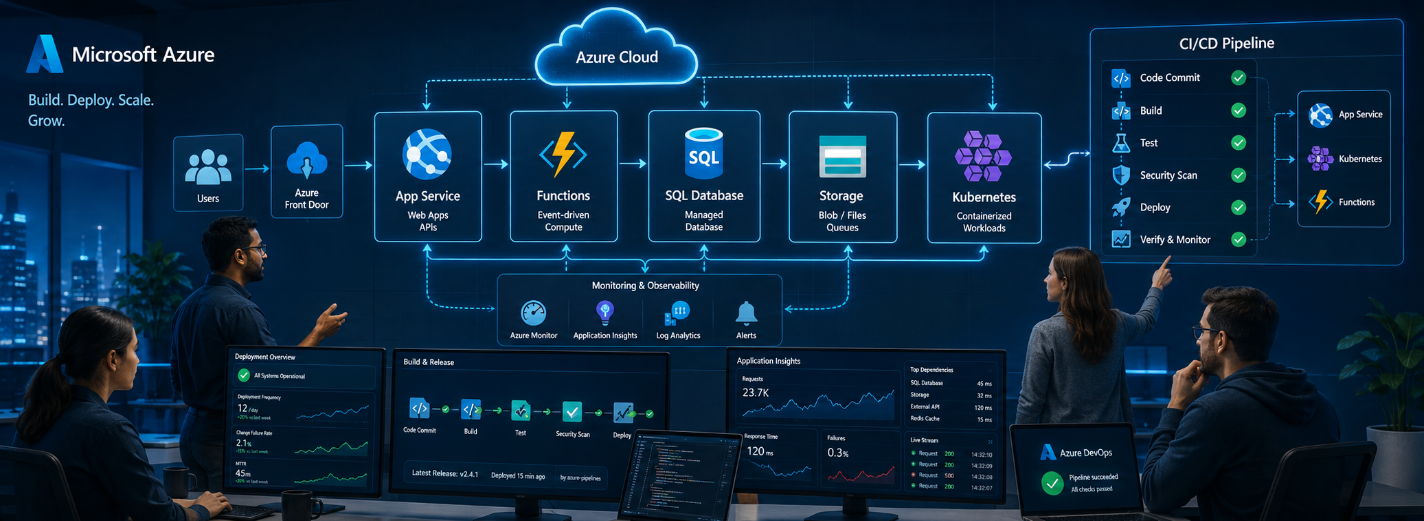
A release pipeline should prove the change before and after deployment. Run code, contract, infrastructure, policy, dependency and security checks appropriate to risk; validate database changes for the coexistence window; deploy to an ephemeral environment, slot, revision or small traffic segment; and exercise critical journeys through the public route. Define health, business and security thresholds, an observation window, an authorized decision owner and rollback or forward-recovery steps before shifting full traffic.
Instrument release version, environment and correlation across edge, application, messages, data and dependencies. Logs, metrics, traces, real-user signals, synthetic journeys and business events should reveal who is affected, when the change began, where time or errors accumulate and whether recovery is working. Connect alerts to service objectives, burn rate, owner and tested runbook. Automation that deploys quickly without diagnostic and recovery evidence only increases the speed of risk.
Threat-model the complete control and data plane: administrators, developers, pipeline, workload identities, public endpoints, internal services, data stores, backups, support tools and third parties. Apply least privilege, MFA and just-in-time privileged access; use private connectivity when the risk justifies it; encrypt in transit and at rest; manage keys and certificates; scan and patch dependencies; protect logs; and monitor policy or access changes. Security controls need owners, evidence and an incident path, not only enabled settings.
Derive availability, latency, data-loss and recovery objectives from business consequences. Design redundancy only to the required level, remove single points within that boundary and understand correlated regional, identity and dependency failures. Health probes should represent the ability to serve traffic, while deeper dependency checks support diagnosis. Test backup restoration, failover, queue recovery, key and certificate rotation, loss of a dependency and operator access under incident conditions. Unrehearsed redundancy is an assumption.
Cost is an architectural signal. Assign subscription, resource, product and environment ownership through hierarchy and tags; create budgets and anomaly alerts; and expose cost beside traffic, reliability and business demand. Model major drivers such as compute time, database tier and storage, provisioned throughput, logs, data retention, network egress, backup, WAF, private endpoints, idle nonproduction and disaster-recovery capacity. Unit measures—cost per active customer, transaction, job or gigabyte processed—show whether efficiency changes as the product grows.
Rightsize from evidence, schedule or remove idle resources, set log sampling and retention deliberately, use commitments only for stable demand, and review architectural waste as well as rate discounts. A cheaper configuration that increases incidents or engineering toil may raise total cost; expensive standby capacity may be justified by recovery objectives. Give product and engineering teams feedback and authority so FinOps becomes a continuous design practice rather than a finance report received after spending.
An Azure partner should be able to connect business outcomes with application code, platform engineering, identity, networking, data, security, reliability, delivery and cost. Ask for production evidence: architecture and decision records, infrastructure code, pull requests, threat models, test strategy, dashboards, incident reviews, migration and rollback plans, and proof of knowledge transfer. Evaluate who will actually work, how decisions are made, who owns risk and how the engagement can shrink or end.
Keep subscriptions, source, domains, identities, keys, telemetry and production approval under client control. Require internal co-owners, documented exceptions, executable runbooks, shared incident participation and handover rehearsals. Measure progress through user, flow, reliability, security, cost and capability outcomes instead of resource count or pipeline activity. The engagement should make the organization more capable of operating Azure, not more dependent on a supplier.
Effective Azure cloud development joins the landing zone, workload design, application architecture, secure identity, automated delivery, observability, recovery and cost ownership. Begin with the smallest decision that reduces meaningful risk: a platform baseline, production-shaped vertical slice, constrained migration, release-system improvement or recovery exercise. Record the evidence, adapt the roadmap and scale the operating model with actual demand. Azure becomes a durable product foundation when teams can change it quickly, explain its tradeoffs and restore it under pressure.
resource identity 'Microsoft.ManagedIdentity/userAssignedIdentities@2023-01-31' = {
  name: 'product-runtime'
  location: resourceGroup().location
}Share the workload, data, current platform, delivery flow, service objectives, incidents, constraints and cost drivers. We will define the smallest responsible architecture or modernization step.
Research and development of AI-powered solutions to optimize business workflows and enhance decision-making processes.
Analysis of machine learning models for predictive analytics in finance, e-commerce, and SaaS platforms.
Exploration of natural language processing and computer vision technologies to strengthen automation, personalization, and customer support.
Design credible MongoDB load tests with production-shaped traffic and data, end-to-end telemetry, query-plan evidence, saturation tests, recovery checks, and a defensible capacity envelope.

9 min read
Compare Flutter and React Native through rendering, native interoperability, UI semantics, performance evidence, team capability, dependencies, releases, accessibility, maintenance, and a production-shaped proof.

9 min read
Grow engineering capacity through clear product demand, stable team boundaries, deliberate leadership, paced hiring, supported onboarding, operational ownership, and evidence of independent contribution.

8 min read