/ 01
Versioned Desired State
Manage application, infrastructure, configuration, policy, migrations, pipeline definitions, and operating documentation through reviewed versions; preview changes and reconcile drift.
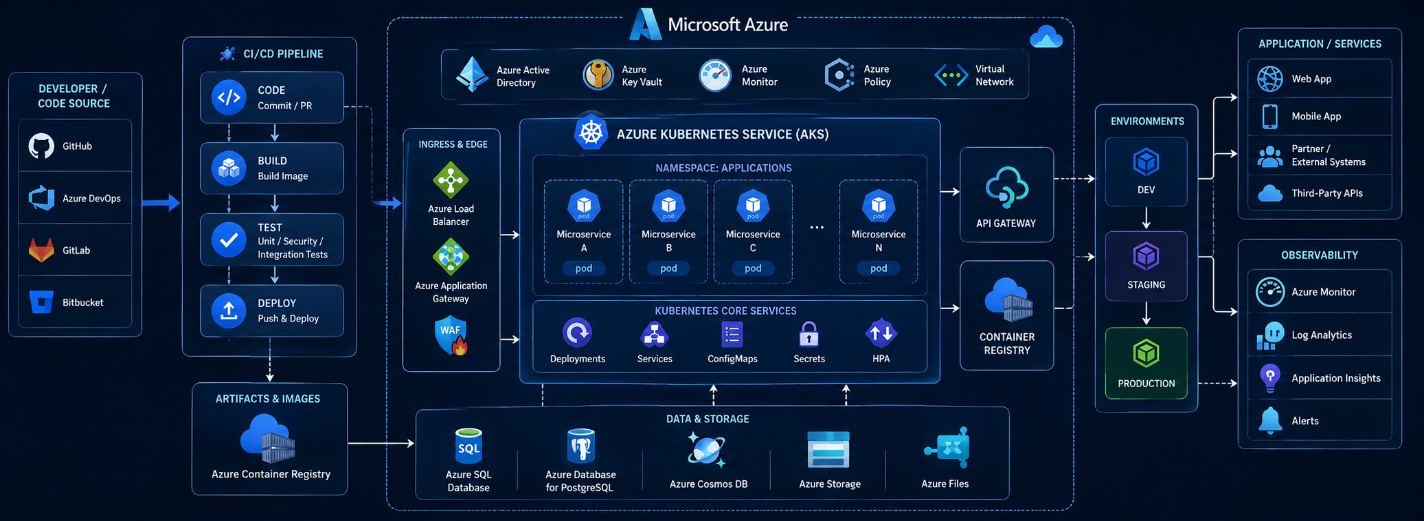
Azure provides compute, data, identity, networking, policy, and monitoring capabilities. DevOps determines how people turn those capabilities into repeatable product change. The combination succeeds when teams can move a requirement from source control to production, observe its effect, recover from failure, and improve the process without depending on undocumented manual knowledge.
DevOps is therefore an operating model, not a CI server or a department between development and operations. Product, engineering, platform, security, support, and finance share one delivery system and explicit responsibilities. Developers own production behavior; platform engineers provide paved paths and guardrails; security shapes controls and response; product owners define outcomes and risk; operations feeds incidents and capacity evidence back into design.
Begin with critical journeys and current constraints. Measure lead time, deployment frequency, change failure, recovery time, availability, latency, incident load, toil, cloud unit cost, and blocked work. Map how code, infrastructure, configuration, schemas, secrets, policies, and feature exposure change today. Improve the bottleneck that limits safe customer value rather than installing every fashionable tool.
Our Azure cloud engineering connects workload architecture, delivery automation, observability, reliability, security, cost, and operational ownership in one implementation boundary.
Infrastructure as code defines the desired state of Azure resources in version control so changes can be reviewed, tested, traced, and repeated. Include resource configuration, identities and role assignments, networks, diagnostic settings, policies, alerts, and budgets where the chosen tool can manage them safely. Keep application and infrastructure versions compatible and sequence changes that cross both.
Use declarative tools such as Bicep or a governed Terraform workflow according to organizational standards and workload needs. Build modules around stable lifecycle boundaries, not abstraction for its own sake. Platform foundations, shared connectivity, workload resources, data-plane configuration, and application releases may need different owners and change rates. Publish supported modules with versions, documentation, tests, and an upgrade path.
Separate environments and their identities, access, data, and blast radius while generating them from the same reviewed definitions. Parameter differences should be intentional and visible. Preview planned changes, detect destructive operations, protect state, and reconcile drift. An emergency portal fix may restore service, but it must be recorded and returned to the versioned desired state.
Test routine and non-routine operations: first deployment, update, scale, certificate or secret rotation, policy change, restore, regional recovery, and teardown. IaC proves repeatability only when the team can recreate or recover the environment. Instrumentation and diagnostic settings should follow the same versioned boundary described in Azure Observability with OpenTelemetry.
A delivery pipeline is a security and reliability boundary. It should produce one traceable, immutable application artifact from reviewed source, record its version and dependencies, and promote that same artifact through environments. Rebuilding for production can introduce an untested difference. Infrastructure templates, database migrations, configuration contracts, and release metadata belong to the same change story.
Choose checks from risk: compilation and linting, focused unit tests, integration and contract tests, migration rehearsal, infrastructure validation, secret detection, dependency and image scanning, policy checks, provenance, and representative performance or resilience tests. A gate needs an owner and a response; a warning everyone ignores only adds delay.
Separate deployment from exposure where useful. Deploy a small change to a staging environment or production ring, verify a workload health model, expose it gradually through revisions, slots, routing, or feature controls, and stop automatically when defined thresholds fail. Backward and forward compatibility matter while versions coexist. Database changes often require expand-migrate-contract rather than a simple binary rollback.
Define routine, emergency, rollback, roll-forward, and decommission paths before the incident. Limit who can alter pipelines or approve protected environments, keep audit evidence, and use workload identity federation or another short-lived mechanism instead of long-lived deployment secrets where supported. The fastest pipeline is not the one with the fewest gates; it is the one that returns trustworthy feedback soon enough to act.
A platform should make the safe path easier than the improvised path. Offer supported templates, modules, pipeline components, identity patterns, telemetry defaults, environment creation, policy feedback, and documentation as a product with users. Publish the boundary: what the platform team operates, what workload teams own, how exceptions are reviewed, and how a team exits a shared capability.
Self-service does not mean unrestricted provisioning. Provide guardrails for subscriptions and resource groups, regions, networking, identities, data classes, tags, budgets, diagnostics, backups, public exposure, and approved services. Give developers fast feedback in pull requests and pre-production rather than discovering policy failure after a release is waiting.
Scale workloads from measured demand. Autoscaling rules need signals, minimums, maximums, cooldowns, startup time, quotas, and cost bounds. Protect databases, brokers, storage, and external providers with connection and concurrency limits, queues, back-pressure, deadlines, safe retries, and graceful degradation. More replicas can amplify a dependency failure.
Scale the operating model too. Define service objectives, capacity review, patching, renewal, backup restore, incident rotation, access review, platform upgrade, module deprecation, and tenant onboarding. Automation is worthwhile when it reduces repeated risk or toil; automating a rare, well-controlled task may cost more than documenting it.
Observability begins with decisions the team must make. Define critical journeys and a health model that connects user outcomes to application, dependency, and infrastructure signals. A successful HTTP rate can hide queued work that never completes; a healthy CPU graph can coexist with failed payments. Measure business completion, latency distributions, errors, saturation, queue age, data freshness, and dependency behavior.
Use structured logs, metrics, and distributed traces with consistent service, environment, version, region, tenant-safe, correlation, and causation context. OpenTelemetry can provide portable application instrumentation while Azure Monitor and Application Insights collect and analyze supported signals. Control sensitive data, sampling, retention, and high-cardinality labels so observability remains useful and financially sustainable.
Alerts must identify a condition requiring action, reach an accountable owner, include context, and link to a tested runbook. Page on user-impacting symptoms and urgent causes; route lower-priority trends to planned work. Test alerts during failure exercises. A dashboard no one watches and an alert no one can act on are inventory, not operational capability.
Incident response needs roles, communication, severity, escalation, mitigation authority, customer updates, evidence preservation, and recovery verification. Connect deployments to telemetry so teams can see whether a release changed behavior. After recovery, use a blameless review to improve code, tests, platform controls, capacity, diagnostics, runbooks, or ownership. Faster recovery comes from practiced systems, not individual heroics.
Security must cover every way the platform changes: source, dependencies, artifacts, infrastructure, configuration, data migrations, policies, feature controls, and emergency operations. Threat-model critical journeys and the delivery system itself. A compromised pipeline identity can bypass controls that protect the running application.
Separate human, pipeline, and runtime identities. Use managed identities for Azure workloads and workload identity federation or another short-lived mechanism for CI/CD where supported. Grant narrow management-plane and data-plane permissions at the smallest practical scope, protect environment approvals, review access, and maintain an auditable emergency path. Avoid shared credentials and secrets copied across environments.
Move useful controls left without turning the pipeline into a pile of unactionable warnings. Review code and IaC, detect secrets, scan dependencies and images, validate policy and configuration, verify licenses where required, and retain artifact provenance. Set severity, ownership, remediation time, exception expiry, and release policy. Validate controls through attack-informed tests and incident exercises.
Runtime security remains essential: supported versions, patching, network exposure, encryption, input validation, authorization, secrets, backups, monitoring, response, and recovery. Azure Policy and pipeline gates can enforce known rules, but they cannot decide the product’s trust model or business authorization. Security teams should provide paved controls and fast consultation rather than a late approval queue.
Cloud cost becomes governable when every resource has an owner, purpose, environment, workload, and lifecycle. Establish subscription and resource-group boundaries, tagging or equivalent metadata, budgets, anomaly alerts, and access to cost data before spend grows. Make teams responsible for the cost of decisions they can influence, while platform and finance provide reliable allocation and guidance.
Connect cost to product units: active tenant, successful order, processed document, API customer, deployment, or test environment hour. A larger bill can be healthy when valuable demand grows; a lower bill can be harmful when it removes recovery capacity or useful telemetry. Review cost with service objectives, performance, security, and engineering toil.
Automate safe hygiene: expire preview environments, schedule eligible non-production resources, enforce retention, detect idle or unattached assets, right-size from telemetry, cap autoscaling, and expose forecast changes in architecture or pull-request review. Optimize application queries, storage lifecycle, data transfer, log volume, and dependency use before treating a cheaper SKU as the universal answer.
Commitment discounts and reservations belong to stable, understood demand. Reliability replicas, backups, security controls, build agents, observability, and recovery exercises are not waste merely because they do not serve normal user traffic. Evaluate their cost against the business consequence they mitigate. FinOps is a decision loop shared by product, engineering, platform, and finance.
Azure supplies cloud capabilities. DevOps turns them into a delivery and operating system whose changes, risks, outcomes, recovery, and costs a team can understand and improve.— GARNO.TECH
Azure and DevOps create leverage when the platform reduces the cost and risk of a meaningful product change. Infrastructure is reproducible, artifacts are traceable, releases are small and progressively exposed, identities are bounded, telemetry explains customer behavior, recovery is practiced, and spend has an owner. Those properties matter more than the number of services or pipeline stages.
Adopt the operating model incrementally. Put source, application and infrastructure changes under review; build one trustworthy artifact path; protect a critical journey with a health model; automate its release and recovery; then reuse the proven pattern. Add platform abstractions only when several teams have the same need and someone will support the contract.
Measure whether the system improves lead time, change failure, recovery, reliability, toil, security response, developer experience, and unit cost. Remove gates, dashboards, modules, and automation that create no useful decision. A modern platform is not finished at launch: it learns from deployments, incidents, users, and cost, and turns that evidence into the next safer change.
steps:
  - script: npm ci
  - script: npm test
- script: az deployment group create --template-file main.bicepResearch and development of AI-powered solutions to optimize business workflows and enhance decision-making processes.
Analysis of machine learning models for predictive analytics in finance, e-commerce, and SaaS platforms.
Exploration of natural language processing and computer vision technologies to strengthen automation, personalization, and customer support.
A decision-grade technical due diligence checklist covering scope, architecture, delivery, security, data, reliability, people, IP, cost, evidence confidence and deal implications.

9 min read
Estimate a NestJS project through delivery scope, uncertainty, integrations, quality, team composition, schedule, commercial model, and total ownership cost.
9 min read
Evaluate mobile app agencies through product discovery, named-team evidence, native and cross-platform judgment, delivery, security, pricing, account ownership, release operations, support, and exit.

9 min read