/ 01
Operational Team Capability
Count the people who can design, release, profile, debug, upgrade, and support the application across JavaScript or Dart and both native platforms—not only those who can build the first screen.
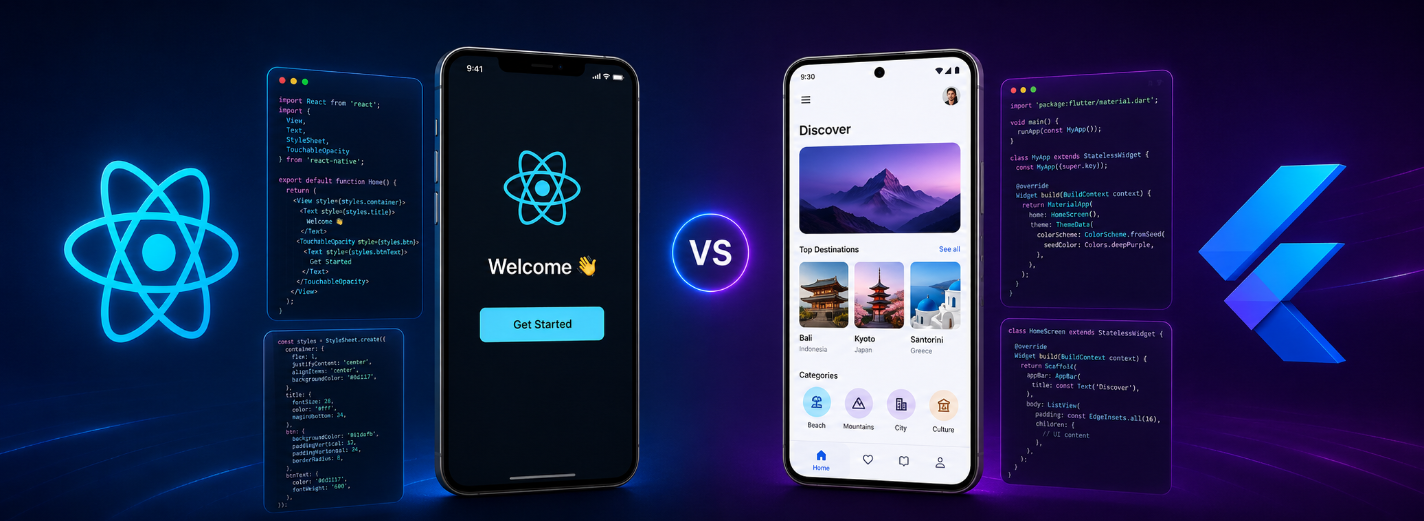
React Native and Flutter can both support serious mobile products. Neither one turns iOS and Android into the same platform, and neither one wins every comparison. The useful question is not “Which framework is best?” but “Which set of constraints will this product and team be able to own for the next several years?”
Begin with the journeys that create value, the devices and operating-system versions you will support, and the capabilities that touch the platform: camera, media, maps, Bluetooth, biometrics, notifications, payments, background work, deep links, widgets, files, accessibility services, and vendor SDKs. Add interface expectations, offline behavior, security boundaries, release frequency, regulatory needs, current code, and the people who will maintain it. These facts expose the expensive edges that generic benchmark tables hide.
A cross-platform framework shares product logic and much of the interface, but the product still has two runtime environments, two permission systems, two build chains, two stores, and two sets of device behavior. Budget for platform-specific code, testing, debugging, signing, store review, and operating-system change. The framework decision is valuable when it reduces duplicated work without erasing differences that matter to users.
React Native expresses product behavior in JavaScript or TypeScript and renders through a React-driven host view tree. Its current architecture uses the Fabric renderer, Turbo Native Modules, Codegen, and direct JavaScript Interface communication rather than the old serialized bridge model. That matters when reviewing advice written for earlier releases. React knowledge transfers well, but mobile lifecycle, layout, gestures, memory, and native tooling remain distinct skills.
Flutter uses Dart and owns a layered widget, layout, and rendering system. In a release build, Dart code is compiled for the target, while the Flutter engine draws the interface and the platform embedder connects it to the operating system. This gives the team a coherent UI model and extensive control over pixels. It also means that a Flutter screen is not merely a thin declaration of standard iOS or Android controls.
“One codebase” should mean one product architecture with intentional seams. Keep domain rules, networking, persistence, analytics, feature flags, and design tokens independent from view details and plugin payloads. Isolate platform implementations behind typed contracts. Decide where behavior must diverge—for example, back navigation, permissions, share sheets, input methods, or tablet layout—and test that divergence explicitly. Shared code percentage is a weak success metric if every release requires fragile conditionals or specialist rescue.
For most account, commerce, booking, content, field-service, and internal products, either framework can deliver responsive software. Architecture and implementation usually dominate the difference: unnecessary renders, oversized images, synchronous parsing, unbounded lists, chatty networking, poor caching, main-thread native work, and uncontrolled state can make either stack slow.
Define performance through user outcomes before comparing frameworks. Measure cold and warm startup, time to interactive, navigation latency, input response, frame build and render duration, dropped frames at the 90th and 99th percentiles, memory growth, battery use, network volume, and package size on the slowest supported devices. Profile production-like builds on physical hardware; debug mode and flagship simulators can produce convincing but irrelevant numbers.
The native boundary deserves a proof, not an assumption. React Native can expose platform APIs through typed TurboModules and native components. Flutter commonly uses maintained plugins or asynchronous platform channels and can add native code when needed. In either case, evaluate threading, data volume, cancellation, lifecycle, permission changes, error mapping, and cleanup. High-rate camera frames, audio, Bluetooth streams, background location, DRM, or a vendor SDK with its own UI may change the result.
Prototype the single riskiest flow end to end on both platforms. Use the real SDK, representative data, permission denial, background and resume, an interrupted network, and at least one low-tier device. Record implementation effort and operational behavior as well as frame timing. A framework-wide benchmark cannot predict whether your particular payment terminal reconnects correctly after Android kills the process.
React Native and Flutter differ most visibly in how they produce an interface. React Native maps its component model to host platform views and can follow platform conventions closely. Flutter composes and paints its own widget tree, making a consistent branded system and custom motion particularly direct. These are tendencies rather than automatic outcomes: either framework can create an alien interface, and either can implement careful adaptation.
Choose the experience before choosing its renderer. Decide which elements should remain consistent across platforms and which should respect local navigation, typography, controls, gestures, safe areas, keyboard behavior, pointer input, window sizes, and system settings. A phone portrait design copied onto tablets or foldables is not cross-platform design. Build responsive rules from content priority and usable space instead of a list of device names.
Accessibility must enter the prototype. Verify semantic roles and labels, reading and focus order, keyboard and switch access, text scaling, contrast, reduced motion, screen-reader gestures, error announcements, dynamic content, and touch targets. Test with VoiceOver and TalkBack on physical devices rather than inferring quality from widget names. Custom-painted controls and animations need explicit semantics; native-looking controls still need correct product text and focus behavior.
Evaluate the difficult states: loading, empty, partial data, expired session, permission denied, offline edits, long translations, right-to-left content, interrupted upload, and recovery after process death. A design system is valuable when it specifies behavior and accessibility for those states, not only colors and ideal screenshots.
The package count in a registry says little about product risk. For every critical dependency, inspect active maintenance, recent releases, issue response, ownership, license, security history, supported operating-system range, framework-architecture compatibility, test coverage, example quality, transitive native dependencies, and an exit option. Confirm the capability in a clean project and in a release build; a persuasive README is not acceptance evidence.
React Native benefits from JavaScript, TypeScript, React, and a large community, but a general JavaScript package may have no relevance to mobile. Native packages must keep pace with React Native architecture, Gradle, Android APIs, Xcode, Swift, CocoaPods or Swift Package Manager, and store requirements. Flutter offers a more unified SDK and mobile-focused package ecosystem, yet plugins still depend on native platform implementations and their maintainers.
Avoid allowing third-party schemas to become the domain model. Wrap analytics, push, storage, maps, identity, payments, and device capabilities behind small contracts. Preserve provider-specific data only where it is needed for evidence or recovery. This contains version changes and lets tests replace external behavior. It does not make vendors interchangeable, because commercial setup, platform configuration, data migration, and edge behavior still cost time.
Build-versus-package is a lifecycle decision. A maintained library is usually preferable for common infrastructure; a small owned adapter may be safer for a narrow capability than an abandoned dependency with broad permissions. Record why the dependency exists, who owns upgrades, how failure appears, which versions are supported, and how it can be removed.
Existing skill changes the economics, but job titles are not enough. A React web team understands components, TypeScript, and much of the tooling; it may still lack mobile navigation, gestures, lifecycle, store release, native profiling, and iOS or Android debugging. A team experienced in Dart and Flutter can move quickly inside its coherent toolchain; it still needs people able to diagnose native build and plugin failures.
Map capabilities by responsibility: product architecture, interface implementation, native iOS, native Android, automated testing, accessibility, security, CI/CD, store operations, telemetry, and incident response. Identify the named person who can inspect an Xcode crash, Gradle conflict, entitlement, signing failure, or native SDK upgrade. If that answer is “the library author,” the delivery model has an unowned dependency.
Estimate a representative release rather than only the first screens. Include environment setup, design system, platform integrations, automated tests, device matrix, observability, privacy declarations, store assets, staged rollout, support tooling, and the first framework and operating-system upgrade. Add recruiting, onboarding, pair work, code review, and knowledge transfer. A quick prototype can make a rare skill look cheap until the first production incident.
The strongest choice is often the framework the team can operate with disciplined boundaries, even if a benchmark favors the other by a small margin. Conversely, existing skills should not override a hard product constraint. If a critical SDK, embedded experience, accessibility behavior, or performance requirement fails the proof, familiarity is not a reason to accept it.
Cross-platform development concentrates code; it does not remove platform change. Apple and Google alter permissions, background execution, privacy declarations, target requirements, signing, store review, and device behavior. React Native, Flutter, Dart, JavaScript, build tools, native SDKs, and packages also evolve. Treat upgrades as routine product work with an owner, cadence, compatibility policy, and reserved capacity.
Keep releases repeatable. Pin tools and dependencies deliberately, generate signed artifacts in CI, isolate secrets, test migrations, automate smoke and journey tests on a useful device matrix, and promote the same traceable artifact through environments. Use staged store rollout, remote feature control, crash and application-not-responding monitoring, release health thresholds, and a documented response. Mobile rollback often means halting exposure or disabling a feature while store users remain on the bad binary.
Test beyond screens. Cover domain rules, state restoration, offline queues, concurrent updates, deep links, notification routes, permissions, local storage migration, background tasks, authentication recovery, accessibility, and platform contracts. Add a small number of physical-device end-to-end journeys for the highest-value paths. Track startup, frame timing, crash-free sessions, memory, network failure, battery-sensitive work, and product outcomes by app and OS version.
Plan ownership if the product is embedded in an existing native app. Both ecosystems support incremental integration, but navigation, engine or runtime lifecycle, state exchange, binary size, build ownership, and debugging become architectural concerns. Rehearse removal or replacement of a module while the team still understands the boundary.
Choose React Native when React and TypeScript capability is real, the product should align closely with host platform views, the required libraries support the current architecture, and the team can own native edges. Choose Flutter when a coherent Dart toolchain, controlled cross-platform rendering, highly branded interfaces, or broader targets fit the product—and the team can own plugin and embedder edges. These are useful starting hypotheses, not verdicts.
Turn the shortlist into a scored decision record. Weight must-have native capabilities, interface and accessibility, measured performance, offline and security needs, package health, current system integration, developer capacity, recruitment, testability, release operations, upgrade path, and expected lifetime. Separate a disqualifying constraint from a preference. Record evidence, uncertainty, and the person responsible for closing each gap.
Then run a time-boxed proof with the same acceptance criteria for both credible options: one representative journey, the riskiest native integration, one demanding interface, offline or restore behavior, automated testing, a release build, telemetry, and CI output on iOS and Android. Include an operating-system permission change, dependency upgrade, and injected failure. Compare working evidence and maintainability, not demo polish.
The final decision should explain what the product gains, which platform-specific work remains, what was measured, which risks are accepted, who owns them, and which event would trigger a review. That record is more valuable than declaring a universal winner. It lets future engineers understand why the choice was rational when it was made—and change it when the facts change.
Research and development of AI-powered solutions to optimize business workflows and enhance decision-making processes.
Analysis of machine learning models for predictive analytics in finance, e-commerce, and SaaS platforms.
Exploration of natural language processing and computer vision technologies to strengthen automation, personalization, and customer support.
Turn MVP evidence into a focused plan for product value, architecture, reliability, team ownership, SaaS capabilities, unit economics and controlled growth.

10 min read
A practical guide to defining an external CTO mandate for a FinTech product across regulation, architecture, delivery, security, provider risk, incidents, and leadership transfer.

12 min read
Design tenant context, data isolation, authorization, jobs, billing, configuration, migrations, observability, recovery, and scaling in a NestJS SaaS platform.

9 min read