
Main
React Development: Design the Product System, Not Just Components
React Development: Design the Product System, Not Just Components
- React
- ReactJS
- Frontend Development
- JavaScript
- TypeScript
- SPA
- Web Development
- UI Development
React is a library for describing user interfaces as components that derive output from props, state, and context. That focused model is powerful because it separates interface composition from the browser operations needed to commit a change. It is also why “we use React” says little about the production system. Routing, data loading, rendering location, caching, authentication, authorization, forms, errors, styling, testing, deployment, observability, and upgrades still require deliberate architecture.
For a new React product, start with user and operating constraints: public discoverability, time to useful content, interaction density, personalization, offline needs, data sensitivity, supported browsers and devices, accessibility target, localization, traffic shape, release frequency, existing backend, team skills, hosting, and recovery expectations. Then choose a framework and rendering model that serve those constraints. Current React guidance recommends a framework for most new applications because frameworks integrate recurring concerns such as routing, data fetching, code splitting, and server or static rendering. Building from scratch remains valid when requirements genuinely do not fit, but the team then owns an application framework whether it uses that name or not.
The business outcome is a dependable journey, not a large component catalogue. Define measurable budgets for initial HTML or content, largest visual element, interaction latency, JavaScript and asset weight, error rate, accessibility, task completion, and recovery from failed dependencies. Identify which content can be static, what must be computed per request, what requires browser interactivity, and what can load after the critical path. Test those choices with representative data, accounts, devices, networks, and production builds.
React succeeds when boundaries stay legible: components express UI responsibility; business rules live in testable modules; server code protects credentials and data authority; client code handles interaction; state has an owner and lifetime; external synchronization is explicit; and platform concerns remain observable. A fast prototype can ignore these boundaries. A durable product makes them part of review, testing, and ownership from the first vertical slice.
Choose the React Architecture Before Building the Component Tree
Components and rendering. Components should be pure for the same props, state, and context: rendering calculates what the interface should be, while React later commits the necessary host changes. A render does not imply that every DOM node changes. Keep render logic free of network calls, subscriptions, mutable global state, and other side effects. Use stable identity and keys that reflect domain identity; poorly chosen keys can silently reset local state or associate it with the wrong item.
State and data. Keep state as local as its consumers allow, lift it only to the nearest meaningful owner, and avoid storing values that can be derived during render. Distinguish server data, durable client state, navigation state, form state, ephemeral interaction, and URL state. They have different sources of truth, freshness, sharing, persistence, and error behavior. A global store is useful when many distant consumers truly coordinate around client-owned state; it is not a default destination for every API response. Define cache keys, invalidation, optimistic updates, retries, cancellation, concurrency, authorization changes, and offline conflict behavior as part of the data contract.
Hooks and effects. Custom Hooks can package reusable stateful behavior without hiding ownership. An Effect exists to synchronize a component with an external system such as a browser API, network connection, timer, or third-party widget. If no external system is involved, an Effect often adds an unnecessary second data flow. Every setup needs symmetric cleanup, and development Strict Mode can expose missing cleanup by exercising an additional setup-cleanup cycle. Treat dependency warnings as design feedback rather than disabling them; unstable objects and functions, stale closures, and chained state-setting effects are frequent sources of defects.
Framework and rendering boundary. Choose client-side rendering, static generation, server rendering, streaming, or a route-level combination based on each journey. Server-rendered HTML can improve the path to content but creates hydration, cache, infrastructure, and failure considerations. React Server Components can execute before bundling and keep eligible code and data access off the client; Client Components provide state and browser interaction. The boundary affects serialization, security, bundle size, data waterfalls, caching, deployment, and debugging. Use a supported framework implementation rather than assembling unstable integration APIs casually, and pin versions where the framework requires it.
Design system and composition. Build accessible primitives and product patterns around semantic HTML, tokens, keyboard behavior, focus, validation, loading, empty and error states, rather than around screenshots. Prefer composition over a component with dozens of mode flags. Define variant APIs and escape hatches, document intended use, and test the system in real product flows. A shared library creates value only when ownership, versioning, migration, support, and contribution rules keep it trustworthy.
Quality and security. Validate behavior at the cheapest meaningful layer: pure domain tests, component interactions, contract tests at service boundaries, and a focused set of end-to-end critical journeys. Test what the user can perceive, including keyboard and assistive-technology paths, rather than implementation details. Treat browser input as untrusted, keep secrets and authority on the server, encode output through safe React paths, review deliberate HTML injection, enforce authorization at data boundaries, protect sessions and state-changing requests, constrain third-party scripts, and patch React, frameworks, build tools, and dependencies promptly.
Turn React into a Maintainable Product Capability
React’s commercial advantage is a mature model for composing complex interfaces, a broad talent and tooling ecosystem, and the ability to adopt incrementally. A team can add an isolated React surface to an existing page, build a client application, or use a framework for routes that mix static, server, and interactive work. The same flexibility can produce fragmentation when every team chooses its own router, data layer, form library, styling method, test setup, and deployment model. Platform standards should narrow routine decisions while preserving escape paths for real product constraints.
Organize frontend ownership around user journeys and stable boundaries. Feature modules should combine the UI, domain rules, data access, analytics, authorization assumptions, tests, and operational signals needed to change a capability safely. Shared code should represent a proven cross-product concept, not merely similar files. Avoid a “components” folder that becomes an unowned dependency graph. Record architecture decisions, dependency policy, browser support, rendering rules, state categories, error semantics, accessibility acceptance, telemetry conventions, and ownership.
Performance work starts with a budget and field evidence. Measure server response, content milestones, interaction responsiveness, layout stability, route transitions, long tasks, memory, JavaScript execution, requests, cache behavior, and completion of the critical task by device and network segment. Reduce client work through appropriate rendering, route and component boundaries, deferred noncritical code, efficient data access, stable images and fonts, and removal of unnecessary dependencies. Memoization is not a substitute for measurement; React Compiler may reduce some manual memoization needs, but application architecture, data waterfalls, DOM size, expensive computation, and third-party scripts remain product concerns.
Treat every ecosystem choice as a lifecycle commitment. Record why a framework, router, state tool, editor, charting library, analytics SDK, or styling system exists; who owns upgrades; what data and browser authority it receives; and how it can be replaced. Lockfiles make an installation repeatable but do not create an update policy. Monitor security notices and deprecations, test supported upgrade paths regularly, and avoid letting a major framework jump accumulate behind years of product changes.
Adopt new React capabilities through evidence. Compiler optimization, Server Components, Actions, streaming, or framework-specific caching can improve a suitable workload, but each changes build, runtime, debugging, hosting, or data behavior. Start with a bounded route, retain production measurements and rollback, and train the team on the new failure modes before declaring a default. Stability comes from controlled learning, not from freezing the stack or chasing every release.
Accessibility must be part of component contracts and release acceptance. Use native semantics before recreating controls, preserve focus and reading order, support keyboard use, labels, errors, status announcements, zoom, contrast, reduced motion, high contrast modes, localization expansion, and right-to-left layout where required. Automated checks catch only part of the problem; combine them with keyboard, screen-reader, and representative user-flow review. A design system can make the correct path easier, but teams still need to test assembled pages.
Make delivery observable. Link an error, slow interaction, or failed request to release, route, component boundary, browser, device, account segment, backend dependency, and trace where privacy permits. Use error boundaries for recoverable UI partitions, but design the fallback, retry, reporting, and user continuity. Release through automated builds, production-mode checks, preview or test environments, staged exposure and feature controls where risk warrants them. Track deployment frequency, lead time, change failure, recovery time, escaped accessibility defects, performance regressions, bundle growth, dependency age, and product outcomes—not story points or component count.
A responsible React engagement begins with one critical journey and the system around it. Map users, tasks, routes, rendering and data paths, authorization, state ownership, dependencies, design primitives, browsers, devices, performance and accessibility evidence, build and release flow, incidents, support load, and current team constraints. Establish a baseline before proposing a rewrite. Many products need a repaired boundary, dependency reduction, targeted rendering change, design-system improvement, or safer delivery path rather than wholesale replacement.
For a new product, prove a production-shaped vertical slice: one real route from authentication and data access through loading, success, empty, error, permission denial, slow network, observability, accessibility, tests, build, deployment, and rollback. Exercise server and client boundaries with representative content and accounts. Set budgets and acceptance before optimization. The slice should answer architecture questions and leave reusable delivery foundations, not become a polished demo isolated from the future system.
For modernization, inventory versions, deprecated APIs, framework and bundler assumptions, custom build patches, state and Effect hotspots, test confidence, browser constraints, third-party widgets, security advisories, design-system divergence, and ownership. Upgrade in observable increments with compatibility tests and a rollback path. Do not combine a framework migration, visual redesign, data rewrite, and service change unless the business accepts the enlarged failure surface. Strangler routes, parallel component replacement, contract seams, and temporary adapters can preserve delivery while risk declines.
GARNO.TECH develops and modernizes React customer portals, SaaS products, operational dashboards, commerce journeys, and enterprise frontend systems. Work can include product and architecture discovery, framework and rendering selection, Server and Client Component boundaries, TypeScript and data contracts, design systems, accessibility, performance budgets, state and Effect remediation, testing, security review, CI/CD, observability, staged migration, documentation, and knowledge transfer. The useful result is a product capability the client can measure and evolve: clear boundaries, reliable journeys, controlled dependencies, production evidence, and a team that can release and recover without undocumented expertise.
Publications
Our research
Research and development of AI-powered solutions to optimize business workflows and enhance decision-making processes.
Analysis of machine learning models for predictive analytics in finance, e-commerce, and SaaS platforms.
Exploration of natural language processing and computer vision technologies to strengthen automation, personalization, and customer support.
React Native Development Services for Production Mobile Products
Design, build, modernize, and operate React Native products with shared domain code, deliberate platform behavior, native integrations, performance evidence, secure delivery, and sustainable ownership.

8 min read
25 Jul 2026
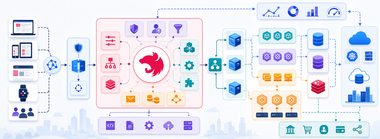
NestJS Architecture for Scalable Backends: Boundaries Before Throughput
A practical architecture guide for NestJS backends: business modules, application services, domain rules, data ownership, reliable integrations, scaling decisions, and modular-monolith evolution.
8 min read
07 Sep 2026
Angular for Long-Lived Web Products: Architecture, Performance, and Fit
Understand where Angular creates value, how its components, signals, dependency injection, routing, forms and rendering modes fit together, and what disciplined teams must add for a maintainable product.

8 min read
25 Jul 2026