
Main
Angular for Long-Lived Web Products: Architecture, Performance, and Fit
Angular for Long-Lived Web Products: Architecture, Performance, and Fit
- Angular
- TypeScript
- Frontend Development
- SPA
- Enterprise Development
- Web Development
- SSR
How Angular’s Capabilities Form a Product Architecture
Angular is a TypeScript web framework for products whose frontend has become a system: many routes, roles, workflows, forms, data sources, teams and years of expected change. Its value is not a single rendering feature. Angular supplies a coherent set of components, reactivity, dependency injection, routing, forms, HTTP integration, build tooling, testing seams and server rendering so teams can make recurring decisions inside one supported model.
That coherence is useful only when the product needs it. A small campaign page, content site or isolated widget may be cheaper with a simpler stack. Angular becomes compelling when inconsistency itself is expensive: permission behavior differs across screens, teams invent incompatible state patterns, upgrades stall, performance regressions hide in large bundles or every release requires broad manual coordination. The decision should follow product shape, operating horizon and team capability, not the framework’s feature count.
Treat the framework as a platform for explicit boundaries. Define business capabilities, routes, data ownership, identity, design-system contracts, rendering modes, performance budgets, quality evidence and upgrade policy before debating folder names. Angular can enforce and automate many of those choices; it cannot decide which boundaries matter or create ownership where the organization has none.
Evaluate the choice with a written scorecard. Include interaction complexity, public discoverability, offline needs, expected lifetime, team size, hiring and training, existing TypeScript skills, accessibility duties, browser support, integration surface, release frequency, hosting model and upgrade capacity. Build a thin production-shaped slice through routing, identity, data, a representative form, observability and deployment. Compare delivery speed, bundle and interaction performance, code clarity, testability and operating effort against at least one credible alternative. A framework decision becomes durable when its assumptions are visible and testable.
Components express the interface boundary. Modern Angular applications can use standalone components, directives and pipes with dependencies declared close to their use. Build components around a product responsibility rather than a collection of HTML fragments. Keep inputs, outputs and public behavior narrow; move business transitions into domain or application services; and let shared presentational components encode accessible interaction and design tokens. This makes a screen understandable without turning every component into an independent miniature architecture.
Signals express synchronous reactive state. Writable and computed signals make dependencies visible to Angular and support fine-grained rendering updates. They work well for local state, derived view models and state owned by a feature. RxJS remains valuable for asynchronous streams, cancellation, time, concurrency and multi-source event composition. Convert deliberately at boundaries instead of wrapping every value in both models. Effects should synchronize with external systems or non-reactive APIs, not serve as a hidden substitute for derived state.
Dependency injection and routing express composition. Providers define lifetimes and replaceable infrastructure; route configuration defines navigation, lazy boundaries, data resolution and access checks. Scope services according to actual ownership—application, route, feature or component—rather than defaulting everything to a global singleton. Route guards improve navigation flow but do not replace server authorization. Lazy loading can reduce initial JavaScript, yet it works best when route boundaries also reflect cohesive product capabilities.
Forms and data access express contracts. Use typed reactive forms where validation, conditional fields and multi-step workflows need explicit control. Separate user input, transport DTOs and domain models; a generated or typed HTTP client does not validate runtime data. Centralize authentication, correlation, error mapping and retry policy at the transport boundary, while keeping feature-specific decisions in the feature. Test cancellation, stale responses, optimistic changes, duplicate submission, partial failure and recovery rather than only the successful request.
Rendering is a route-level product decision. Client rendering offers the simplest browser-only model. Prerendering can serve stable public routes as static HTML. Server rendering can improve first delivery and discoverability for dynamic public pages, while hydration reuses server-rendered DOM on the client; incremental hydration can defer selected interactive areas. These modes add server cost, cache and serialization concerns, browser/server compatibility and hydration constraints. Choose per route from user experience, SEO, freshness, personalization and operating evidence—not from the assumption that one mode is universally modern.
Where Angular Creates Business Value—and Where It Does Not
Angular is strongest in applications with substantial interaction and a long operating horizon: internal operations, financial workflows, healthcare administration, commerce management, SaaS control planes, CRM and ERP surfaces, regulated portals and multi-role dashboards. A common architecture and toolchain reduce the number of private conventions teams must negotiate. Typed templates, structured injection, supported migrations and clear component boundaries make broad change easier to review when the codebase and organization grow together.
The commercial benefit comes from change safety, not from framework adoption alone. A well-shaped Angular product can introduce a new role, workflow, locale, channel or brand without rewriting unrelated screens. Shared components improve accessibility and visual consistency; feature boundaries allow teams to work independently; contracts and tests shorten regression feedback; release telemetry shows whether change helped users. These capabilities reduce coordination and defect cost only when teams own them as product infrastructure.
Angular also provides meaningful security foundations: template binding escapes untrusted values in normal contexts, compilation constrains template code and the ecosystem supports browser protections such as Content Security Policy and Trusted Types. Those foundations do not authorize data, secure an API or make arbitrary HTML safe. Keep Angular current, avoid constructing templates from untrusted input, minimize direct DOM access, review third-party packages and enforce identity and permissions on the server. Security remains an end-to-end property.
The tradeoffs are real. Angular’s breadth requires learning and governance; careless dependency injection can hide coupling; RxJS can become opaque; universal state stores can centralize unrelated behavior; and server rendering can add complexity before it adds value. A large framework does not rescue unclear domains or fragmented ownership. For a short-lived microsite, a mostly static publication or a team unable to maintain TypeScript and regular upgrades, another approach may have lower lifetime cost. Record the alternatives and the conditions that would change the decision.
A design system is one of the clearest places to convert framework consistency into business value. Treat tokens, interaction patterns, content rules and accessible components as versioned product assets. Publish supported APIs, examples, ownership and migration guidance; test keyboard behavior, themes, localization and visual regressions at the component boundary. Measure adoption, duplicate implementations and upgrade effort. A component library without governance merely moves inconsistency into a central package and can slow every team at once.
Team topology matters as much as code structure. Give product teams end-to-end ownership of cohesive capabilities while a small platform group maintains build, observability, design-system and architecture guardrails. Define which choices are mandatory, which are defaults and where experimentation is welcome. Fast onboarding, independent deployment and predictable upgrades are better evidence of scalability than repository size. When every decision requires a frontend committee, the architecture has centralized coordination even if the code is divided into features.
Begin implementation with a capability map. Group routes, components, state, API clients and tests around business areas such as onboarding, billing or fulfillment. Set dependency direction: shared primitives know nothing about features; features depend on stable platform contracts; cross-feature workflows coordinate through explicit application interfaces. Avoid a “shared” directory that becomes an unowned dependency warehouse. Use architecture checks and code ownership to keep intended boundaries true as people and features change.
Choose state by lifetime and authority. Keep transient interaction state near the component, feature state inside its boundary and durable truth on the server. Derive view state rather than storing duplicate flags. Use signals for synchronous ownership and computed values; use RxJS where cancellation, streaming or time is central; introduce a store only when its event model, tooling or cross-feature coordination solves a demonstrated problem. Define cache freshness, invalidation, optimistic updates and reconciliation instead of allowing every screen to invent them.
Engineer performance from user journeys. Establish budgets for initial and route JavaScript, images, fonts, interaction latency and Core Web Vitals. Lazy-load coherent routes, defer noncritical work, keep list rendering stable, virtualize only measured large collections and inspect change-detection cost with profiling. Modern zoneless operation and fine-grained signal updates can reduce unnecessary work, but application architecture still matters. For SSR or hybrid routes, keep server and client output consistent, avoid uncontrolled DOM mutation and measure hydration, backend latency and cache behavior together.
Build quality into public contracts. Unit-test decision-heavy functions and state transitions; render components to verify DOM, keyboard and accessible behavior; verify HTTP and schema boundaries; and keep a small set of decisive end-to-end journeys. Make test data, identity, time and external dependencies deterministic. Add observability for route load, API failure, frontend errors, long tasks and release versions. Accessibility needs semantic components, focus management, announcements, zoom, contrast and real assistive-technology review—not an automated score alone.
Plan upgrades as routine product work. Follow supported Angular releases, use official migration tooling, remove deprecated APIs early and keep libraries compatible before a forced leap compounds risk. Review bundle and runtime evidence after migrations rather than assuming equivalence. Document architectural decisions, supported browsers, rendering modes, ownership and recovery. A healthy Angular codebase is not one frozen in a perfect structure; it is one the team can change, test, deploy and repair predictably.
Treat delivery as part of the frontend architecture. Build once and promote the same version through environments, inject environment-specific configuration safely, protect source maps and secrets, and record the application, API, schema and feature-flag versions seen by a user. Use staged rollout, synthetic journeys and real-user monitoring to compare a release before widening exposure. Define rollback for static assets, server-rendered routes and incompatible backend changes. An Angular application is production-ready when the team can connect a user-visible regression to a release and restore service without rebuilding under pressure.
Looking for an Angular engineering partner? Explore our Angular Development Services. Bring the product journeys, users and roles, current architecture, API contracts, performance and accessibility evidence, release process, incident history, supported browsers and team constraints. We can assess whether Angular is the right fit, define the smallest useful boundary and turn the highest-risk assumptions into a measured pilot or migration plan.
A credible engagement should leave more than feature code. Expect a capability map, architecture decisions, performance and quality baselines, a prioritized roadmap, explicit acceptance criteria, source and infrastructure under your control, and paired knowledge transfer. Measure success through user outcomes, change lead time, reliability, bundle and interaction budgets, defect escape, accessibility and independent team ownership. The strongest Angular platform is the one your organization can continue evolving after the original project ends.
Publications
Our research
Research and development of AI-powered solutions to optimize business workflows and enhance decision-making processes.
Analysis of machine learning models for predictive analytics in finance, e-commerce, and SaaS platforms.
Exploration of natural language processing and computer vision technologies to strengthen automation, personalization, and customer support.
How to Upgrade Angular Without Stopping Product Development
A practical version-by-version Angular migration plan using dependency evidence, parallel delivery rules, focused compatibility work, regression gates, staged releases, rollback, and debt closure.

10 min read
08 Sep 2026
Angular Performance Optimization for Data-Heavy Applications
Optimize data-heavy Angular applications through representative profiling, bounded DOM and computation, deliberate state updates, virtualization, chart control, route budgets, leak prevention, and field evidence.

9 min read
08 Sep 2026
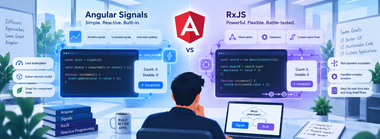
Angular Signals vs RxJS: How to Choose the Right State Model
Choose Angular Signals, RxJS, or a deliberate combination by separating current state from events over time, defining ownership, and testing cancellation, lifecycle, and failure semantics.
9 min read
08 Sep 2026