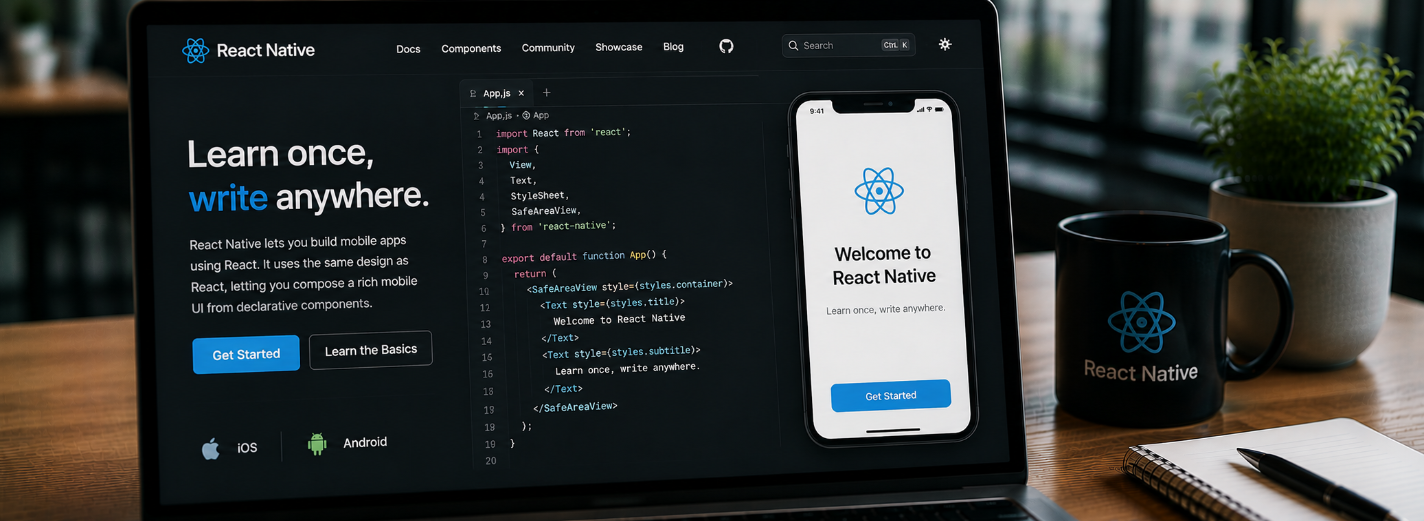
Main
React Native Development Services for Production Mobile Products
React Native Development Services for Production Mobile Products
- React Native
- React
- Mobile Development
- iOS Development
- Android Development
- Cross-Platform Development
- JavaScript
- TypeScript
React Native enables teams to build iOS and Android applications with React and TypeScript while rendering through native platform components. Its business value comes from sharing product behavior, data access, state, validation, design-system logic, analytics, and much of the interface—not from pretending that iOS and Android are identical. A responsible implementation preserves the interactions, permissions, lifecycle, accessibility, release rules, and customer expectations of each platform.
We use React Native for customer applications, internal operations, marketplaces, FinTech, commerce, field tools, connected products, and companion experiences where shared capability is valuable and native integration remains important. An engagement may cover product discovery, a new application, an incremental migration, feature delivery, performance recovery, dependency modernization, native modules, release engineering, or added capacity inside an existing team. The scope begins with a measurable product outcome and an ownership boundary.
Before selecting the framework, define the critical journeys, target devices and operating-system range, offline needs, data sensitivity, accessibility, performance budgets, native capabilities, background work, notifications, deep links, integrations, app-store obligations, release cadence, analytics, support, and internal skills. Prototype the riskiest element on real devices. Camera or media pipelines, maps, Bluetooth, complex gesture and animation work, background processing, cryptography, large offline datasets, and specialized SDKs deserve evidence before an architecture commitment.
Code sharing is an outcome to optimize, not a quota. Share stable domain and product behavior when it reduces duplication; keep platform-specific code where conventions, APIs, performance, security, or maintainability require it. A smaller explicit iOS or Android adapter is healthier than a dense web of conditionals that obscures behavior. The target is one coherent product operated by one capable team, with deliberate differences where users and platforms need them.
What a Production React Native Product Requires
Architecture follows product boundaries. Organize code around capabilities rather than screens or framework folders. Keep domain rules and use cases separate from navigation, storage, network clients, analytics, notifications, and native adapters. Use typed contracts at boundaries and define authoritative data, caching, pagination, cancellation, retries, idempotency, conflict handling, and error semantics. State management should make product transitions explainable; it should not become a second ungoverned database.
Offline behavior needs a consistency model. “Works offline” can mean read-only cache, saved drafts, queued commands, background synchronization, or full local-first collaboration. Define what remains available, what may be edited, how identity and encryption work, when data expires, how conflicts are detected and resolved, what the user sees during synchronization, and how failed or duplicated commands are repaired. Test time changes, interrupted networks, process termination, storage pressure, and upgrades with pending work.
Native integrations are first-class code. Review each library for maintainer health, supported React Native architecture, iOS and Android coverage, permissions, privacy behavior, release history, issue response, build impact, and exit path. Where a suitable library does not exist, define a typed native-module or component contract and own its Swift, Objective-C, Kotlin, Java, or C++ implementation. Keep platform projects reviewable; generated configuration does not remove responsibility for signing, entitlements, manifests, dependency managers, and build settings.
Performance must be measured in release conditions. Establish budgets for launch, interaction, navigation, lists, memory, binary size, energy, data use, and critical journey latency. Profile real devices, production-shaped content, slow networks, long sessions, and older supported hardware. Observe the JavaScript thread, native UI thread, rendering, image work, serialization, network waterfalls, storage, and backend latency before optimizing. Development-mode timing is not production evidence.
Security and privacy span the complete path. Model actors, assets, trust boundaries, and abuse cases. Enforce authorization on the server, minimize sensitive data on the device, use platform-protected storage where appropriate, secure transport, redact telemetry, validate deep links and untrusted content, govern third-party SDKs, protect builds and signing credentials, and define session revocation, device loss, compromise response, retention, deletion, and support access. Device controls supplement backend integrity; they do not replace it.
Accessibility and platform quality are acceptance criteria. Build semantic names, roles, values, focus, reading order, scalable text, contrast, reduced motion, input alternatives, error recovery, and meaningful announcements into the design system. Test screen readers, keyboard or switch paths where relevant, dynamic type, locale expansion, right-to-left layouts if required, permissions, interruptions, orientation, and system appearance. Shared components help only when their behavior is verified separately on iOS and Android.
Testing follows risk. Use fast tests for business rules and state transitions, component tests for user-observable behavior, contract tests for APIs and native boundaries, and a focused set of end-to-end journeys on real platform builds. Include installation, upgrade, migration, authentication recovery, notification routing, offline queues, app backgrounding, provider failure, and corrupted or partial state. Automated JavaScript tests cannot by themselves prove the native module, operating-system integration, packaging, signing, or store artifact.
Release engineering is part of the product. Maintain reproducible local and continuous-integration builds, controlled environments and configuration, protected signing credentials, version and build-number rules, dependency locks, provenance, staged distribution, store metadata, privacy declarations, review ownership, and a tested rollback or forward-repair path. Separate deployment from exposure with server-compatible changes and controlled feature release where useful. Test upgrades from supported production versions; a clean installation cannot expose migration failures experienced by existing customers.
Observability begins with customer journeys. Correlate app version, platform, device class, network state, release, navigation, API request, native-module work, and business completion without collecting unnecessary personal data. Track crash-free critical journeys, handled errors, startup and interaction distributions, API and synchronization failures, queue age, notification delivery, update adoption, and support signals. Define severity, ownership, alert thresholds, playbooks, and the evidence that service has recovered. A crash-free-session percentage alone can hide a broken payment or login flow.
Backend contracts shape the mobile cost. Mobile clients remain in the field after a server release and users may skip updates, so APIs and configuration need explicit compatibility windows, additive evolution, schema validation, pagination limits, stable error semantics, clock and locale rules, and deprecation telemetry. Coordinate authentication, token refresh, idempotency, request deadlines, cancellation, rate limits, uploads, and retry behavior across client and server. Design a safe minimum-supported-version policy and degraded state before an emergency forces an untested mandatory update.
Dependency upgrades need a standing budget. React Native, React, Xcode, Android tooling, operating systems, stores, libraries, SDKs, and backend contracts continue moving after launch. Maintain an inventory with owners, supported ranges, security and compatibility status, replacement options, and planned review dates. Upgrade in small observable increments, validate both native projects and critical journeys, and remove abandoned packages before they block a platform release. Postponed maintenance accumulates correlated risk: the eventual change combines framework migration, native build repair, library replacement, and product regression in one event.
When React Native Creates Business Value
React Native fits when iOS and Android products share substantial behavior, the team benefits from TypeScript and React, and the required native capabilities can be supported without turning every release into two unrelated projects. It can shorten the feedback loop, concentrate product knowledge, reduce duplicated domain work, and let platform specialists focus on the differences that matter. These benefits are strongest when product, design, mobile, backend, quality, and operations share one delivery model.
It is less attractive when the core value depends on platform-specific rendering or media pipelines, extreme graphics or latency constraints, deep use of new operating-system APIs before ecosystem support exists, separate platform roadmaps, or teams that already possess mature independent native capability. A small proof should compare user experience, performance, integration effort, upgrade risk, testing, release, and team ownership. Framework preference is weak evidence.
Choose Expo tooling or a direct native setup from actual constraints. Managed tooling can simplify common development, builds, credentials, updates, and service integrations, while development builds and native projects support custom native changes. Evaluate required modules, compliance, network and build controls, delivery model, vendor dependency, internal skill, debugging, and exit. The decision should leave a reproducible build and an understood native surface.
Measure value over the product lifecycle. Compare time to validated customer outcomes, shared versus platform-specific change cost, defect escape, release lead time, store rejection, crash-free journeys, performance objectives, accessibility, upgrade effort, incident recovery, and team sustainability. A high code-sharing percentage is not success if the shared abstraction makes both platforms slower to change.
Plan the team around ownership rather than a single “React Native developer” label. Product and design must understand both platform conventions; mobile engineers need JavaScript and native debugging literacy; backend engineers own stable client contracts; quality engineering covers devices, operating systems, networks, upgrades, and stores; security and operations own controls and response. Ensure at least one person can diagnose each native project and build chain. Shared code reduces duplicate implementation, but it does not remove platform review, device testing, release management, or on-call responsibility.
Compare total ownership with realistic alternatives. Include discovery, design, shared and platform-specific development, native SDK work, backend change, devices, CI and build services, store operations, dependency upgrades, accessibility, performance, support, and the cost of recruiting and retaining the required skills. Compare a coherent release and two years of change, not only the first set of screens. React Native creates economic value when it reduces repeated product work while keeping native differences explicit and affordable.
GARNO.TECH delivers React Native products through a sequence of evidence. We clarify the outcome, users, constraints, current estate, native requirements, service objectives, data and integration boundaries, security duties, release path, and ownership. We then prove the riskiest slice, establish architecture and design-system foundations, and deliver vertical journeys that include backend behavior, telemetry, tests, deployment, and operator readiness.
For existing applications, we begin with a current-state assessment: React Native and React versions, architecture mode, native projects, dependencies, build services, release history, crashes, performance, security, accessibility, test coverage, app-store health, and team pain. Modernization proceeds in bounded stages with compatibility evidence, production telemetry, rollback or forward-repair paths, and controlled dependency change. A rewrite is justified only when incremental change cannot responsibly meet a named requirement.
Delivery is complete when the owning team can build, sign, release, observe, support, recover, update, and extend the product. We leave versioned code and configuration, architecture decisions, automated pipelines, useful tests, telemetry, runbooks, dependency ownership, store access, current documentation, and knowledge transfer. The result should be a mobile product the business can continue to operate—not a shared codebase that only its original authors understand. Success is visible when a new engineer can reproduce the build, trace a customer problem across mobile and backend boundaries, make a platform-safe change, pass the release evidence, and restore service without private instructions from the original team.
Publications
Our research
Research and development of AI-powered solutions to optimize business workflows and enhance decision-making processes.
Analysis of machine learning models for predictive analytics in finance, e-commerce, and SaaS platforms.
Exploration of natural language processing and computer vision technologies to strengthen automation, personalization, and customer support.
Stripe Payment Integration: Architecture, Reliability, and Launch
A practical engineering guide to Stripe Checkout, Elements, PaymentIntents, webhooks, subscriptions, Connect, security, testing, reconciliation, and payment operations.

10 min read
25 Jul 2026
Node.js Development Services: Architecture, Performance, and Delivery
A practical guide to choosing and building Node.js backends: workload fit, event-loop safety, streams, workers, API architecture, data integrity, queues, security, observability, and delivery evidence.

8 min read
25 Jul 2026
Docker in Production: Build One Artifact, Prove Every Boundary
A practical guide to Docker images, containers, Compose, BuildKit, registries, reproducible CI/CD, least privilege, supply-chain evidence, observability, rollout, and sustainable operations.
9 min read
25 Jul 2026