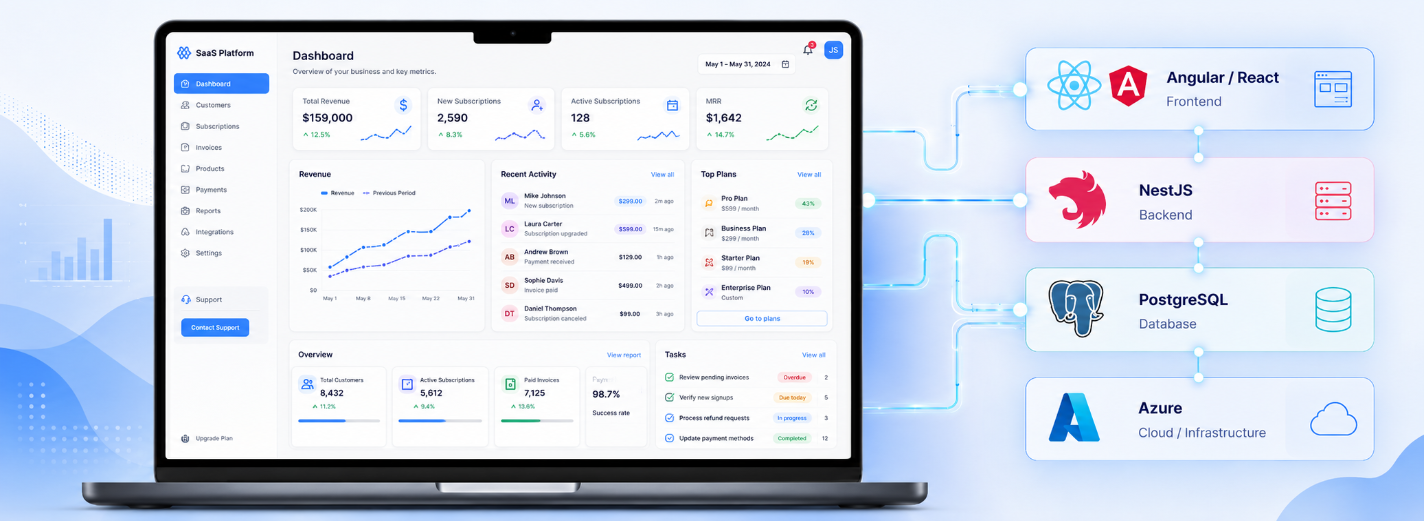
Designing REST, GraphQL and Distributed APIs with NestJS
- NestJS
- API development
- REST API
- GraphQL
- microservices
- backend development
Designing REST, GraphQL and Distributed APIs with NestJS
NestJS is often introduced as an “enterprise Node.js framework,” but the label explains little. Its practical value is a shared grammar for backend code: modules define visibility, controllers adapt incoming requests, providers hold application capabilities, guards and pipes enforce cross-cutting policy, and dependency injection makes composition explicit. This can help a growing team locate responsibility and change behavior without rediscovering the structure on every feature.
The framework does not supply the business architecture. A large NestJS application can still become a tightly coupled collection of global modules, generic services, leaking repositories, and decorators that hide control flow. The decision therefore depends less on a feature checklist than on the system’s expected lifetime, domain complexity, team size, integration surface, operational obligations, and willingness to enforce boundaries.
Design REST Around Business Operations
Nest can expose the same application capabilities through REST, GraphQL, WebSockets, queues, scheduled jobs, command-line tools, and microservice transports. This breadth is useful when adapters remain adapters. An order-placement use case should enforce the same pricing, inventory, authorization, and idempotency rules whether invoked from HTTP, a message, or an administrator tool.
Choose a transport for its semantics. REST is clear for resource-oriented public APIs; GraphQL can serve client-driven graphs but needs authorization, batching, and complexity controls; WebSockets support low-latency updates but introduce connection state and backpressure; queues decouple time and absorb bursts but require durable outcomes, duplicate handling, and backlog operations. Nest’s common pipes, guards, interceptors, and exception concepts reduce learning cost, yet they do not erase these differences.
Avoid a universal abstraction that hides delivery guarantees or forces every protocol into request-response. Define contracts at the application boundary and implement transport-specific concerns outside it. Version public APIs and messages deliberately. Add correlation and causation IDs to asynchronous paths. Test the real adapter and failure behavior, not merely the provider with every dependency mocked.
- Enforceable module APIs: Providers are private unless exported. Use this to expose application capabilities while keeping persistence and implementation details inside their domain.
- Explicit composition: Dependency injection and tokens show how capabilities are assembled and let infrastructure adapters change without moving business rules.
- Layered evidence: Plain domain tests, focused testing modules, real adapter integration tests, and a small end-to-end suite provide fast feedback without hiding boundary risk.
- Multiple delivery adapters: HTTP, GraphQL, WebSockets, queues, schedules, and microservice transports can call shared application rules while retaining protocol-specific behavior.
Use GraphQL for a Measured Client-Composition Need
TypeScript makes relationships visible to tools and reviewers. Typed commands, results, ports, configuration, and generated API clients reduce ambiguity and make large refactoring safer. Strict compiler settings, exhaustive unions, branded identifiers, and deliberate null handling catch many integration mistakes before runtime. They also turn the editor into a guide through a change.
Types disappear at the network and persistence boundary. A DTO annotation does not validate JSON by itself, and a database row, environment variable, message, token claim, or third-party response remains untrusted. Apply runtime validation at every external boundary, reject unknown or malformed input, normalize once, and pass trusted domain values inward. Keep transport DTOs distinct from persistence entities and domain models so one contract cannot silently rewrite the others.
Dependency injection has a similar boundary: TypeScript interfaces are erased at runtime. Use explicit tokens for ports and keep provider registration near the composition root. Avoid type assertions that merely silence uncertainty, broad any, and generated types treated as business truth. Type safety is strongest when runtime validation, database constraints, authorization, and tests defend the same invariant.
A modular monolith is often the most responsible starting architecture: one deployment, one observable runtime, simple local calls, and a database transaction where consistency requires it. The modules still establish ownership and public contracts. This gives the team architectural discipline without paying immediately for distributed tracing, message compatibility, network failure, eventual consistency, fleet deployment, and cross-service incident response.
Distribution should answer measured needs. Extract a service when a capability needs independent release cadence or scaling, a distinct security boundary, separate availability, specialized technology, or genuinely autonomous ownership. High traffic alone does not require microservices; a well-designed monolith can scale horizontally. A team chart alone does not require them either; ownership can begin with modules.
Design an extraction seam before an extraction project. Remove cross-module table access, make the contract explicit, publish events through an outbox, define idempotency, and measure the call pattern. Then compare the future operational cost with the actual constraint. If a module cannot be separated inside one process, moving it across a network usually turns hidden coupling into slower and less reliable coupling.
Distribute Services Only When the Boundary Earns It
NestJS runs wherever its Node.js runtime and dependencies run. On Azure, AWS, Google Cloud, Kubernetes, containers, or a simpler platform, design the application around portable operational contracts: validated configuration, stateless request handling where practical, external durable state, health and readiness signals, graceful shutdown, structured logs, traces, metrics, and repeatable deployment artifacts.
Cloud services are architectural choices, not annotations. For every managed database, queue, cache, identity provider, secret store, or object store, define timeouts, retries, idempotency, connection limits, data residency, recovery targets, cost boundaries, and the behavior when the service is slow or unavailable. Hide vendor SDKs behind narrow adapters where substitution or domain isolation matters, but preserve provider-specific semantics rather than pretending all services are interchangeable.
Scale from evidence. Measure event-loop delay, memory, garbage collection, request latency, throughput, connection-pool saturation, queue age, and downstream limits. Use the appropriate HTTP adapter only after profiling the representative workload. Keep build and runtime images small, run migrations as a controlled release step, deploy progressively, and prove rollback and restoration. Cloud elasticity cannot repair an unbounded query, blocking CPU work, or a dependency already at its quota.
Nest supplies extension points for authentication, authorization, validation, rate limiting, security headers, CORS, CSRF protection, serialization, and exception handling. A secure system still needs a threat model and consistent policy. Authenticate centrally, authorize at the business action and resource level, validate and normalize untrusted input, minimize returned data, protect secrets, and deny by default. Test that each transport applies the intended policy; an HTTP guard does not automatically secure a queue consumer.
Use the dependency graph to make testing precise. Unit-test domain rules as plain TypeScript. Instantiate focused testing modules for application services and replace ports deliberately. Run integration tests against real database constraints, transactions, message serialization, caches, and third-party adapters. Keep a small end-to-end suite for critical journeys, authentication, global pipes, filters, and production bootstrap configuration.
Do not mock away the largest risks. A repository double cannot prove a unique constraint, rollback, isolation level, or migration. A fake broker cannot prove delivery semantics. A controller test cannot prove proxy, timeout, body-size, or graceful-shutdown behavior. The test portfolio should follow consequences and boundaries, while dependency injection makes substitution controlled rather than universal.
NestJS repays its ceremony when the team uses modules and dependency injection to make responsibility visible, contracts narrow, and change safer over years of product growth.— GARNO.TECH
Treat Security, Performance and Reliability as Contract Work
Predictability reduces coordination cost. A developer joining an established NestJS codebase can expect modules, injectable providers, decorators, lifecycle hooks, and conventional testing utilities. Consistency makes reviews and ownership easier when it reflects stable rules. It becomes harmful when teams mistake folders and decorators for architecture.
Organize feature modules around business capabilities—orders, billing, identity, inventory—not technical layers shared across the entire system. Nest modules encapsulate providers by default; their exports form a public API. Use that property deliberately. Export application commands or domain-facing ports, keep persistence adapters private, and reject imports that reach through another module to its tables or internal services.
Controllers should translate transport input into application requests and map results back to the protocol. They should not contain transactions, pricing logic, or orchestration across half the system. Application services coordinate use cases; domain objects protect invariants; adapters talk to databases and external systems. Dependency injection connects these pieces through explicit tokens. Document dependency direction and test it with architecture rules, because Nest can resolve a dependency even when the design should forbid it.
NestJS may be too much structure for a short-lived script, a tiny proxy, a narrow serverless handler, or an experiment whose primary question is still product demand. Modules, decorators, reflection, dependency injection, and bootstrap conventions have learning and debugging cost. A smaller framework or plain library composition can be clearer when the application has few endpoints, little shared policy, and one or two maintainers.
It can also be the wrong fit for CPU-intensive computation that belongs in specialized workers, for teams committed to a different runtime ecosystem, or when cold-start and bundle constraints dominate. A framework migration rarely fixes unclear ownership, unstable requirements, poor data design, or missing operations. Measure those problems before prescribing Nest.
Run a thin technical spike around the hardest representative journey: authentication, transaction, external integration, background effect, deployment, and telemetry. Compare NestJS with at least one credible alternative using delivery time, clarity, performance, library maturity, hiring and team experience, security patching, testability, observability, and long-term change cost. Include the cost of leaving the chosen framework, not only entering it.
Choose the Smallest Architecture the Team Can Operate
The strongest reason to choose NestJS is organizational: the application will live long enough, grow complex enough, and involve enough people that consistent composition and enforceable boundaries repay their cost. The weakest reason is fashion or the assumption that decorators automatically make software enterprise-ready.
Begin with the business map. Identify capabilities, invariants, owners, transactions, integrations, security boundaries, latency and recovery targets, and expected change. Create modules around those capabilities, expose narrow contracts, keep the domain independent of delivery mechanisms, and start with the simplest deployment that meets the evidence. Add distributed components only when a measured constraint justifies their permanent operating cost.
Review the architecture by following one important request from authentication through validation, business decision, persistence, external effects, telemetry, and recovery. If each step has an owner, a testable contract, observable evidence, and a safe failure path, NestJS is supporting the system. If the journey disappears inside global providers and circular imports, more framework features will not rescue it.
GARNO.TECH can assess an existing Node.js backend or design a new NestJS system from the first domain map through production rollout. NestJS development services can cover modular architecture, API and event contracts, data access, integrations, security, testing, performance, cloud delivery, observability, migration, and team enablement. Bring one critical business journey, the systems it touches, current failure evidence, and the change you expect over the next two years; that is enough to begin an architecture grounded in reality.
When implementation needs additional capacity, evaluate a NestJS partner through one consequential boundary: a contract, authorization rule, integration, migration, performance constraint or recovery path. Require production-shaped evidence, explicit ownership and knowledge transfer. Our NestJS development services can cover a focused assessment, a vertical product slice, modernization or complete backend delivery.
A Four-Step NestJS API Design
- /01Define the ContractModel resources, operations, permissions, validation, errors, pagination and idempotency before choosing REST or GraphQL syntax.
- /02Choose Transport by NeedUse REST for durable resource workflows, GraphQL for controlled client composition and events for asynchronous state changes.
- /03Protect CompatibilityVersion deliberately, publish schemas, run consumer or contract tests and make deprecation measurable before removing behavior.
- /04Observe and RecoverTrace work across boundaries, standardize correlation and errors, and test timeouts, duplicates, retries, partial failure and repair.




Should one NestJS application expose both REST and GraphQL?
Should one NestJS application expose both REST and GraphQL?
Design a NestJS API Around Real Boundaries
Share the domains, consumers, workflows, data, integrations, service objectives and operating constraints. We will define the smallest responsible contract and architecture.
Publications
Our research
Research and development of AI-powered solutions to optimize business workflows and enhance decision-making processes.
Analysis of machine learning models for predictive analytics in finance, e-commerce, and SaaS platforms.
Exploration of natural language processing and computer vision technologies to strengthen automation, personalization, and customer support.
Enterprise Angular Forms: Design the Workflow, Not Just the Controls
A production guide to Angular forms for long, permission-sensitive workflows: typed models, layered validation, dynamic sections, draft protocols, authorization, server errors, conflicts, accessibility, and testing.

11 min read
08 Sep 2026
How to Plan Azure Cloud Development for a Business Application
A practical guide to planning Azure applications from workload evidence: architecture, migration, identity, delivery automation, reliability, operations and cost.

8 min read
04 Aug 2026
Azure Cloud Migration Assessment: What to Check Before Moving
Turn an Azure migration assessment into an evidence-based decision about workload boundaries, dependencies, target architecture, security, recovery, cost, and migration waves.

10 min read
08 Sep 2026