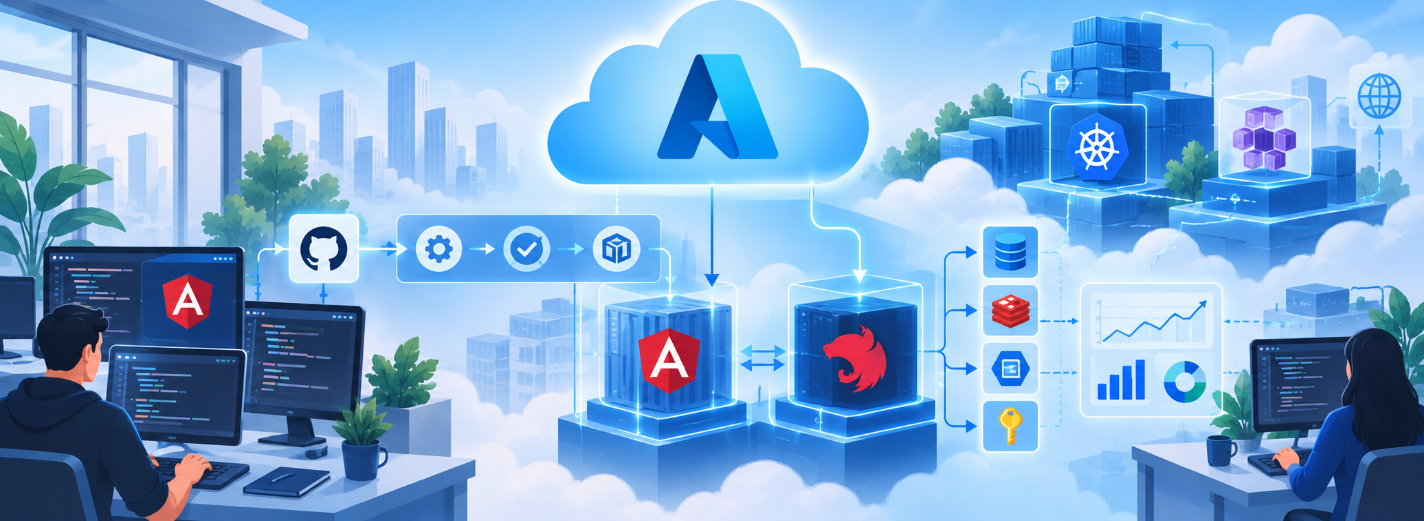
Building Angular and NestJS Applications on Azure: A Production Architecture
- Angular
- NestJS
- Microsoft Azure
- Azure architecture
- Angular SSR
- Container Apps
- App Service
- CI/CD
Building Angular and NestJS Applications on Azure: A Production Architecture
An Angular frontend and a NestJS backend may share TypeScript, but they do not share a runtime, trust boundary, or scaling profile. A production system normally includes browser code, static assets, optional server rendering, an HTTP API, background consumers, a database, object storage, messaging, identity, edge routing, delivery pipelines, and telemetry. Treating that system as “one web app” hides the decisions that later dominate reliability and cost.
Begin with journeys and data flows. Trace sign-in, first page load, authenticated navigation, search, file upload, a write transaction, asynchronous processing, notification, and administrative support. For each path, record latency and availability objectives, consistency needs, sensitive data, expected traffic, dependency behavior, and recovery target. The result tells you where rendering runs, which components need public ingress, what may scale independently, and where failure must be contained.
Draw deployable and ownership boundaries before naming Azure products. The Angular build, Angular SSR runtime, NestJS API, and workers should usually be independently versioned even if one team owns them. Durable state belongs outside their filesystems. Define environments, regions, tenants, release cadence, and the team responsible for every platform surface. Our Angular development, NestJS engineering, and Azure delivery work uses this shared model so application and operations decisions reinforce one another.
Choose Rendering Per Route, Then Place the Angular Runtime
Choose client-side rendering, prerendering, server-side rendering, or a hybrid by route rather than by framework fashion. An authenticated workspace with little search value often needs only CSR. Stable public pages can be prerendered during the build. Dynamic public product or editorial pages may earn SSR when fresh HTML, social previews, or first-content performance justify a server runtime. A mixed product can use all three.
A CSR or prerendered build produces immutable files. Host them on Azure Static Web Apps or Blob Storage behind an appropriate CDN or Azure Front Door. Give fingerprinted JavaScript, CSS, fonts, and images long cache lifetimes; keep the HTML shell and routing fallbacks compatible with deployment. Decide how runtime configuration reaches the browser, remembering that every value delivered to JavaScript is public. Define API origins, CORS, content security policy, source-map access, and authentication redirect URLs per environment.
SSR adds a Node.js service with availability, scaling, security, and cost consequences. Place it on App Service or Container Apps, give it explicit health probes and timeouts, and keep it independently scalable from the NestJS API. Make components safe for server execution, delay browser-only libraries, and prevent third-party DOM mutation from breaking hydration. Control transferred HTTP data and caches by route, user, locale, and tenant; a shared cache key can turn a performance optimization into a data leak.
Measure the whole path with real devices and production-shaped data. SSR can improve initial content while increasing time to first byte or delaying interactivity if rendering and hydration are heavy. Track Core Web Vitals, server render latency, hydration errors, bundle weight, cache hit ratio, origin load, and fallback behavior. Adopt incremental hydration or deferred views only where field evidence shows a benefit.
Separate the API, Workers, and Public Edge
Keep the synchronous request path short. The public edge may use Azure Front Door for global routing, acceleration, TLS policy, origin health, and WAF controls. Do not add API Management automatically: it earns its place when consumer onboarding, subscription products, quotas, transformations, policy enforcement, version governance, or a developer portal solve a real problem. Every proxy adds configuration, latency, cost, and another failure surface.
Host a conventional NestJS API on App Service when a managed web runtime, predictable HTTP scaling, and deployment slots fit. Use Container Apps when container revisions, independent workers, jobs, event-driven KEDA scaling, or related services provide value. Select AKS only for verified Kubernetes APIs, operators, specialized scheduling, or cluster-level controls. Package portability helps, but ingress, health, identity, scaling, rollout, and recovery semantics remain platform-specific.
Move long-running and durable work out of HTTP. The API should validate and authorize a command, commit its authoritative state, and enqueue work through a transactional outbox or another design that cannot silently lose the handoff. A NestJS worker consumes Service Bus messages with bounded concurrency, idempotent processing, explicit settlement, retry limits, and dead-letter ownership. Duplicate detection can reduce repeated sends within its configured window; it does not replace an idempotent consumer because locks, acknowledgements, and restarts can still produce redelivery.
Separate liveness from readiness. A live process may be unable to serve because its database pool is exhausted, a required configuration is invalid, or startup migrations are incomplete. Readiness should protect traffic without causing every transient dependency slowdown to restart healthy instances. Set request, database, broker, and outbound HTTP timeouts deliberately, propagate cancellation, and retry only transient, idempotent operations with bounded backoff and jitter.
Users and crawlers
  | HTTPS
Azure Front Door + WAF (when global edge policy is required)
  |
  +-- Static and prerendered routes --> Static Web Apps / Blob + CDN
  |
  +-- Dynamic rendered routes ------> Angular SSR runtime
  |                                      |
  +-- /api --------------------------> NestJS API
                                         |
                                         +--> PostgreSQL / Azure SQL
                                         +--> Azure Managed Redis (defined use only)
                                         +--> Blob Storage
                                         +--> Service Bus --> NestJS worker

Microsoft Entra ID --> users, operators, workloads, and CI/CD identities
Key Vault ----------> unavoidable secrets, keys, and certificates
OpenTelemetry ------> Azure Monitor / Application Insights
IaC + CI/CD --------> immutable frontend, SSR, API, and worker artifacts
Design Identity, Secrets, and Network Paths Together
Use identity as the backbone of the design. End users authenticate through an appropriate Microsoft Entra tenant or external identity provider; the NestJS API validates issuer, audience, signature, time, and token type before applying resource-level authorization. Browser guards improve navigation but do not enforce security. Distinguish customer identity, workforce administration, workload identity, and CI/CD identity because their lifecycle and blast radius differ.
Assign separate managed identities to the API, workers, and SSR runtime when they need different permissions. Grant narrowly scoped data-plane roles to Key Vault, Storage, Service Bus, Azure SQL, PostgreSQL, or other services that support Microsoft Entra authentication. An identity is only a principal: it grants no access until a role or policy is assigned. Prefer short-lived tokens over connection strings, remove unused assignments, and test denial as well as success.
Key Vault still matters for third-party credentials, signing keys, certificates, and unavoidable secrets. Reference secrets from the hosting platform where suitable, but understand refresh behavior. In Container Apps, a secret change is application-scoped and does not create a new revision; running revisions need a restart or replacement to observe it. Limit permissions that can list secret values, rotate with overlap, and never place secrets in Angular bundles, images, source control, pipeline logs, or telemetry.
Draw inbound and outbound paths separately. Decide whether origins are public behind Front Door or reached privately, how private DNS resolves, where TLS terminates, how the runtime reaches data services, how images are pulled, and how operators deploy during an incident. CORS is a browser rule, not a network firewall. Private endpoints do not automatically control outbound traffic. Test resolution, routes, certificates, firewall policy, and identity from every environment and recovery region.
resource api 'Microsoft.App/containerApps@2025-01-01' = {
  name: 'orders-api'
  location: location
  identity: { type: 'SystemAssigned' }
  properties: {
    managedEnvironmentId: environment.id
    configuration: {
      activeRevisionsMode: 'Multiple'
      ingress: { external: false, targetPort: 3000 }
      secrets: [{
        name: 'partner-api-key'
        keyVaultUrl: partnerApiKeySecretUri
        identity: 'system'
      }]
    }
    template: {
      containers: [{
        name: 'api'
        image: apiImageDigest
        env: [
          { name: 'PARTNER_API_KEY', secretRef: 'partner-api-key' }
          { name: 'OTEL_SERVICE_NAME', value: 'orders-api' }
        ]
        probes: [
          { type: 'Liveness', httpGet: { path: '/health/live', port: 3000 } }
          { type: 'Readiness', httpGet: { path: '/health/ready', port: 3000 } }
        ]
      }]
      scale: { minReplicas: 2, maxReplicas: 20 }
    }
  }
}

// Add least-privilege RBAC role assignments separately. Managed identity
// authenticates the workload but grants no data access by itself.
Make Data and Messaging Failure Explicit
Select Azure Database for PostgreSQL or Azure SQL from domain behavior, query and transaction needs, existing expertise, extensions, compatibility, availability options, and recovery objectives. Do not choose by framework affinity. Keep one authoritative owner for each business fact, model tenant isolation explicitly, encrypt connections, size connection pools across all replicas, and monitor database saturation before compute autoscaling multiplies connections.
Treat schema change as part of product delivery. Use expand-and-contract migrations so the old and new application versions can overlap: add compatible structures, deploy readers and writers, backfill with measured load, switch behavior, then remove obsolete fields later. Never make application startup the only migration coordinator in a horizontally scaled service. Backups are useful only when point-in-time restoration, permissions, encryption keys, and application reconciliation have been rehearsed against stated RPO and RTO.
Add Azure Managed Redis for a measured cache, coordination, or ephemeral-state need, not as a reflex. Define the source of truth, keys, tenant boundary, TTL, invalidation, stampede protection, eviction behavior, and acceptable stale window. Design cache outage behavior before launch. Store files in Blob Storage rather than instance disks; authorize each object through business rules, validate type and size, scan untrusted content, use short-lived scoped access when direct transfer is suitable, and define retention and deletion.
Messaging introduces another consistency model. Give each Service Bus message a stable business identifier, schema version, trace context, and minimal payload. Make consumers idempotent with an inbox, unique constraint, or domain-specific deduplication. Bound retry, renew locks only for legitimate long work, and alert on queue age and dead-letter growth. A dead-letter queue is not an archive: assign an owner, inspection method, replay policy, and a way to repair the cause before resubmission.
Release Independently and Operate One Product
Build each artifact once and promote its immutable identity. The Angular assets, SSR image, API image, and worker image may travel through environments at different rates, but their compatibility must be known. Produce software bills of materials, scan dependencies and images, sign or attest artifacts where required, and deploy by digest rather than a mutable tag. Provision Azure resources with Bicep or Terraform and review infrastructure changes with application changes.
Authenticate pipelines through workload identity federation instead of stored service-principal secrets. Separate build permission from environment deployment permission, protect production with appropriate review and policy, and give the pipeline only the resource scope it needs. A release plan should sequence compatible database expansion, backend rollout, worker rollout, frontend activation, and eventual cleanup. Feature flags control exposure; they do not replace version compatibility or rollback.
Use App Service slots or Container Apps revisions to warm and validate a candidate before shifting traffic. Container Apps single-revision mode keeps traffic on the old revision until the new one is ready; multiple-revision mode permits weighted traffic and direct revision testing. Verify probes, startup, message consumers, configuration, and database compatibility before promotion. Define what rollback means when a migration has written new data or an event has escaped to another system.
Instrument Node.js before NestJS application modules load so libraries can be traced. Connect browser, SSR, API, database, Service Bus, and worker spans with correlation while filtering tokens, credentials, query-string secrets, and unnecessary personal data. Give each runtime a stable service name and version. Monitor user outcomes, latency, error rate, saturation, queue age, dead letters, render time, and deployment markers against SLOs. Sampling and retention must preserve enough evidence for incidents without turning telemetry into an uncontrolled data store.
Finally, rehearse failure. Test a bad frontend release, an unhealthy revision, an expired certificate, database throttling, Redis loss, poison messages, unavailable identity endpoints, a zone failure, and regional failover. Measure detection and restoration instead of assuming managed services make the application resilient. Keep runbooks executable, contacts current, capacity available in the recovery path, and customer communication part of the exercise.
Production Readiness Review
- Rendering is evidence-based: CSR, prerendering, SSR, and hydration are selected per route; cache keys include every relevant user, tenant, locale, and content dimension; Core Web Vitals and server-render latency are measured in the field.
- Runtime boundaries are explicit: static assets, SSR, API, and workers deploy and scale independently; only required origins have public ingress; every runtime has probes, limits, timeouts, least-privilege identity, and an accountable owner.
- State survives failure: schema changes are backward compatible, pool limits match total replicas, cache invalidation is defined, file access is authorized, message consumers are idempotent, dead letters have an owner, and restore tests meet RPO and RTO.
- Delivery is controlled: CI/CD uses federated identity, promotes immutable artifacts, sequences database and application compatibility, validates a warmed candidate, limits production permission, records evidence, and has a tested rollback or forward-repair path.
- Operations follow the journey: correlated telemetry connects browser, SSR, API, data, messaging, and workers; SLO alerts have owners; sensitive values are filtered; failure drills cover dependencies, releases, zones, regions, and customer communication.
Does Angular require a Node.js server on Azure?
Does Angular require a Node.js server on Azure?
Should Angular SSR and NestJS use one container?
Should Angular SSR and NestJS use one container?
Does managed identity replace Key Vault?
Does managed identity replace Key Vault?
Is AKS required for an Angular and NestJS platform?
Is AKS required for an Angular and NestJS platform?
Turn the Angular and NestJS Workload into a Tested Azure Design
Share the rendering routes, user journeys, API and worker loads, data boundaries, identity model, delivery constraints, and recovery objectives. We will define a production topology, prove its critical paths, and create a staged implementation plan with explicit ownership.
Publications
Our research
Research and development of AI-powered solutions to optimize business workflows and enhance decision-making processes.
Analysis of machine learning models for predictive analytics in finance, e-commerce, and SaaS platforms.
Exploration of natural language processing and computer vision technologies to strengthen automation, personalization, and customer support.
Angular with NestJS: Production Full-Stack Architecture
Design Angular and NestJS around clear authority, generated API contracts, secure authentication, recoverable errors, state consistency, SSR boundaries, end-to-end observability and compatible releases.

9 min read
08 Sep 2026
Azure SaaS Architecture: Isolation, Reliability, and Unit Economics
A practical guide to Azure SaaS architecture covering tenant identity, isolation tiers, request and job flows, deployment stamps, recovery, observability, automation, and cost per tenant.
8 min read
08 Sep 2026
Azure App Service vs Container Apps vs AKS: Choose by Ownership
Compare Azure App Service, Container Apps, and AKS through workload shape, operational responsibility, scaling, networking, isolation, deployment, recovery, observability, and total ownership cost.

9 min read
08 Sep 2026