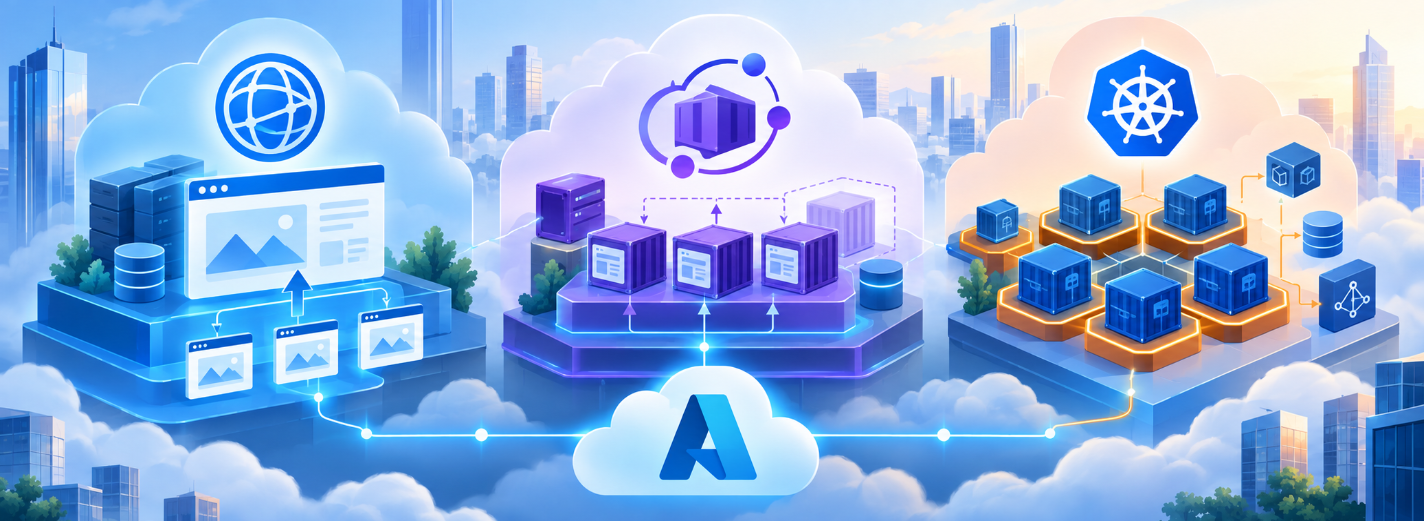
Azure App Service vs Container Apps vs AKS: Choose by Ownership
- Azure App Service
- Azure Container Apps
- AKS
- Azure hosting
- Azure containers
- Kubernetes
- web application hosting
Azure App Service vs Container Apps vs AKS: Choose by Ownership
Azure App Service, Azure Container Apps, and Azure Kubernetes Service can all run a web API packaged as a container. That is the least useful fact in the decision. The important difference is the operating model: which infrastructure concerns Azure absorbs, which controls the workload team receives, and which permanent responsibilities appear when those controls are selected.
Start from a workload dossier: components, protocols, deployment units, state, traffic distribution, latency, CPU and memory profile, jobs, event sources, dependencies, regions, recovery objectives, tenant isolation, compliance, networking, delivery cadence, and team capability. Mark hard requirements separately from preferences and hypothetical future needs. A Kubernetes operator required today is evidence; “we may want flexibility” is not.
Choose the least complex service that meets verified constraints and can pass production-shaped tests. App Service is often the responsible default for conventional web apps and APIs. Container Apps suits container-native APIs, workers, jobs, and related services without direct Kubernetes operations. AKS earns its cost when Kubernetes APIs, specialized scheduling, operators, granular policies, custom networking, diverse workloads, or an established cluster platform provide measurable value.
The choice is reversible, but never free to reverse. Containers help with packaging; identity, ingress, health, storage, service discovery, scaling, rollout, policy, telemetry, and recovery semantics remain platform-specific. Record the decision, rejected alternatives, evidence, owners, and revisit triggers. Our Azure application development work uses this method to select and deliver the smallest responsible platform.
Compare the Service Models Before the Features
App Service is a managed web platform for code or a web container. Azure handles the underlying operating system and web hosting infrastructure; the workload team owns application configuration, dependencies, identity, data, scaling policy, releases, monitoring, and recovery. App Service plans define compute capacity, and closely related apps can share a plan when their lifecycle, trust, and noisy-neighbor profile align. Deployment slots make conventional web releases and rollback approachable.
Container Apps is a managed container application platform that uses Kubernetes-related technology while withholding the Kubernetes API and cluster operations. An environment forms a major networking and security boundary. Applications gain immutable revisions, weighted traffic, service discovery, jobs, and HTTP or KEDA-driven scaling, including scale to zero for suitable workloads. It fits teams that want cloud-native container patterns while allowing Azure to own node and control-plane concerns.
AKS exposes Kubernetes and the widest control over deployments, operators, node pools, hardware, scheduling, networking, policies, storage, service meshes, and extensions. Azure manages the Kubernetes control plane; the customer still owns workload configuration, guardrails, node and version strategy, add-ons, capacity, disruption behavior, policy, observability, and incident response. AKS Automatic reduces setup and node-management burden with opinionated defaults, but it remains Kubernetes and requires Kubernetes-aware ownership.
Start with verified constraints
|
+-- Conventional HTTP app or API; smallest operating surface is valuable
|   +-- App Service is the leading candidate
|
+-- Containers + revisions + jobs/workers + event scaling are required
|   +-- Direct Kubernetes API is not required
|       +-- Container Apps is the leading candidate
|
+-- Kubernetes API/operators, special nodes, deep scheduling,
|   cluster extensions, or custom network control are required
|   +-- AKS is the leading candidate
|
+-- For every candidate
    +-- Test identity, networking, load, cold/warm behavior, failure,
        deployment, rollback, observability, regional recovery, and total cost

Choose only after the production-shaped proof; record revisit triggers.
Match Scaling to Workload Shape and Downstream Limits
Scaling starts with workload shape, not a checkbox. Measure steady and burst request rates, concurrency, CPU and memory per request, startup and warm-up time, job duration, queue arrival rate, connection lifetime, session state, and downstream capacity. Set a latency objective and determine how quickly new capacity must become useful. Scaling stateless compute cannot repair database locks, provider quotas, serial business rules, or connection-pool exhaustion.
App Service scales apps within App Service plan capacity. Sharing a plan can improve utilization but couples apps to the same allocated compute and failure or saturation domain. Always-warm instances and straightforward instance scaling suit predictable HTTP services. Validate autoscale signals, warm-up, health routing, plan limits, zone configuration, and whether one noisy app can consume the plan.
Container Apps scales each revision through HTTP, TCP, or custom KEDA rules. Scale to zero can reduce idle usage for tolerant workloads, but cold starts, minimum replicas, polling intervals, queue semantics, and downstream connections remain design choices. AKS separates pod demand from node supply: HPA or KEDA changes workload replicas while cluster or node auto-provisioning supplies capacity. Requests, limits, disruption budgets, scheduling, daemon overhead, node pools, and pending-pod behavior create more control and more interacting failure modes.
Draw Networking and Isolation End to End
A platform is not private because one public endpoint was disabled. Draw every path: user ingress, administrative access, service-to-service calls, database and cache traffic, secret retrieval, image pulls, package downloads, identity endpoints, telemetry export, partner networks, on-premises routes, and disaster-recovery traffic. For each path, name the DNS answer, route, firewall decision, identity, encryption boundary, and owner. Then test it from the networks an attacker or operator could actually occupy.
In App Service, inbound private endpoints and outbound virtual-network integration solve different directions. Validate private DNS, egress routing, network security controls, deployment access, and dependencies rather than assuming a single toggle encloses the application. An App Service Environment can provide stronger isolation, but its cost and operational footprint need a real requirement. When apps share a plan, decide whether shared capacity and trust are acceptable.
A Container Apps environment is a major network and security boundary. Group applications that may legitimately share that boundary, regional placement, and environment-level capabilities; separate unrelated trust zones. Confirm internal versus external ingress, private connectivity, DNS, egress controls, service discovery, certificate ownership, registry access, and the telemetry destination. In AKS, the team gains the richest options for CNI design, ingress, egress, network policy, service mesh, and private control-plane access. It also owns address planning, component upgrades, policy compatibility, packet-level diagnosis, and more ways for a small configuration error to interrupt traffic.
Compare Release, Recovery, and Observability Together
Release design and recovery design are the same conversation. App Service deployment slots can warm a candidate, validate it, shift the production hostname, and support a fast swap back. The safety depends on slot-specific settings, database compatibility, cache behavior, background work, and a health check that represents readiness rather than mere process survival.
Container Apps revisions provide immutable application versions and traffic weights, making gradual exposure and reversal natural. Decide whether old revisions may continue consuming messages, how single-active and multiple-active modes affect workers, which configuration change creates a revision, and how long rollback remains valid. AKS supports rolling, canary, and blue-green strategies through Kubernetes resources and delivery controllers. That flexibility only pays off when the team owns admission policy, probes, disruption budgets, rollout analysis, manifest promotion, controller upgrades, and recovery when desired and observed state diverge.
All three choices are regional services. Multi-region resilience requires another deployment, suitable data replication, global routing, capacity, secret and configuration distribution, observability, and a tested failover decision. A diagram is not a recovery test. Exercise a bad release, unavailable dependency, exhausted quota, lost zone or region, broken DNS, and expired certificate; measure detection, containment, restoration, data loss, and customer impact.
Observability should follow user journeys across every managed boundary. Start with service-level indicators for availability, latency, correctness, and freshness, then connect requests, revisions, instances, queues, dependencies, and deployment events with correlation identifiers. App Service usually exposes the smallest platform surface. Container Apps adds revision, replica, environment, and event-scaling behavior. AKS adds nodes, pods, controllers, scheduling, networking, storage, policies, and cluster upgrades. More telemetry is useful only when dashboards, alerts, retention, access, and response ownership remain deliberate.
# Inventory App Service apps and the plans that define their compute boundary.
az webapp list --query "[].{app:name,group:resourceGroup,plan:serverFarmId,state:state}" -o table
az appservice plan list --query "[].{plan:name,group:resourceGroup,sku:sku.name,workers:numberOfWorkers}" -o table

# Inventory Container Apps and expose environment, revision mode, and scale limits.
az containerapp list --query "[].{app:name,group:resourceGroup,environment:properties.environmentId,revisionMode:properties.configuration.activeRevisionsMode}" -o table
az containerapp show --name <app> --resource-group <group>   --query "{ingress:properties.configuration.ingress,scale:properties.template.scale}" -o json

# Inventory AKS versions, node pools, network model, and private-cluster status.
az aks list --query "[].{cluster:name,group:resourceGroup,version:kubernetesVersion,nodes:agentPoolProfiles[].count,network:networkProfile.networkPlugin,private:apiServerAccessProfile.enablePrivateCluster}" -o json
az aks nodepool list --cluster-name <cluster> --resource-group <group>   --query "[].{pool:name,mode:mode,count:count,vmSize:vmSize,version:orchestratorVersion}" -o table

# Inventory is evidence, not a decision: add load tests, failure drills,
# current regional pricing, operational labor, and recovery verification.
Price the Operating Model, Not Just Compute
Compare total ownership cost under the same assumptions. Include compute, reserved or minimum capacity, load balancing, public addresses, NAT and egress, storage, registry, DNS, certificates, gateway or web application firewall, logs, metrics, backups, security tooling, support, and duplicated disaster-recovery capacity. Price steady traffic, an expected peak, a failure with reduced headroom, and plausible growth. Use current regional prices and measured resource profiles; generic monthly examples age quickly.
App Service plans allocate capacity whether every hosted app is busy or idle. Sharing can be efficient, but it can also create coupled scaling and noisy-neighbor risk. Container Apps can align cost closely with replica use and can scale suitable workloads to zero, yet minimum replicas, dedicated profiles, environment resources, gateways, logs, and dependent services remain. AKS cost includes nodes and spare capacity plus load balancers, disks, registry, egress, monitoring, policy and security tooling, upgrades, and the platform labor needed to keep the cluster dependable. A low node price does not make a low-cost service.
Account for engineering time with the same seriousness as Azure charges: platform design, infrastructure code, access reviews, patching, version upgrades, vulnerability response, deployment maintenance, capacity planning, incident diagnosis, on-call training, and recovery exercises. Also price delay. A platform that exposes valuable control may accelerate a capable organization; the same platform can slow a product team that must first build an operating system around it.
The decision should survive a review by application, platform, security, finance, and operations owners. State the chosen service in one sentence, name the requirements it satisfies, quantify major assumptions, identify accepted risks, and set triggers for reassessment. Revisit when protocols, isolation, regional objectives, traffic shape, compliance, team capability, or workload diversity materially change—not merely because another platform has accumulated more features.
Make the Decision with Production Evidence
- Choose App Service when the workload is primarily a conventional HTTP application or API, rapid delivery matters, deployment slots fit the release model, and the team benefits from a small infrastructure surface. Prove plan sizing, warm-up, health routing, private connectivity, shared-plan isolation, and regional recovery.
- Choose Container Apps when independently released containers, APIs, workers, jobs, event-driven scaling, revisions, or scale to zero are genuine requirements, while direct Kubernetes APIs are not. Prove environment boundaries, cold-start tolerance, KEDA behavior, queue correctness, traffic splitting, egress, and rollback.
- Choose AKS when required capabilities depend on Kubernetes APIs, operators, specialized hardware or scheduling, granular cluster policy, custom networking, service meshes, or a mature internal platform. Name the team that owns upgrades, guardrails, add-ons, capacity, security, observability, and incidents before provisioning a cluster.
- Run one production-shaped proof on each credible finalist. Deploy the real image and identity, connect private dependencies, generate steady and burst traffic, interrupt an instance, release a bad version, roll back, rotate a secret, inspect traces, and estimate cost from observed consumption.
- Write an architecture decision record with constraints, measured evidence, alternatives, rejected assumptions, cost scenarios, failure tests, accepted risks, owners, and revisit triggers. A clear record prevents accidental platform expansion and makes later migration a reasoned decision.
Is AKS the safest future-proof default?
Is AKS the safest future-proof default?
Can Container Apps replace every AKS workload?
Can Container Apps replace every AKS workload?
Which option is cheapest?
Which option is cheapest?
Can we move between the services later?
Can we move between the services later?
Turn the Azure Platform Choice into Tested Evidence
Share the workload shape, dependencies, network and compliance boundaries, release cadence, recovery objectives, traffic evidence, and team ownership. We will compare credible options, run a focused proof, and produce an actionable architecture decision.
Publications
Our research
Research and development of AI-powered solutions to optimize business workflows and enhance decision-making processes.
Analysis of machine learning models for predictive analytics in finance, e-commerce, and SaaS platforms.
Exploration of natural language processing and computer vision technologies to strengthen automation, personalization, and customer support.
Microsoft Azure Development and Architecture Guide
A practical guide to Azure compute, data, networking, identity, reliability, delivery automation, observability, cost control and migration decisions for production workloads.

12 min read
25 Jul 2026
Azure SaaS Architecture: Isolation, Reliability, and Unit Economics
A practical guide to Azure SaaS architecture covering tenant identity, isolation tiers, request and job flows, deployment stamps, recovery, observability, automation, and cost per tenant.
8 min read
08 Sep 2026
Azure Cloud Implementation: Migration Checklist and Mistakes
A practical Azure migration checklist for workload discovery, landing zones, strategy, identity, data, migration waves, recovery, performance, cost and operating ownership.
8 min read
04 Aug 2026