Main
AWS Cloud Development: Choose Services by Workload Evidence
AWS Cloud Development: Choose Services by Workload Evidence
- AWS
- Amazon Web Services
- EC2
- Lambda
- ECS
- EKS
- RDS
- S3
- DynamoDB
- Cloud Development
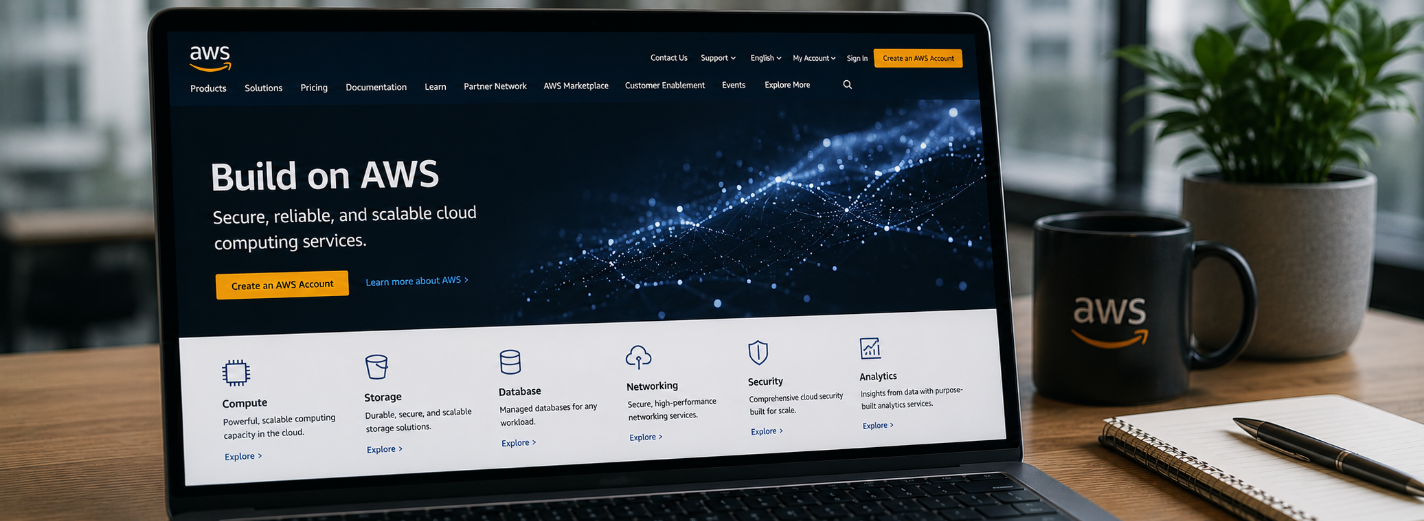
Amazon Web Services provides computing, storage, databases, networking, integration, analytics, security and operating capabilities on demand. That breadth is useful only when architecture begins with a workload rather than a service catalog. A product needs defined users and journeys, data, latency, availability, recovery, geography, security, change rate, demand shape, team capability and economic limits. The AWS design should make those requirements easier to meet and operate.
Start with a workload brief. Map request and event flows, authoritative data, consistency needs, peak and background demand, retention, external dependencies, failure consequences and customer commitments. Define service objectives and recovery time and recovery point objectives. Classify data and identity boundaries. Model normal, peak and failure cost. Record which decisions are reversible and which create migration, contract or skill lock-in.
Establish the cloud foundation before production grows. Use an AWS Organizations and account structure that separates workloads or environments where ownership, policy, billing, quota or blast radius differs. Centralize only capabilities with an accountable operator: identity federation, security visibility, networking, DNS, logging, backup or account vending. Express guardrails and infrastructure as versioned code. Every account, role, key, resource and exception needs a purpose, owner and lifecycle.
AWS security follows shared responsibility. AWS protects the cloud infrastructure; the customer’s duties vary with the services selected and include identities, data, application behavior and configuration. A managed database removes some operating tasks but does not choose authorization, retention, recovery objectives or safe queries. The architecture must name responsibilities at every boundary instead of assuming that “managed” means fully managed for the business.
Governance should make the safe path easier than an improvised one. Define how accounts are requested and retired, how production access is approved, which Regions and services are permitted, how security findings reach owners, and how exceptions are reviewed. Use service control policies and configuration rules carefully: begin with visibility, test impact and enforce in stages. Threat-model critical journeys, rehearse incident access and keep an independent recovery path for identities or tooling needed during a major compromise.
Set production readiness criteria before choosing a launch date. Require named service and data owners, capacity evidence, monitored objectives, escalation, backup and restore proof, dependency limits, security acceptance, cost budgets and a rollback or repair path. Document quotas and request increases before the workload reaches them. Test failure under realistic concurrency and data skew. A green deployment status means code reached AWS; it does not mean the customer journey is healthy, recoverable or economically sustainable.
Choose Core AWS Services from the Workload
Choose compute by execution behavior and operating responsibility. Amazon EC2 offers operating-system and runtime control for workloads that require it, with patching, scaling, images and instance operations owned by the team. Amazon ECS can run containers with AWS-native orchestration; AWS Fargate can remove host management for compatible tasks. Amazon EKS provides a managed Kubernetes control plane when Kubernetes portability, ecosystem or organizational standards justify its considerable platform surface. AWS Lambda fits bounded, event-driven work whose duration, concurrency, startup, state and integration constraints have been tested.
Select data services from access patterns and failure semantics. Amazon RDS and Amazon Aurora suit relational constraints, transactions and query models, but indexes, connection behavior, failover and maintenance still need evidence. DynamoDB can serve key-value and document access at scale when partition keys, item size, consistency and cost follow known patterns. Amazon S3 provides durable object storage for files, artifacts, data lakes and backups, with lifecycle, versioning, encryption, access and deletion designed explicitly. Search, cache, warehouse, graph and streaming services deserve their own business and operational case.
Use integration services to make time and failure visible. Amazon SQS can buffer work and isolate producers from consumers; Amazon SNS can fan out messages; Amazon EventBridge can route events; Step Functions can coordinate workflows. The application must still define authoritative state, delivery assumptions, ordering, idempotency, retries, timeouts, dead-letter handling, schema evolution, replay and reconciliation. Adding a queue does not automatically make a process reliable.
Design network and edge paths around traffic. Define VPC and subnet boundaries, routing, DNS, ingress, egress, private connectivity, hybrid links, inspection, capacity and cost. CloudFront and managed load balancing can improve reach and resilience, while AWS WAF and DDoS capabilities can support protection, but application authorization and abuse controls remain necessary. Prefer IAM roles and temporary credentials, apply least privilege, protect privileged paths and collect CloudTrail and workload telemetry into an actionable response model.
Follow data through its complete lifecycle: collection, validation, storage, replication, cache, analytics, export, backup, retention and deletion. Name the system of record and reconciliation path when several services contain copies. Choose consistency and partitioning from customer behavior, then test extreme keys, tenants and record sizes. Observability should connect traces, metrics and structured logs to the same business journey, with sampling, redaction, retention, alarm ownership and repair guidance designed before production volume makes telemetry expensive.
Delivery architecture matters as much as runtime architecture. Build artifacts once, identify them immutably and promote them through controlled environments. Automate tests, dependency and image checks, infrastructure plans, database migrations and release evidence. Use feature controls, progressive exposure or blue-green deployment where the customer risk justifies them. Define who can approve production, what stops a release, how a failed change is contained and how operators correlate it with telemetry. A pipeline that can deploy quickly without proving what changed is fast but not safe.
Turn AWS Capabilities into Business Outcomes
AWS can shorten infrastructure lead time, automate repeatable environments and make capacity available without purchasing hardware. Those capabilities create value when they reduce time to validated product learning, improve release safety, meet customer service objectives or lower total operating cost. They do not remove architecture or operations. Elastic capacity without limits can amplify spend, and high availability without an explicit target can add cost and complexity the product does not need.
Review every workload across the six AWS Well-Architected pillars: Operational Excellence, Security, Reliability, Performance Efficiency, Cost Optimization and Sustainability. Treat them as interacting decisions. More redundancy can improve recovery but raises cost and operational surface; aggressive caching can improve latency but complicates freshness; detailed telemetry helps incidents but consumes budget and sensitive data. State the priority, trade-off and evidence for each significant choice.
Build reliability from the customer journey backward. Remove single points only where their failure would violate an objective. Use health signals, timeouts, bounded retries, idempotency, backpressure and graceful degradation. Distribute across Availability Zones when the requirement and service support it; use multiple Regions only when business impact justifies data, deployment, consistency and testing complexity. Backups are inputs to recovery—restore representative data, exercise dependencies, measure achieved RTO and RPO and let the receiving team run the procedure.
Make cost an engineering signal. Allocate spend to owners and useful demand units such as active tenants, transactions, jobs, stored data or model calls. Combine Cost Explorer and billing data with workload telemetry. Review idle resources, rightsizing, storage lifecycle, data transfer, logs, nonproduction schedules and commitments. Savings Plans, reservations and Spot capacity can improve economics for suitable demand, but commitments should follow a stable baseline and interruption handling should be tested.
Performance and sustainability often improve together when the system does less unnecessary work. Measure utilization, over-fetching, duplicate processing, idle capacity, retention and data movement. Select a Region from customer latency, service availability, regulation, resilience and environmental considerations rather than one factor alone. Architecture must also fit the team: fewer services with clear runbooks can outperform a theoretically elegant design that nobody can debug at night. Budget training, operational exercises and ownership changes as part of delivery.
GARNO.TECH designs, builds and modernizes APIs, SaaS products, web applications, data workflows and enterprise integrations on AWS. An engagement begins with the business outcome, workload evidence and operating boundary. We compare credible compute, data and integration options; define the minimum production foundation; and identify the riskiest assumptions through a proof, load scenario, restore exercise or migration rehearsal before committing to broad implementation.
Delivery includes client-controlled accounts and repositories, infrastructure as code, reproducible environments, automated build and release, security checks, data migrations, observability, cost allocation, runbooks and acceptance evidence. We choose the simplest architecture that meets the current objectives and record thresholds that would justify change. A modular application on managed services may be safer than premature microservices or Kubernetes; a container or virtual machine may be clearer than forcing every workload into functions.
For migration, inventory applications and dependencies, then choose among retire, retain, rehost, relocate, repurchase, replatform and refactor or rearchitect. Use bounded waves with entry and exit criteria, data reconciliation, business acceptance, rollback or forward repair and a stabilization period. Avoid redesigning every application inside a fixed transfer deadline. Modernize where a measured product, reliability, delivery or cost outcome justifies the additional uncertainty.
Before handover, the client team should deploy a change, trace a request, respond to an alert, restore data, rotate access and explain cost movement. Documentation, architecture decisions and training support that exercise. Post-launch work follows measured service objectives, incident learning, security remediation, dependency updates, capacity and cost reviews. The result is not merely an AWS account containing resources; it is a workload the organization can own, recover, fund and evolve.
Service selection remains a lifecycle decision. Record why each material AWS service was chosen, its quotas, regional limits, upgrade and deprecation path, data export, replacement cost and responsible operator. Review that decision when demand, price, product requirements or team capability changes. Preserve portability at business boundaries—owned schemas, contracts, tests and data—not by avoiding every useful managed capability. A deliberate exit path gives the company negotiating and recovery options without paying for speculative abstraction everywhere.
Evaluate a proposed architecture through one production-shaped journey before approving the full roadmap. Send an authenticated request through edge, application, data and asynchronous work; then inject duplicate delivery, a slow dependency, capacity pressure and partial failure. Observe customer behavior, recovery, telemetry and cost. The exercise exposes hidden state, unowned boundaries and unrealistic scaling claims more reliably than a service diagram. Record acceptance criteria and the evidence that would trigger a different design.
Keep a decision register with the option selected, alternatives rejected, assumptions, owner and review trigger. Link it to dashboards, incidents and cost evidence so architecture reviews use current behavior. Retire obsolete resources and permissions deliberately after migrations and experiments; forgotten paths accumulate security exposure, spend and operational ambiguity. Review the register with product, finance, security and operations before each material commitment.
Publications
Our research
Research and development of AI-powered solutions to optimize business workflows and enhance decision-making processes.
Analysis of machine learning models for predictive analytics in finance, e-commerce, and SaaS platforms.
Exploration of natural language processing and computer vision technologies to strengthen automation, personalization, and customer support.
Docker in Production: Build One Artifact, Prove Every Boundary
A practical guide to Docker images, containers, Compose, BuildKit, registries, reproducible CI/CD, least privilege, supply-chain evidence, observability, rollout, and sustainable operations.
9 min read
25 Jul 2026
Azure Cloud Implementation: Steps, Costs, and Migration Risk
A production guide to Azure migration: business outcomes, discovery, workload strategies, landing zones, identity, networking, data, migration waves, cost models, cutover, rollback and operations.

9 min read
31 Jul 2026
NestJS: An Engineering Guide to Production TypeScript Backends
Understand where NestJS adds value, how its modules, providers, request pipeline, contracts, data boundaries, testing, security, observability, and delivery fit a production backend.
8 min read
25 Jul 2026