Main
NestJS
NestJS
- NestJS
- Node.js
- TypeScript
- Backend Development
- API Development
- Microservices
- Web Development
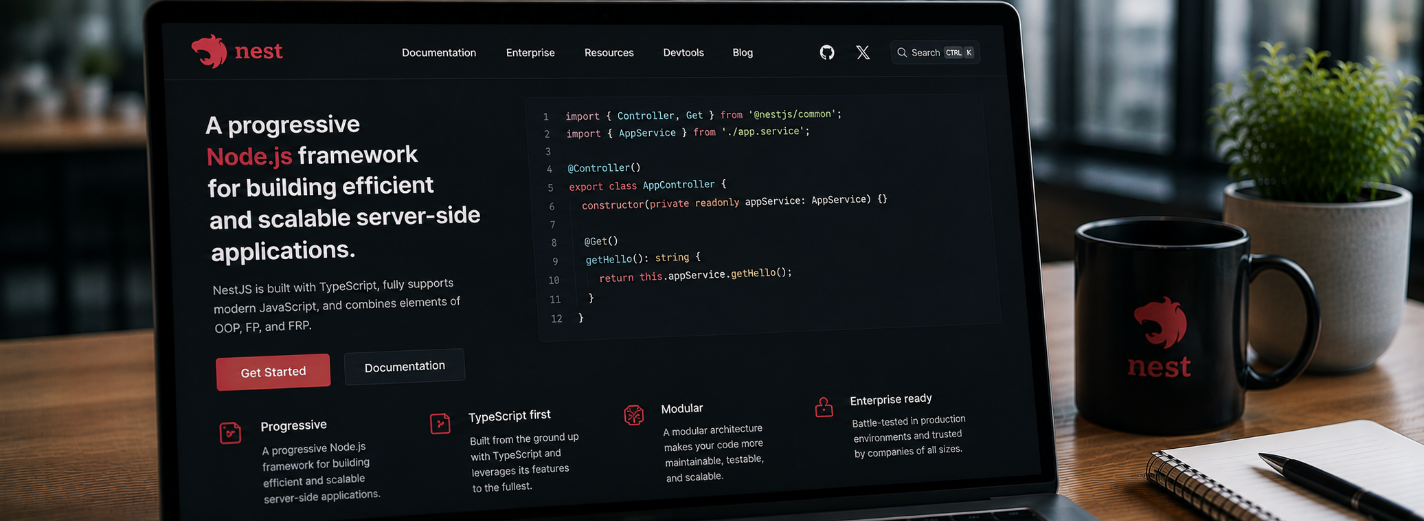
NestJS is a progressive Node.js framework for building efficient, scalable and maintainable backend applications. It is written in TypeScript and provides a structured architecture based on modules, controllers, providers and dependency injection. NestJS is widely used for REST APIs, GraphQL services, microservices, SaaS platforms and enterprise systems where clear architecture and long-term maintainability are important.
Core NestJS Capabilities
NestJS includes built-in support for dependency injection, validation, authentication, authorization, caching, WebSockets, scheduled tasks and microservices. It integrates with TypeORM, Prisma, Mongoose, PostgreSQL, MySQL, MongoDB, Redis and message brokers such as RabbitMQ and Kafka. Guards, interceptors, pipes and middleware help implement reusable cross-cutting logic, while OpenAPI support simplifies API documentation and client integration.
Benefits of NestJS for Business
NestJS gives teams a consistent project structure that makes large backend systems easier to understand and maintain. TypeScript improves reliability, while modules and dependency injection support isolated development and testing. The framework is suitable for MVPs, complex SaaS products, fintech platforms, marketplaces and enterprise systems. Its compatibility with the Node.js ecosystem helps teams deliver features quickly without giving up architectural discipline.
GARNO.TECH develops scalable APIs, SaaS platforms, microservices and enterprise backend systems using NestJS, Node.js and TypeScript. We can build a new product, modernize an existing backend, improve architecture and testing, integrate databases and external services, or migrate a legacy Node.js application to NestJS.
For a production engagement, speak with our senior NestJS backend team.
Looking for a NestJS engineering partner? Explore our NestJS Development Services.
Publications
Our research
Research and development of AI-powered solutions to optimize business workflows and enhance decision-making processes.
Analysis of machine learning models for predictive analytics in finance, e-commerce, and SaaS platforms.
Exploration of natural language processing and computer vision technologies to strengthen automation, personalization, and customer support.
Website Development: What to Prepare Before Starting a Project
Learn what business goals, content, functionality, integrations and technical requirements to prepare before starting a website project.

8 min read
30 Jul 2026
MySQL
Learn what MySQL is, how relational databases work and why businesses use MySQL for secure, reliable and high-performance applications.

5 min read
25 Jul 2026
NextJS
Learn how Next.js enables fast, SEO-friendly React applications using SSR, SSG and modern web architecture.

5 min read
25 Jul 2026