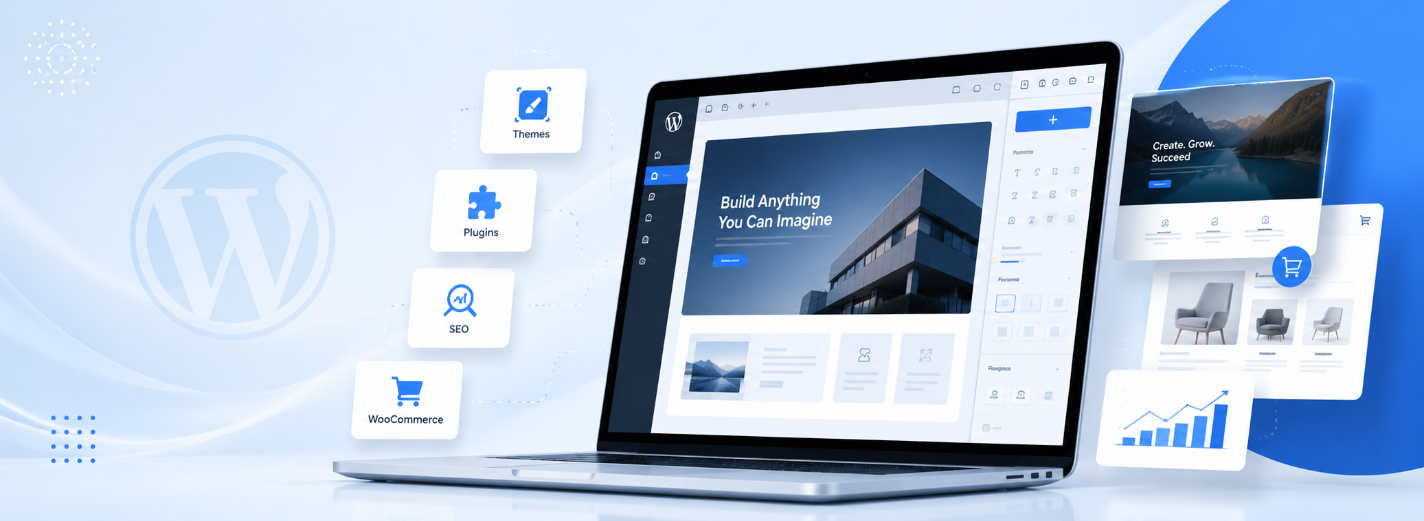
WordPress Development for Business: Fast Publishing Without Fragile Growth
- WordPress
- Web Development
- WooCommerce
- Business Websites
WordPress Development for a Fast, Governable Business Website
WordPress creates business value when people can publish, govern and improve content without turning every change into a software release. The platform can support a focused company site, a multilingual publication, a lead engine, a membership product or a transactional WooCommerce operation. Its flexibility also makes weak decisions easy: overlapping plugins, unbounded editor freedom, duplicated content, fragile page builders and infrastructure nobody owns.
Begin with users and decisions. Map customer journeys, conversion and trust moments, content types, taxonomy, search, localization, editor roles, approval, retention and integrations. Define performance, accessibility, search visibility, availability, security and recovery evidence. Only then choose a block theme, classic or hybrid approach, plugins and custom code. The goal is a publishing system that expresses the business reliably, not a stack assembled from demonstrations.
Choose Custom Work Where the Business Needs Control
A reputable ready-made theme can be efficient when the site has conventional content, the visual system can accept its constraints, the theme is actively maintained and the team can remove unused features. Evaluate the rendered HTML, accessibility, asset weight, editor experience, update history, extension model and exit cost with representative content. A low purchase price does not compensate for years of overrides, bundled plugins and layouts that break under localization or real editorial volume.
Custom development is justified where structure or behavior creates value: distinctive content relationships, governed campaign patterns, complex search, account or partner experiences, pricing tools, integration workflows or performance and accessibility targets that a generic package cannot meet cleanly. Custom does not mean replacing WordPress conventions. Use supported APIs, hooks, blocks, templates, roles, REST endpoints and data models, keeping presentation in the theme and reusable business functionality in owned plugins.
A hybrid path often has the best economics. Use WordPress Core and trusted extensions for commodity publishing, SEO metadata or forms; create a controlled design system and custom blocks for the brand; build narrow adapters for CRM, product data, search or identity. Record why every dependency exists, what data it owns, how it is tested and how the site works if it fails. Prefer a small composable estate over a plugin for every request.
- Use a maintained theme when: the information architecture and brand fit its supported patterns, representative content performs and remains accessible, and the team accepts the theme’s visual and upgrade constraints.
- Build custom blocks and a theme when: content relationships, editorial governance, brand behavior, conversion, accessibility or performance require a controlled system that generic options cannot provide cleanly.
- Build an owned plugin or integration when: reusable business behavior, external data, permissions, transactions or lifecycle rules must survive presentation changes and remain testable behind a clear contract.
Shape WordPress Around the Business Model
A corporate site needs clear service, sector, evidence, insight, location, people and contact models rather than hundreds of unrelated pages. A publication needs editorial roles, scheduling, authorship, corrections, taxonomy, related content and archive performance. A multilingual site needs translation ownership, locale-specific URLs, metadata, fallback, media and workflow. A membership or portal experience needs identity and authorization beyond simply hiding navigation.
Model reusable content as fields and relationships when its meaning matters; use blocks for page composition where editors need controlled flexibility. Define allowed blocks, patterns, templates, styles and lock rules by content type. A design system should give editors safe options without asking them to invent spacing, heading hierarchy or interaction. Preview must resemble production, and migrations must preserve meaning independently of a vendor-specific visual builder.
For headless delivery, justify the extra application, hosting, preview, cache invalidation, routing, SEO, authentication and deployment complexity. Headless WordPress can serve multiple channels or highly interactive frontends, but a conventional rendered site may be faster to operate and easier for editors. Prototype the actual publishing and preview path, not only API retrieval. The architecture should improve a named business constraint rather than signal technical fashion.
Treat WooCommerce as a Transaction System
WooCommerce turns the website into a financial and operational system. Model products, variants, inventory authority, customer identity, pricing, tax, shipping, promotion, payment, order states, refunds, fulfillment and communication according to the real business. Decide which system owns each fact and how updates reconcile. Avoid editing order state directly to repair symptoms; give support controlled actions with an audit trail.
Payment redirects and webhooks are asynchronous and retryable. Verify provider messages, persist their identity, process idempotently and reconcile against provider state. A browser success page does not prove payment, and a timeout does not prove failure. Protect checkout from duplicate submission, reserve inventory deliberately, preserve calculation and consent evidence, and test partial capture, failed fulfillment, refund, chargeback and recovery paths.
Extension count is not the main risk; overlapping authority is. Review how subscriptions, taxes, shipping, currencies, product feeds, ERP and CRM extensions alter checkout, scheduled jobs, data and updates. Load-test realistic catalogs, logged-in sessions, search, cart and checkout without allowing full-page caches to hide dynamic work. Track conversion, payment outcomes, queue age, stock conflicts, latency, errors and cost per order. A store is scalable when operational exceptions remain controlled as volume grows.
Engineer Performance and Core Web Vitals
Performance begins with content and templates. Set budgets for server response, Largest Contentful Paint, Interaction to Next Paint, Cumulative Layout Shift, page weight, JavaScript, CSS, images, fonts and third-party work on representative page types. Test mobile hardware and networks, anonymous and authenticated users, cold and warm caches, and important geographies. One perfect homepage score says little about a slow article archive, search result or checkout.
Use layered caching deliberately: CDN and edge rules, page cache where personalization permits, persistent object cache when data access justifies it, optimized queries and bounded external calls. Define invalidation and privacy before caching. Resize and compress images at ingestion, deliver modern formats where supported, reserve dimensions, preload only critical assets, self-host or subset fonts when appropriate and load block styles or scripts only where used. Remove third-party tags that cannot justify their user and revenue cost.
Profile before optimizing. Correlate browser timings with PHP execution, database queries, object cache, external APIs, background jobs, resource saturation and release version. Query monitors and synthetic tools help diagnose, while real-user monitoring shows field experience. Protect the editor as well as the public site: large block documents, media libraries and plugin panels can make publishing costly. Verify improvements against the same pages, data and environment and retain performance budgets in CI or release review.
Make SEO a Content and Rendering Contract
Search visibility starts with an information architecture people can understand. Give each search intent a useful canonical destination, stable URL, clear title and heading, descriptive copy, relevant internal links and a place in navigation or taxonomy. Define index rules for archives, parameters, filters, internal search, pagination, translated variants and expired content. A plugin can emit tags; it cannot decide which pages deserve to exist.
Build metadata into the content model: titles and descriptions, canonical policy, robots directives, social previews, structured data, authorship, dates, language relationships and image alternatives. Generate XML sitemaps that contain intended canonical pages and keep redirects as reviewed source-controlled or managed data during migrations. Preserve valuable URLs where possible, map every retired page to the closest valid destination and monitor crawl errors, indexation and traffic after launch.
Rendering and performance affect discovery and use. Ensure important content and links exist in the delivered HTML, templates remain semantic, media is accessible and JavaScript enhancement does not hide navigation from users or crawlers. Structured data must match visible facts. Measure organic landing outcomes, branded and non-branded demand, search journeys and conversions—not rankings alone. Editorial governance, content accuracy and update cadence sustain SEO after the development project ends.
Operate Security, Updates, and Recovery Continuously
WordPress security is an operating practice. Keep Core, themes, plugins, PHP, database and server components on supported versions. Select actively maintained dependencies from trusted sources, remove unused code and maintain an inventory with owners and update expectations. Protect administrators with least privilege, strong authentication and HTTPS; restrict production file editing and write access; safeguard secrets; limit automated abuse; and place network or application controls according to the threat model.
Updates need a repeatable path: dependency review, automated and exploratory checks on representative content and business journeys, staging, backup, deployment, smoke verification and rollback. Test plugin and theme changes together because compatibility failures occur at their boundaries. Separate deployable code from uploads and environment configuration, build immutable artifacts where practical and record the exact versions running. Emergency patching should follow a prepared playbook rather than editing production through the dashboard.
Back up the database, uploads and required configuration on schedules derived from data loss tolerance, store copies outside the primary failure boundary and test restoration. Monitor availability, integrity changes, authentication, privileged actions, PHP and JavaScript errors, queue failures, certificate and domain expiry, resource saturation and critical journeys. An incident plan should cover containment, clean rebuild, credential rotation, evidence preservation, notification and content recovery. A backup nobody has restored is only a hopeful file.
A reliable WordPress site gives customers a fast, trustworthy path and gives editors a safe publishing system—while updates, failures, and future change remain routine to operate.— GARNO.TECH Engineering Team
Choose a Partner Who Leaves the Website Operable
Evaluate a WordPress partner on production evidence, not screenshot variety. Ask how the team models content, governs blocks, reviews plugins, meets accessibility and performance budgets, tests WooCommerce and integrations, deploys updates, monitors failure and restores service. Review code and artifacts from a short paid exercise using sanitized context. Confirm the named team, allocation, senior review, subcontracting, security practices and continuity.
Compare proposals on one lifecycle scope: discovery, content migration, design system, authoring, integrations, SEO preservation, accessibility, performance, environments, testing, analytics, security, launch, support, licenses and hosting. Require assumptions, exclusions, dependencies, ranges and acceptance measures. Retain ownership of repository, domains, hosting, CDN, analytics, search accounts, payment and email providers, credentials and production approval.
A successful partner leaves internal owners able to publish, approve, deploy, diagnose, recover and plan changes. Require architecture and decision records, dependency inventory, block and content documentation, test and performance baselines, backup and incident runbooks, update policy and paired handover. Measure the relationship by time to safe change, editor success, user outcomes, reliability and knowledge distribution rather than output volume alone.
Build the Smallest WordPress Platform Worth Owning
WordPress is a strong choice when content operations are central, editors need autonomy and the product can benefit from its publishing model and ecosystem without surrendering architectural control. The most durable implementation keeps the content model explicit, editor freedom bounded, custom code narrow, dependencies accountable and production behavior measurable.
Start with the page type, workflow or integration that creates the greatest customer or editorial friction. Prove it through representative content, accessibility, performance, search, security, deployment and recovery, then expand the pattern. Explore our WordPress development services or bring the current site, content inventory, analytics and release constraints for a focused assessment.
A Four-Stage WordPress Delivery
- /01Map Journeys, Content, and OwnershipDefine audiences, conversion and trust moments, content types, taxonomy, search, localization, editor roles, approval, integrations, current evidence and operating owners.
- /02Design the Smallest Durable BoundaryChoose rendering, theme, blocks, plugins, custom code, systems of record, data exchange, accessibility, SEO, performance budgets, environments and recovery from evidence.
- /03Deliver a Production-Shaped SliceBuild a representative journey through authoring, responsive and accessible rendering, integration, telemetry, automated checks, deployment, cache behavior, support and rollback.
- /04Migrate, Launch, and OperateValidate content and redirects, stage exposure, monitor user and editor outcomes, rehearse restore, own updates and incidents, transfer knowledge, and improve from production evidence.
How do we decide between a ready-made WordPress theme and custom development?
How do we decide between a ready-made WordPress theme and custom development?
Planning Custom WordPress Delivery?
Share the current site, content inventory, customer and editor journeys, analytics, integrations, performance and SEO evidence, security concerns, release process and target outcome. GARNO.TECH will identify the smallest valuable scope and define architecture, migration, quality, launch and ownership evidence.
Publications
Our research
Research and development of AI-powered solutions to optimize business workflows and enhance decision-making processes.
Analysis of machine learning models for predictive analytics in finance, e-commerce, and SaaS platforms.
Exploration of natural language processing and computer vision technologies to strengthen automation, personalization, and customer support.
Enterprise Software Quality: From AI Research to Reliable Releases
Build enterprise software quality through governed AI research, risk-based regression, maintainable Angular architecture, production feedback, and business evidence.
9 min read
31 Jul 2026
Regression Testing That Makes Every Release Safer
A practical guide to risk-based regression testing, durable automation, test data, flaky-test control, CI/CD gates, and the metrics that reveal whether quality is improving.

12 min read
31 Jul 2026
NestJS Performance Optimization: Find the Bottleneck Before Scaling
A production guide to NestJS API performance through workload budgets, Node.js event-loop evidence, database access, Redis caching, queues, horizontal scaling, Express or Fastify, profiling, and load tests.

11 min read
27 Aug 2026