Main
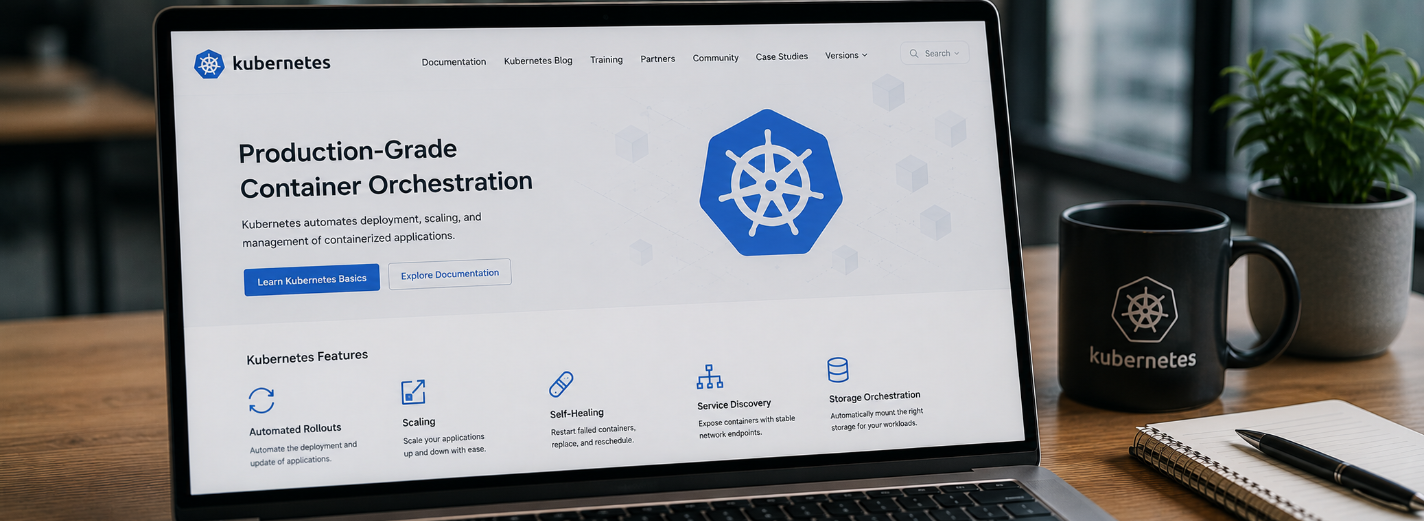
Kubernetes Engineering: When Orchestration Becomes a Product Capability
Kubernetes Engineering: When Orchestration Becomes a Product Capability
- Kubernetes
- K8s
- Docker
- Containers
- Microservices
- DevOps
- Cloud Native
- Helm
Kubernetes is an API-driven control system for placing and reconciling containerized workloads across a pool of compute. It can keep declared replicas running, expose services, roll out versions, attach configuration and storage, schedule by resources and constraints, and provide extension points for policy and automation. That makes Kubernetes valuable when many workloads need consistent delivery and operations. It does not make an application scalable, secure, observable, or resilient without the architecture and ownership around it.
Begin with the product and operating problem. Record workload count and change rate; traffic, batch, queue, and scheduled patterns; isolation and regulatory needs; regions and recovery targets; state and data gravity; release independence; capacity volatility; environments; team boundaries; current incidents; infrastructure cost; and the people who will run the platform. A handful of stable services may be cheaper and safer on a managed application or container service. Kubernetes becomes credible when standardization, scheduling, portability, workload diversity, or independent team delivery repays a permanent control-plane and platform burden.
Separate application, platform, and provider responsibilities. The application must start predictably, expose useful health, handle termination, protect data, tolerate dependency failure, and declare honest resource needs. The platform supplies safe workload patterns, identity, networking, policy, secrets integration, observability, delivery, and support. A managed Kubernetes provider may operate parts of the control plane and nodes, but the organization still owns workload configuration, access, upgrades, add-ons, data protection, cost, incident response, and the consequences of architectural choices.
Define success as outcomes: teams can ship a routine service through a supported path; releases remain bounded and reversible; user-facing objectives are observable; resource contention is controlled; sensitive workloads receive suitable isolation; backup restoration and regional recovery are proven; upgrades complete inside policy; platform demand and cost are visible; and product teams can diagnose their services without unrestricted cluster access. Cluster creation is an early implementation task, not the completion criterion.
Design the Platform Across Workload and Cluster Boundaries
Design the workload before writing manifests. Choose Deployment for replicated stateless behavior, StatefulSet only where stable identity or ordered storage semantics are truly required, DaemonSet for node-local capability, and Job or CronJob for bounded work. A Pod is a scheduling and lifecycle unit, not a durable machine. Keep containers cohesive, make startup deterministic, handle SIGTERM, drain connections, bound shutdown, and avoid local state unless loss is explicitly acceptable. Distinguish startup, readiness, and liveness signals; an aggressive liveness check can turn a slow dependency into a restart storm.
Declare resource requests from measured demand because scheduling, bin packing, and autoscaling depend on them. Use memory limits to contain exhaustion and decide CPU limits from latency and fairness evidence rather than habit. Test throttling, out-of-memory termination, node pressure, eviction, and noisy neighbors. Horizontal scaling needs a signal that reflects demand and enough time for new capacity to become ready; queue depth or concurrency may be more useful than CPU. Workload scaling and node scaling must cooperate, while disruption budgets, placement constraints, topology spread, and capacity headroom protect availability during maintenance and failure.
Design service discovery and traffic as a path. Services provide stable addressing to changing Pods; ingress or gateway components route external traffic but require an owned controller, certificates, DNS, timeouts, body limits, health behavior, logging, and denial-of-service controls. Define east-west and egress policy, not only ingress. Start from deny-by-default where the environment and network implementation support it, then allow required flows. Trace user requests through proxies, services, queues, and dependencies so an extra layer does not become an extra blind spot.
Treat configuration and secrets differently. Version non-confidential configuration, validate it, identify which changes require rollout, and prevent undocumented cluster edits. Kubernetes Secret objects need encryption at rest, least-privilege RBAC, narrow mounting, audit, rotation, and protection after the application reads them; base64 is not encryption. External secret stores can reduce distribution risk when the lifecycle is designed end to end. Workload identity and short-lived credentials are preferable to shared static keys.
Storage design begins with the data system’s guarantees. Define access mode, latency, throughput, topology, encryption, snapshots, backup, retention, expansion, reclaim behavior, and failure domains for every persistent volume and external database. A StatefulSet plus a volume is not a disaster-recovery strategy. Test application-consistent backup and timed restore into a clean environment, including metadata, secrets, schemas, and dependencies. Decide what happens when a zone, cluster, account, or provider service is unavailable and where recovery control remains reachable.
Keep the platform reproducible. Build immutable images, scan and sign artifacts as appropriate, store desired state in reviewed version control, promote the same artifact through environments, and reconcile drift through CI/CD or GitOps. Helm can package configurable resources, but templates still require schema validation, safe defaults, upgrade tests, ownership, and deprecation. Admission controls should enforce a small risk-based baseline—approved sources, non-root execution, restricted privileges, resource declarations, labels, and policy—while exceptions remain named, monitored, expiring, and reviewable.
Choose cluster topology from failure, trust, regulatory, scale, quota, region, and ownership boundaries rather than a rule such as “one cluster for everything” or “one per team.” A namespace is useful for organization, quota, policy, and delegation; it is not always sufficient isolation for hostile tenants or workloads with materially different assurance. Document who may create namespaces, workloads, RBAC, and network rules, who owns shared controllers, and how one tenant is prevented from exhausting or compromising others.
Plan the cluster lifecycle on day one. Record supported versions, upgrade window and order, removed-API checks, add-on compatibility, node rotation, critical-state backup, emergency access, and replacement criteria. Test a change in a representative environment, then a bounded cohort; observe workload and platform signals and retain a stop path. Accumulating unsupported versions turns routine maintenance into a risky migration program.
Use Kubernetes Where Its Operating Model Earns Its Cost
Kubernetes creates business value through a common operating contract. Product teams can package workloads consistently, use supported deployment and telemetry patterns, and release independently without learning every infrastructure provider primitive. Platform teams can improve identity, policy, supply-chain controls, observability, and cost allocation once for many services. The result can be faster delivery and a smaller operational variation surface, provided the paved path is easier to use than bypass.
Reliability comes from tested application behavior, capacity, and recovery—not from replica count alone. Use service objectives and alerts around user impact; correlate metrics, logs, traces, events, deployments, and audit data; and assign responders and runbooks. Exercise node drain, dependency loss, DNS failure, exhausted quota, failed rollout, expired credentials, corrupt data, and loss of a zone or cluster according to consequence. Control-plane health matters, but users experience the application and its dependencies.
Security is a layered system. Federate human access, minimize cluster-admin rights, separate routine and emergency identities, review RBAC, protect the Kubernetes API and audit data, enforce suitable Pod Security Standards, restrict host access and privileges, segment workloads by trust, control images and admission, patch supported versions, and isolate more strongly where namespace boundaries are insufficient. Anyone able to create a Pod may gain indirect access to powerful service accounts or secrets, so permission to deploy is itself sensitive.
Cost control requires allocation and capacity evidence. Label ownership, map cluster and shared-service spend to products, observe requests versus use, right-size workloads, remove idle environments, tune autoscaling, review storage and network transfer, and account for platform staff, observability, security products, backups, and upgrade work. High utilization is not always efficient if it destroys headroom and increases incidents. Optimize useful transactions and service objectives rather than the lowest node bill.
Kubernetes also imposes a continuous tax: upgrades, API removals, nodes, networking, storage drivers, ingress or gateway controllers, certificate and secret systems, autoscaling, policy, observability, incident response, and developer support. Limit add-ons, pin and inventory them, test compatibility, and define an upgrade cadence with rollback. If every application team must understand the entire cluster, the platform has shifted complexity rather than reduced it. Measure time to first safe deployment, adoption, exceptions, support load, failed changes, recovery, reliability, and cost to see whether the platform is earning its place.
Migrate to Kubernetes as a sequence of testable changes. First make the application container-ready: external configuration, predictable startup and termination, state outside local disk, meaningful health signals, structured logs, and measured resources. Then prove the image, policy, secret, network, deployment, telemetry, and recovery path with one representative service. Move dependency groups with acceptance, data reconciliation, and rollback. Avoid combining containerization, microservice decomposition, database replacement, a new provider, and a new team model in one cutover unless the dependency makes it unavoidable.
GARNO.TECH designs, builds, modernizes, and audits Kubernetes platforms and the products that run on them. We start with business outcomes, workload inventory and dependencies, deployment and incident evidence, data and security boundaries, recovery objectives, current cloud or infrastructure, team ownership, skill, cost, and deadline. We explicitly test whether Kubernetes is warranted and compare managed clusters, simpler container or application services, and retained infrastructure before committing to a target.
The architecture can cover cluster and account topology, tenancy and namespaces, workload patterns, network and egress, identity and secrets, storage, delivery and GitOps, artifact provenance, policy, observability, autoscaling, capacity, backup and recovery, upgrades, cost allocation, and support. Delivery begins with a representative workload and a production-shaped path through build, policy, deployment, traffic, telemetry, incident handling, restoration, and rollback. Acceptance is based on measured behavior rather than a running demo cluster.
Internal engineers participate in decisions, implementation, releases, exercises, upgrades, and incident preparation. Repositories, infrastructure definitions, cluster and provider accounts, dashboards, runbooks, inventories, decision records, budgets, and ownership remain accessible. The engagement succeeds when product teams can use a safe paved path and the platform team can operate, improve, recover, and eventually replace the platform without permanent dependence on its original builders.
Treat the internal platform as a product with named users. Publish supported templates and service levels, documentation, examples, a capability request path, and an exception process. Gather feedback from product teams and observe where the paved path accelerates work or creates queues and hidden failure. Let recurring needs and risks shape the platform roadmap rather than the desire to adopt another operator or tool.
Define exit conditions as well. Keep workload artifacts and data portable where the business requires it, document provider-specific dependencies, test restoration outside the primary cluster, and retain enough architectural context to consolidate, split, or retire clusters when economics and risk change. Revisit the platform decision periodically; an architecture that earned its cost at one scale may cease to do so after the product or organization changes.
Publications
Our research
Research and development of AI-powered solutions to optimize business workflows and enhance decision-making processes.
Analysis of machine learning models for predictive analytics in finance, e-commerce, and SaaS platforms.
Exploration of natural language processing and computer vision technologies to strengthen automation, personalization, and customer support.
Flutter Development Services for Production Applications
Design and deliver Flutter applications through product evidence, deliberate platform boundaries, tested native integrations, measurable performance, accessible UX and sustainable release ownership.

8 min read
25 Jul 2026
Docker in Production: Build One Artifact, Prove Every Boundary
A practical guide to Docker images, containers, Compose, BuildKit, registries, reproducible CI/CD, least privilege, supply-chain evidence, observability, rollout, and sustainable operations.
9 min read
25 Jul 2026
How DevOps Turns Digital Transformation into Delivery Capability
Use DevOps to turn digital strategy into a measurable operating capability through small releases, automated evidence, cloud platforms, observability, resilience, security, ownership, and learning.
8 min read
24 Jul 2026