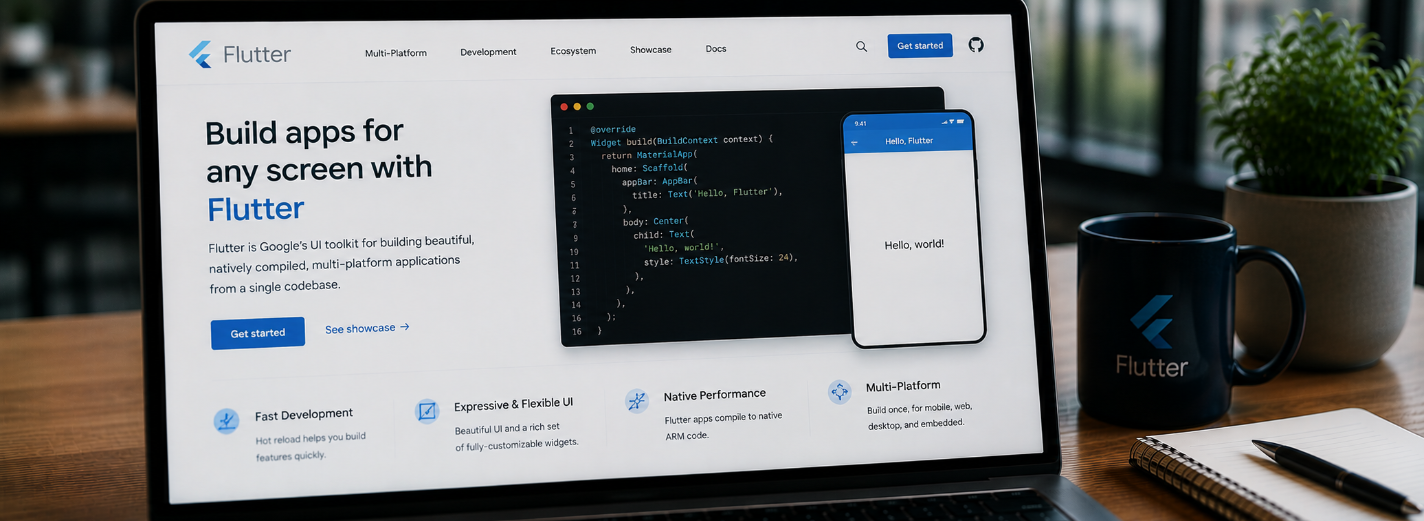
Main
Flutter Development Services for Production Applications
Flutter Development Services for Production Applications
- Flutter
- Dart
- Mobile Development
- Cross-Platform Development
- iOS Development
- Android Development
- Web Development
Flutter and React Native can deliver iOS and Android products from a largely shared codebase, but shared code is not the business outcome. The framework must support the product’s critical journeys, native capabilities, accessibility, performance, release obligations, team, and maintenance horizon at an acceptable total cost. A percentage of code reuse cannot show whether users receive a reliable experience or whether the company can ship the next operating-system change safely.
Start with constraints instead of a generic winner: target devices and OS versions, interaction and visual ambition, startup and responsiveness budgets, camera or media work, Bluetooth, NFC, location, background execution, notifications, payments, widgets, offline data, privacy, app size, web or desktop ambitions, existing native code, team skills, hiring market, and support expectations. Then test the riskiest vertical journey in both credible options—or include native development when cross-platform itself is the uncertain assumption.
Build a weighted decision model from the actual product: critical journeys, interface strategy, native surface, performance budgets, accessibility, offline and background behavior, target platforms, existing code, team evidence, hiring, package risk, release operations, security, support, upgrade horizon, and total cost. Mark mandatory constraints separately from preferences. Compare Flutter, React Native, and native options on the same boundary.
Use a time-boxed vertical proof when the highest-risk assumptions remain. It should exercise the real design, backend and provider integration, local data, one demanding native capability, telemetry, accessibility, slow and interrupted network, release build, signing, test distribution, and target devices. Define thresholds and a stopping rule before coding. Retain the proof’s measurements, dependency findings, native code, build path, and decisions.
Flutter is often compelling for controlled bespoke interfaces and a team ready to own Dart, Flutter rendering, and native edges. React Native is often compelling for React and TypeScript organizations that value native composition and can own the modern React Native and native toolchains. Native development remains rational for a deep platform surface or when cross-platform compromise costs more than duplication. The responsible answer is the option whose risky journey has passed evidence, whose lifecycle has owners, and whose trade-offs the business accepts.
What Production Flutter Development Includes
Flutter is a Dart-based UI toolkit with its own framework, engine, widget tree, rendering pipeline, and platform embedder. On native targets, release Dart code is compiled ahead of time and Flutter paints most interface pixels through its engine rather than composing the operating system’s standard widget hierarchy. This gives the team tight, portable control over layout, animation, and visual behavior. Platform channels, plugins, FFI, generated bindings, and embedded platform views connect to host APIs and native controls where needed.
React Native uses React and JavaScript or TypeScript while rendering through native platform UI building blocks. Its New Architecture includes Fabric rendering and typed Turbo Native Modules and Components, with Codegen producing platform interfaces. Platform-specific files and native Swift, Objective-C, Kotlin, Java, or C++ remain available. The result is not a web page in a wrapper: it is a cross-platform application whose React model composes native capabilities.
The architectural difference changes ownership. Flutter teams own a larger rendered UI stack and must decide where platform adaptation is necessary. React Native teams work closer to platform components and the React ecosystem while managing JavaScript, native projects, New Architecture compatibility, Metro, and native dependencies. Neither removes Xcode, Gradle, store signing, device testing, or platform expertise from a serious product.
Framework-wide benchmark charts rarely decide a real application. Performance comes from the product’s work: startup, navigation, list size, image and media processing, animation, state updates, network and database behavior, native calls, background work, memory pressure, and third-party SDKs. A simple counter can flatter either framework while the actual camera, map, checkout, or infinite feed still fails its budget.
Define user-centered thresholds by device and network segment: cold and warm startup, time to interactive, route transition, frame time and dropped frames, input response, scroll stability, memory, battery, app and update size, crash-free sessions, and completion time for the critical journey. Profile release builds on representative low and mid-range physical devices. Development mode, simulators, and one flagship phone are poor evidence.
Flutter’s controlled rendering can support highly custom, consistent animation; it also ships an engine and can make embedded platform views or certain native composition paths important to measure. React Native’s native component model and modern architecture can deliver responsive experiences; expensive JavaScript work, unnecessary renders, native-module behavior, and dependency quality still matter. Optimize the observed bottleneck, then re-run the whole journey rather than arguing from an architectural slogan.
Decision rule: choose Flutter when its rendering model, plugin ecosystem, native escape hatches, team skills and release obligations fit the product better than separate native applications or another cross-platform stack.
Proof before commitment: build the riskiest thin slice on representative devices and networks, including startup, a critical interaction, native integration, offline recovery, accessibility and release packaging.
When Flutter Creates Business Value
Flutter is attractive when a product has a distinctive design language and needs the same composition and animation under team control across platforms. Material and Cupertino libraries provide starting points, but “same pixels” should not become the objective. Text metrics, input methods, navigation expectations, permission flows, back gestures, menus, share sheets, accessibility settings, and system conventions differ. Platform adaptation remains product work even with one widget tree.
React Native maps its core primitives to native UI and can align naturally with platform behavior, but a shared component does not guarantee correct iOS and Android experience. Styling, navigation, keyboard avoidance, touch feedback, accessibility, native sheets, and third-party libraries may behave differently. Platform-specific components are a valid design tool rather than a failure of reuse.
For both frameworks, test dynamic type or font scaling, screen readers, focus order, reduced motion, contrast, external keyboards, right-to-left layout, localization expansion, safe areas, rotation where supported, dark mode, permission denial, and system interruptions. Decide what must remain visually consistent, what should feel native, and who approves divergence. A design system should encode shared meaning and tokens while permitting platform-specific behavior where users benefit.
React Native may shorten onboarding for a team already strong in React, TypeScript, mobile state, testing, and the native build toolchain. Web React knowledge helps, but DOM and browser assumptions do not transfer automatically to mobile lifecycle, gestures, navigation, offline behavior, memory, app stores, or native debugging. Flutter asks the team to learn Dart and its widget, layout, state, isolate, tooling, and native interop models; its integrated SDK can give teams a coherent development surface.
Compare demonstrated capacity, not language popularity. Who can diagnose an iOS signing failure, Android build regression, rendering problem, native crash, package conflict, store rejection, accessibility defect, or background restriction? How quickly can the organization hire or train those people? Who will own backend contracts, analytics, CI/CD, security, release, support, and platform upgrades? One experienced team can outperform a theoretically larger talent pool it cannot retain.
Measure lead time from accepted behavior to monitored release, rework, review latency, escaped defects, build time, flaky tests, dependency wait, and time to repair. Hot reload improves the inner loop in both ecosystems; it does not prove production speed. Product clarity, component discipline, test seams, stable APIs, automated builds, device coverage, and decision rights usually dominate sustained delivery.
Operational ownership: budget for app-store delivery, signing, crash diagnostics, analytics, dependency upgrades, OS compatibility, plugin maintenance, privacy changes and the native code that remains.
Inventory every native capability and vendor SDK before committing: authentication, keychain or keystore, camera, audio and video, maps, background location, Bluetooth, NFC, health data, biometrics, notifications, deep and universal links, payments, subscriptions, ads, analytics, crash reporting, widgets, wearables, files, sharing, device management, and anti-tamper controls. Mark maturity, supported versions, licences, maintainers, release cadence, unresolved issues, New Architecture or platform compatibility, and the cost of replacing the package.
Flutter plugins typically expose Dart APIs backed by platform implementations or platform channels; a team can write or repair the native side. React Native packages may expose Turbo Modules, Fabric Components, C++ or platform code, while older libraries can depend on compatibility layers. In both cases, “there is a package” is only discovery evidence. Read its source and native setup, test the current target OS, and verify error, lifecycle, concurrency, privacy, and upgrade behavior.
Build the highest-risk capability as a vertical proof with production SDKs, permissions, signing, telemetry, offline and interruption cases, and representative devices. Include the fallback: maintain a fork, own native modules, replace the provider, isolate the feature, or choose native development. Cross-platform succeeds when native code is a controlled boundary with named owners, not when the team pretends it will never exist.
Long-term cost includes framework and language upgrades, iOS and Android changes, Xcode and Gradle, package maintenance, store policy, privacy declarations, security findings, build infrastructure, device tests, native debugging, telemetry, crash triage, support, and knowledge transfer. Count platform-specific code and operational tooling alongside the shared feature layer. A quick MVP can create an expensive second year when dependencies are abandoned or nobody owns native projects.
Establish a supported-version policy and regular upgrade cadence. Inventory direct and transitive dependencies, lock and review versions, automate builds and critical checks, monitor deprecations, and trial major framework changes on a production-shaped branch. For React Native, include New Architecture compatibility and native package migration. For Flutter, include engine, Dart, plugin, embedder, and platform-view effects. Keep store releases small enough to observe and contain through staged or phased rollout, feature controls, backend compatibility, and a hotfix path.
Plan ownership and exit. Preserve client-controlled repositories, developer accounts, signing and upload keys, bundle identifiers, cloud and provider accounts, build pipelines, analytics, crash systems, documentation, and architectural decisions. Decide how data and business logic could move if the framework no longer fits. Portability is the tested ability to preserve critical behavior within an acceptable cost and time, not the claim that most source files are shared.
Acceptance: measure customer journeys, frame and startup performance, memory, binary size, battery, accessibility, failure recovery and support effort rather than judging the framework from a demo.
Can benchmarks determine whether Flutter or React Native is better?
No. Generic benchmarks isolate framework behavior under conditions that may not resemble your product. Define budgets for the critical journey, then profile release builds on representative devices and networks with the real UI, data, native SDKs, background work, analytics, and error paths. Combine those results with accessibility, package maturity, team ownership, release operations, upgrade evidence, support, and total lifecycle cost. The better choice is the one that meets the product thresholds with risks the organization can own.
Publications
Our research
Research and development of AI-powered solutions to optimize business workflows and enhance decision-making processes.
Analysis of machine learning models for predictive analytics in finance, e-commerce, and SaaS platforms.
Exploration of natural language processing and computer vision technologies to strengthen automation, personalization, and customer support.
AWS Cloud Development: Choose Services by Workload Evidence
A production guide to AWS cloud development: workload requirements, accounts, identity, compute, data, integration, reliability, security, delivery, migration, cost and operations.
8 min read
25 Jul 2026
Custom WordPress Development vs Ready-Made Themes: How to Choose
Compare custom WordPress development and ready-made themes by workflow fit, editorial control, performance, accessibility, integrations, security, maintenance, cost, and migration risk.

8 min read
02 Aug 2026
React Native Development Services for Production Mobile Products
Design, build, modernize, and operate React Native products with shared domain code, deliberate platform behavior, native integrations, performance evidence, secure delivery, and sustainable ownership.
8 min read
25 Jul 2026