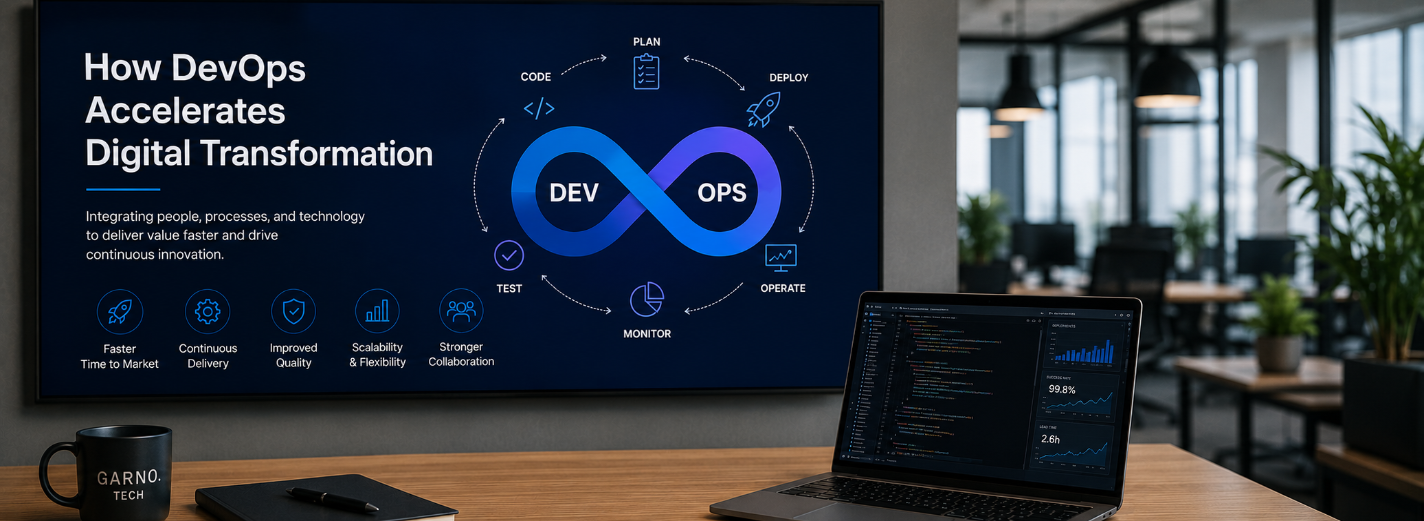
How DevOps Turns Digital Transformation into Delivery Capability
- DevOps
- digital transformation
- CI/CD
- cloud automation
- infrastructure as code
- software delivery
- DevSecOps
- observability
- enterprise modernization
- platform engineering
Digital transformation creates value only when an organization can turn a business decision into dependable behavior for customers and staff, learn from its use, and change it again. A new channel, automated workflow, data product, or cloud service that takes months to release and days to recover remains a fragile initiative. DevOps addresses that constraint by treating delivery and operation as one product capability with shared evidence and ownership.
This is broader than installing a pipeline or renaming an operations team. It connects product discovery, architecture, code, tests, security, infrastructure, data change, deployment, observability, support, incidents, and cost. The practical objective is a fast and safe learning loop: smaller changes move through a repeatable path, production shows whether they work, failures remain bounded, and teams use the evidence to improve product and system.
Start with a value stream rather than an enterprise-wide tool program. Trace one consequential journey from idea to observed outcome. Measure waiting for decisions, dependencies, environments, reviews, tests, approvals, and release; deployment frequency and lead time; failed change and recovery; user success; incident and support burden; and cost. The largest delay or risk may sit outside engineering. Automation applied to a confused priority system only produces waste faster.
To connect technical improvement to business transformation, state a testable causal hypothesis. For example, reducing release lead time may let a team test an offer more often, but only if it also measures adoption, journey completion, revenue, or operational effect. Record the baseline, expected movement, evaluation window, and person who will decide from the result. Flow measures such as change lead time are useful system diagnostics; they do not replace measures of value, reliability, or team health.
Treat transformation as a portfolio of small bets with guardrails. For each one, define its blast radius, budget, dependencies, continuation or stop criteria, and a route back to a safe state. Review the results with product, operations, finance, security, and support in the room. This allows leaders to stop costly rituals, increase investment in demonstrated capabilities, and see where apparent speed merely moves a queue into another part of the organization. Measures should guide inquiry rather than become quotas: once a metric becomes an individual target, people can improve the number while weakening the system it was meant to describe.
Make Software Delivery a Reliable Business Capability
Large, infrequent releases combine many assumptions and owners. When they fail, diagnosis is difficult, rollback may conflict with data changes, and the cost of coordination encourages even larger batches. Smaller independently valuable changes reduce the blast radius and shorten feedback. They are safe only when architecture, contracts, data migration, testing, exposure, observability, and recovery support the cadence.
Continuous integration should create a traceable artifact from reviewed source and run fast, relevant evidence: compilation, unit and component behavior, contracts, integration, migrations, dependency and policy checks, and selected journeys. Continuous delivery keeps that artifact releasable through representative environments; continuous deployment exposes it automatically only where risk and controls justify that choice. The useful distinction is not pipeline labels but who can make which change with what evidence.
Separate deployment from user exposure through progressive traffic, feature controls, or compatible clients when useful. Define acceptance and stop thresholds before release: technical health, critical journeys, business outcomes, security signals, and data integrity. Make normal, emergency, rollback, forward-fix, and decommission paths explicit. Delivery accelerates when a routine change is boring and a consequential change receives stronger evidence without forcing every change through the same ceremony.
Automate Evidence and the Safe Path to Production
Automation is valuable when it makes a sound path repeatable, visible, and reviewable. Prioritize frequent, consequential, and error-prone work: builds, environment creation, configuration validation, tests, artifact signing and promotion, compatible data changes, backups, restore verification, policy checks, deployment, health verification, access lifecycle, and routine operational response. Keep an audited emergency path for exceptional recovery and reconcile its changes back into code.
Do not automate an undefined decision. A pipeline cannot know whether a latency regression harms a critical journey, whether a schema change is reversible after new writes, or whether a security exception is acceptable. Encode thresholds, approvals, separation of duties, and evidence retention from an explicit risk model. Remove controls that collect no useful evidence or lead to automatic approval; they consume time without reducing risk.
Design developer experience as a product. Provide maintained templates, environment setup, local and remote feedback, reusable CI/CD capabilities, secrets and identity integrations, observability, documentation, and supported paths for common workloads. Measure adoption, time to first release, failure and support burden, and exceptions. A platform team succeeds when product teams safely own outcomes with less cognitive load, not when every team is forced onto an elaborate internal product.
Modernize the Cloud Operating Model, Not Only Hosting
Cloud changes the available primitives and responsibility boundaries; it does not automatically modernize delivery. Moving manual server procedures into a cloud account can increase cost, identity sprawl, and failure complexity without improving customer outcomes. Choose services from workload, availability, recovery, security, data, region, latency, team capability, and economic evidence—not a target diagram.
Infrastructure as code makes networks, identities, compute, storage, databases, policies, monitoring, and selected provider configuration versioned and reviewable. Separate reusable platform capabilities from application-specific composition. Validate plans, protect state and credentials, detect drift, constrain destructive change, and test both provisioning and restoration. Immutable artifacts and environment configuration prevent “works only in staging” from becoming a release method.
Cloud operating design includes accounts and subscriptions, environment and tenant isolation, least-privilege identity, network and egress, encryption and key lifecycle, quotas, capacity, scaling, backups, regional recovery, provider failure, cost allocation, and decommissioning. Tie spend to useful transactions and service objectives. Elasticity without demand limits or ownership can scale an error and its bill at the same time.
Use Production Evidence to Improve Resilience
Observability answers questions about system and user behavior from emitted evidence. Correlate requests, jobs, events, deployments, databases, providers, and critical journeys through structured logs, metrics, traces, release markers, and business events. Define field and label standards, sampling, retention, access, cost, and sensitive-data handling. A large telemetry bill and thousands of unowned dashboards do not create understanding.
Set service objectives around user-centered behavior and dependency reality. Alerts should represent actionable threats to those objectives, have a named responder, and link to context and a runbook. Measure error, latency, saturation, queue age, freshness, successful business completion, and data integrity by version, region, tenant, cohort, or provider when global averages can hide harm. Use error budgets or equivalent evidence to negotiate reliability work with feature demand.
Resilience comes from tested response. Design timeouts, bounded retries with jitter, idempotency, backpressure, isolation, graceful degradation, compatible data change, capacity headroom, and recovery according to consequence. Exercise dependency failure, traffic bursts, credential loss, corrupted data, zone or region loss, and unsuccessful releases. Backups become controls only after timed restoration and verification. Incident review should change system conditions without punishing the person who surfaced risk.
Change Ownership and Incentives Across the Value Stream
DevOps changes responsibility across the value stream. Product teams need enough product, engineering, quality, security, data, and operational capability to own a customer outcome from discovery through production learning. Operations and platform specialists shape architecture and paved paths early; developers participate in releases, telemetry, incidents, capacity, and cost. Quality and security provide methods and controls throughout the lifecycle rather than accepting work at the end.
Shared ownership needs boundaries. Name owners for products, services, data, integrations, environments, alerts, incidents, providers, and costs; define who decides locally, who must be consulted, and how exceptions escalate. “You build it, you run it” is irresponsible without access, competence, time, support rotation, service objectives, and leadership backing. Central experts should enable teams while retaining direct ownership only where concentration is justified.
Align incentives with outcomes and sustainable flow. If teams are rewarded for feature volume while another group absorbs incidents, local optimization is rational. Review product value, lead and waiting time, deployment and recovery, defect escape, service health, security exposure, cost, support, and team load together. Avoid individual rankings from commits, story points, alerts closed, or uptime; these proxies are easy to game and discourage the collaboration transformation requires.
Build Security into the Delivery System
DevSecOps integrates security decisions and evidence into product and delivery work. Begin with assets, actors, trust boundaries, data classification, abuse paths, regulatory and contractual duties, risk owners, and recovery. Translate the model into design controls, resource-specific authorization, least-privilege identities, secure defaults, secrets and key lifecycle, dependency governance, logging, retention, and incident response.
Automate high-signal checks close to the change: secret detection, dependency and license policy, static and infrastructure analysis, container or artifact scanning, configuration and admission rules, and selected dynamic or contract tests. Tune, baseline, and own findings so noise does not teach teams to ignore controls. Define severity, remediation targets, accepted-risk authority, expiry, compensating control, and evidence retention. A passing scanner is not proof that business authorization or abuse behavior is safe.
Secure the software supply chain through protected source and review, strong identities, isolated and ephemeral build workers where appropriate, pinned and verified dependencies, provenance, signed artifacts, controlled registries, promotion rather than rebuild, and auditable deployment. Test credential revocation, provider compromise, vulnerable dependency response, backup isolation, and emergency release. Security becomes faster when common controls are built into the paved path and exceptional risk receives focused human judgment.
DevOps accelerates digital transformation when it makes learning through software fast, safe, observable, and repeatable. The durable advantage is the organization’s delivery capability, not its collection of tools.— GARNO.TECH Engineering Team
Begin Transformation with One Measurable Value Stream
GARNO.TECH helps teams assess and improve the delivery system behind digital products. Begin with one value stream, critical journeys, architecture and ownership maps, current pipeline and environments, cloud and data boundaries, service objectives, incidents, security obligations, cost, team, and transformation decision. We identify the governing constraints and define the smallest responsible improvement sequence with baseline, acceptance, recovery, owners, and review dates.
The work can include CI/CD and artifact controls, infrastructure as code, cloud and platform modernization, observability and service objectives, compatible migrations, security controls, resilience and recovery, cost visibility, operating model, and capability transfer. Technology choices follow evidence. A container platform, microservice decomposition, or new cloud account is recommended only when it improves the measured product and operating outcome enough to repay its continuing cost.
Delivery proceeds through complete slices that product teams can use and operate. Internal engineers participate in decisions, reviews, releases, incidents, and recovery exercises; source, accounts, infrastructure definitions, dashboards, runbooks, and decision records remain accessible. Transformation is successful when the organization can repeatedly deliver, observe, recover, learn, and improve without a permanent dependency on the transformation program.
Publications
Our research
Research and development of AI-powered solutions to optimize business workflows and enhance decision-making processes.
Analysis of machine learning models for predictive analytics in finance, e-commerce, and SaaS platforms.
Exploration of natural language processing and computer vision technologies to strengthen automation, personalization, and customer support.
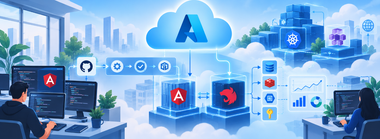
Building Angular and NestJS Applications on Azure: A Production Architecture
Design an Azure architecture for Angular and NestJS across CSR, SSG and SSR, API and worker hosting, managed identity, data, messaging, delivery, observability, and disaster recovery.
10 min read
08 Sep 2026
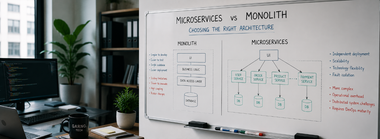
Microservices vs Monolith: Choosing the Right Architecture
Compare monoliths, modular monoliths, and microservices through delivery, domain boundaries, data, reliability, scaling, team ownership, cost, and migration evidence.
8 min read
24 Jul 2026
The Business Impact of Custom Software: Value, Risk, and Ownership
A decision guide to custom software: identify the constraint, compare buy and build options, redesign operations, control data, improve customer journeys, model lifecycle ROI, and preserve long-term ownership.

9 min read
24 Jul 2026