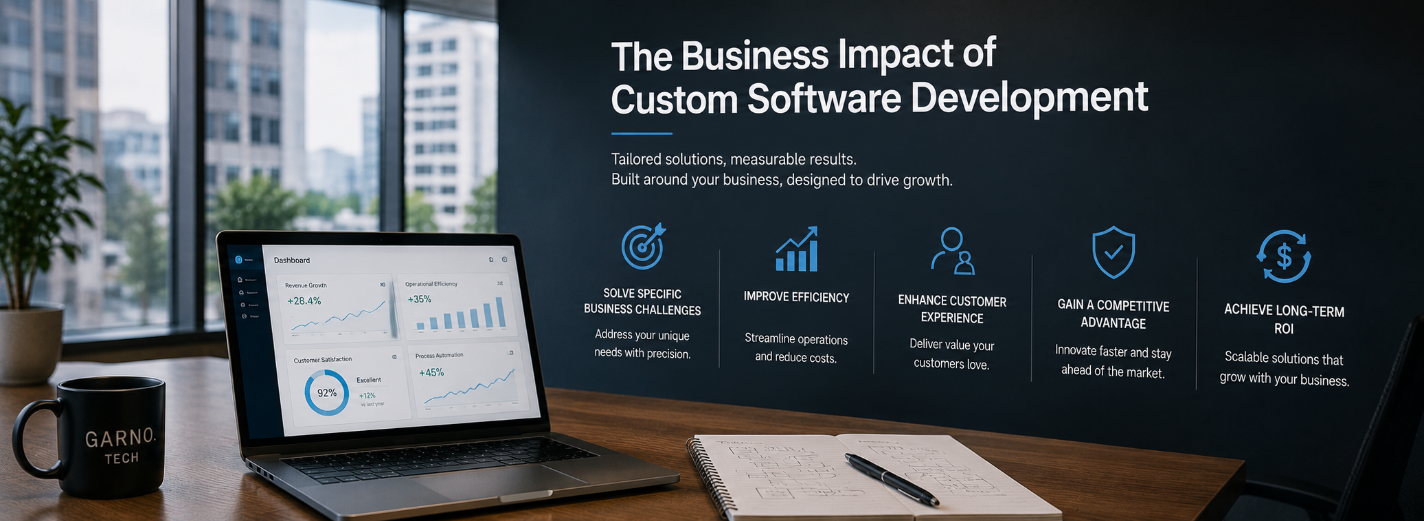
The Business Impact of Custom Software: Value, Risk, and Ownership
- custom software development
- business software
- enterprise software
- business automation
- digital transformation
- software ROI
- scalable software
- custom business platforms
- process optimization
- software modernization
Custom software creates business value when it removes a constraint that standard products cannot remove economically.
The constraint may be a slow order-to-cash cycle, fragmented customer data, a manual compliance review, an inflexible pricing model, poor self-service, or a platform that cannot support a new market. Code is only one part of the answer. Process design, data quality, integration, controls, adoption, operating ownership, and the ability to change the system determine whether the investment improves the business or merely creates another application to maintain.
Begin with the decision, not a feature list. Describe the affected users and workflow, current baseline, cost of the problem, desired outcome, deadline, risk, and evidence that would prove improvement. Then compare changing the process, buying a product, configuring or integrating existing systems, building a focused extension, and creating a custom platform. Standard software is often the better choice for commodity work. Custom development earns its premium when the workflow is strategically distinctive, the integration or control boundary matters, the volume makes recurring friction expensive, or ownership enables a valuable capability that the market does not supply.
Redesign the Operation, Not Only Its Interface
Operational value rarely comes from digitizing the visible form. Trace the work from trigger to verified outcome: who supplies information, which decisions occur, where people wait, how exceptions are handled, which systems change, what evidence is retained, and how the customer learns the result. Measure touch time, elapsed time, handoffs, work in progress, rework, error cost, abandonment, service-level breaches, support contacts, and demand by case type. This distinguishes a true constraint from a step that merely looks inefficient.
Redesign before automating. Remove approvals that manage no meaningful risk, clarify decision rights, standardize essential inputs, and expose exceptions instead of encoding every historical habit. The system can validate data at entry, calculate prices and entitlements, route cases by risk, generate documents, synchronize records, schedule work, request approval, preserve an audit trail, and notify the right person. Keep a human in the loop where judgment, legal accountability, empathy, or rare ambiguity matters, and give operators the context and authority to resolve those cases safely.
A shared workflow changes management as well as execution. Leaders can see queue age, capacity, demand, failure reasons, service levels and exception patterns without asking teams to assemble spreadsheets. Employees stop maintaining private copies of the truth. Customers receive consistent status. The best result is not maximum automation; it is shorter flow time, fewer avoidable errors, clearer ownership and more capacity for valuable judgment. Validate that outcome with a representative vertical slice, then remove the parallel spreadsheet or legacy step that would otherwise preserve the old cost.
Create Capacity for Scale and Change
Business scalability means that revenue, customers, products, regions and transaction volume can grow without equivalent growth in manual coordination, risk or support. Model future volume and variability by workflow, not as a single traffic multiplier. More customers may create more identity checks, invoices, disputes and data retention; a new region may add language, tax, residency, currency and support requirements; a new pricing model may affect contracts, billing, entitlement, reporting and reconciliation. The platform must scale the complete operation, not only the web tier.
Design stable domain boundaries around capabilities the business understands. Separate orders, billing, inventory, identity or case management where their rules and ownership differ; use APIs and events deliberately; keep critical invariants close to the data they protect. Modularity makes change safer only when interfaces, ownership and test evidence are clear. Premature microservices can multiply deployment, networking, consistency and on-call work, while a well-structured modular application may offer better speed and reliability for years.
Control of the roadmap is valuable when paired with disciplined product management. Maintain an outcome-based backlog, architecture decisions, supported-version policy, dependency inventory, quality budgets and deprecation plan. Reserve capacity for security, observability, performance, accessibility, upgrades and simplification. Use feature flags and progressive rollout for uncertain changes. Custom software should shorten the time from market evidence to a safe product response; if every change depends on one supplier, undocumented code or fragile releases, nominal flexibility has not become business adaptability.
Turn Data Control into Better Decisions
Custom software can establish a controlled data model across CRM, finance, operations, customer portals and partner systems, but integration does not automatically create truth. Name a system of record for each entity and field, stable identifiers, ownership, validation, allowed transitions, synchronization direction, latency, conflict policy and repair process. Use APIs, events, change data capture or batches according to consistency and timeliness needs. Monitor freshness, duplication, failed messages and reconciliation rather than assuming that a successful connector means correct data.
Data control includes classification, lawful purpose, consent where required, access by role and attribute, encryption, lineage, retention, deletion, residency, backup, recovery and auditable change. Minimize collection and separate operational access from analytics. Ensure that exports, migration tools and documented schemas preserve the company’s ability to leave a provider or replace a component. Ownership is practical only when the organization can understand, retrieve, correct, protect and move its data without privileged knowledge held elsewhere.
Reliable data improves decisions because definitions are explicit. Build metrics from business events and reconcile them to operational and financial sources. A dashboard should let leaders investigate conversion, cycle time, unit economics, backlog, capacity, quality and customer outcomes rather than display totals without provenance. The same foundation supports search, forecasting and AI, but those uses also require permission, quality evaluation, monitoring and human accountability. An intelligent assistant trained on contradictory or unauthorized records makes bad decisions faster.
Earn Customer Value and Differentiation
A custom customer journey can express the service model precisely: what information is needed, which choices are available, how price or eligibility works, when human help appears, and what happens after submission. Start with research and service evidence, not the freedom of a blank canvas. Observe where people hesitate, abandon, contact support, repeat information or lose trust. Include customers using assistive technology, slower devices, weak networks, different languages and unfamiliar domain terminology.
Connect the interface to operational reality. Real-time availability is valuable only when inventory is trustworthy; personalized offers require explainable eligibility and consent; self-service needs safe identity recovery, meaningful status, error correction and escalation to a person. Measure task success, time, conversion, retention, repeat contacts, accessibility, complaints and cost to serve. Faster completion that increases downstream errors or excludes a customer group is not an unqualified improvement.
Differentiation comes from a capability competitors find difficult to reproduce: superior fulfillment, an unusual configuration model, faster underwriting, transparent tracking, partner coordination, or insight created by proprietary operations and data. Visual novelty is easily copied. Protect the advantage through learning speed, dependable execution, domain knowledge and an architecture that can evolve. Test the smallest experience that proves demand before building a complete platform, and continue to compare its customer and economic outcome with simpler market alternatives.
Model Lifecycle Economics, Not the Build Quote
Compare options over a realistic horizon. The custom path includes discovery, design, engineering, migration, integration, security and compliance evidence, infrastructure, release, training, change management, support, observability, incident response, hosting, licenses, upgrades, dependency remediation, data retention and eventual replacement. Buying includes subscription growth, implementation, customization, integration, consulting, data export, vendor constraints, price change and switching cost. Preserving the current process also has a cost in labor, delay, errors, lost demand, risk and foregone change.
Build an economic model from the baseline. Quantify volume, minutes per case, loaded labor, rework, failure loss, support demand, licensing, infrastructure, conversion, gross margin, working capital, risk exposure and the capacity needed for growth. State a range for adoption, delivery time and benefit rather than one confident forecast. Use net present value, payback or another finance measure appropriate to the organization, but keep assumptions visible. Avoid counting employee time as cash savings unless workload or headcount can actually change.
Fund phases that reduce uncertainty. Discovery maps the workflow, data, constraints and alternatives. A prototype tests comprehension; a technical proof tests the riskiest integration or scale assumption; a vertical slice exercises one outcome through production-shaped architecture and operations. Define evidence gates, maximum investment and stop conditions before each phase. Reforecast from what was learned. Software becomes an asset when it reliably supports a valuable capability and the organization can maintain and change it; capitalization on a balance sheet does not create that condition.
Manage the Risks That Turn Software into a Liability
The most common failure is committing to a solution before verifying the problem. Large requirement documents then freeze assumptions, stakeholders add protective features, and delivery reports output while the original constraint remains. Use product discovery, direct observation, data, prototypes and thin production slices to test the riskiest beliefs. Give one product owner authority to order outcomes and reject work. Control scope by the value hypothesis and operating boundary, not by treating every early request as a promise.
Technical debt becomes business risk when releases slow, incidents grow or knowledge concentrates. Set requirements for security, privacy, accessibility, performance, availability, recovery, audit, testing and observability alongside features. Automate builds, checks, infrastructure and rollback. Keep repositories, cloud accounts, domains, certificates, analytics, app-store records, documentation and production authority under company control. Use architecture records, runbooks, dependency inventories and internal co-ownership to make supplier replacement or team change possible.
Adoption is a change programme. Involve users in workflow design, identify how roles and incentives change, prepare data and support, train on real tasks, and measure actual use and outcomes by segment. Plan migration, coexistence and retirement; running the old and new process indefinitely doubles cost and hides failure. After launch, assign product, technical, data, security and operational owners with budget for maintenance and improvement. Review benefits against the baseline and stop, simplify or replace capabilities whose value does not justify their lifetime cost.
Custom software is valuable because it changes a measurable business constraint and leaves the organization able to operate, learn, and change.
— GARNO.TECH
Build the Smallest System That Changes the Outcome
GARNO.TECH helps organizations decide whether custom software is justified and, when it is, build the smallest system that changes a measurable outcome. We begin with the business constraint, affected users, workflow, data, current systems, risk, baseline and decision deadline. The result may be a process change, configuration of an existing product, integration, modernization, a focused internal tool, a customer platform, or a new digital product.
Discovery produces a service and data map, option assessment, target operating boundary, prioritized outcomes, architecture direction, risk register, delivery slices, lifecycle estimate and acceptance evidence. Engineering can cover web and backend applications, enterprise workflows, API and event integration, cloud infrastructure, migration, automation, observability and operational readiness. We release in bounded increments, demonstrate working evidence, transfer knowledge and keep source, environments and decisions reviewable.
Bring the workflow that creates delay or limits growth, the systems and data involved, volumes, user groups, known risks, current cost, regulatory constraints, target outcome and available team. We will challenge the build assumption, compare credible alternatives, identify the riskiest unknown and shape a first phase that buys useful evidence. The goal is a business capability the organization can operate and evolve—not a larger backlog of custom code.
Publications
Our research
Research and development of AI-powered solutions to optimize business workflows and enhance decision-making processes.
Analysis of machine learning models for predictive analytics in finance, e-commerce, and SaaS platforms.
Exploration of natural language processing and computer vision technologies to strengthen automation, personalization, and customer support.
Machine Learning Across Industries: From Prediction to Better Decisions
A practical guide to machine learning in healthcare, finance, retail, manufacturing, logistics, real estate, education, and professional services—with evaluation and governance built in.

11 min read
24 Jul 2026
Microservices vs Monolith: Choosing the Right Architecture
Compare monoliths, modular monoliths, and microservices through delivery, domain boundaries, data, reliability, scaling, team ownership, cost, and migration evidence.

8 min read
24 Jul 2026
Building Scalable SaaS Platforms: Architecture That Preserves the Business Model
Design SaaS architecture around tenant lifecycle, isolation, entitlements, billing, data growth, reliability, security, delivery, observability, and operating cost per customer.
8 min read
24 Jul 2026