Building Scalable SaaS Platforms: Architecture That Preserves the Business Model
- SaaS architecture
- scalable SaaS
- multi-tenant architecture
- cloud SaaS platform
- SaaS best practices
- software scalability
- SaaS security
- SaaS billing
- platform engineering
- enterprise SaaS
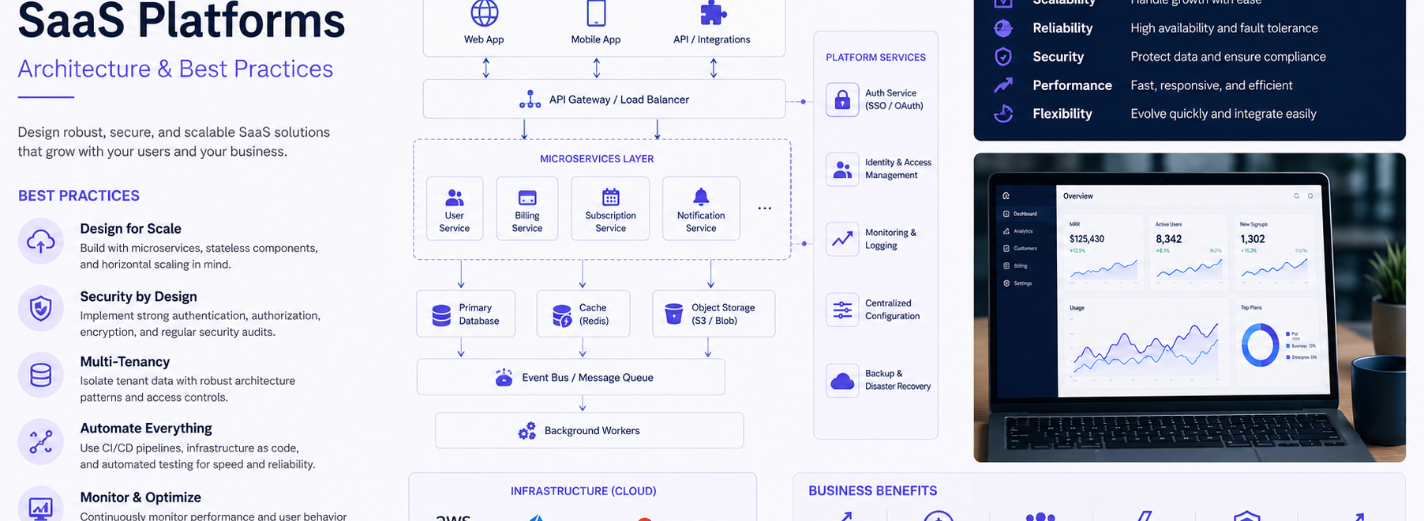
A scalable SaaS platform does more than process additional requests. It can onboard more customers, support more users and data, introduce plans and markets, release product value, recover from failure, and answer customer obligations without operating effort and cost rising at the same rate as revenue. That is an architectural and organizational property, not an autoscaling setting.
SaaS concentrates responsibility. One continuously changing product serves many organizations with different people, permissions, configuration, usage, contracts, support expectations, and data obligations. A defect in tenant context, entitlement, migration, or administrative tooling can affect many customers at once. The architecture must preserve isolation while retaining enough standardization for one product team to operate it economically.
Start with business journeys and the operating model: tenant acquisition and provisioning, identity and membership, configuration, core work, collaboration, usage, plans, billing, support, export, retention, suspension, reactivation, and deletion. Define service and recovery targets, expected tenant distribution, demand peaks, geographic needs, regulated boundaries, manual operations, and ownership. Scale means these journeys remain correct, observable, and affordable as the distribution changes.
Begin with the SaaS Operating Model
Organize the application around business capabilities with narrow contracts: tenant management, identity, entitlements, billing, core domains, notifications, search, reporting, and integrations. A modular monolith is often the responsible starting point because it keeps local transactions and deployment simple while allowing boundaries to be enforced through imports, public APIs, tests, and ownership. Extract services only when independent team ownership, failure isolation, scale, or release cadence repays distributed cost.
Keep synchronous journeys shallow. Remote calls need end-to-end deadlines, bounded concurrency, cancellation, shorter upstream timeouts, safe retry rules, and meaningful degraded states. Move work to a queue when the product can tolerate delay, peaks need buffering, or expensive processing should not hold a customer request. Define delivery, ordering, deduplication, replay, poison handling, age limits, reconciliation, and operator tools before calling the workflow reliable.
Isolate external providers behind contracts that reflect the product rather than a vendor SDK. Record authoritative state, mapping, credentials, limits, webhook verification, idempotency, errors, monitoring, support, and replacement. This boundary makes supplier change visible and prevents provider semantics from spreading through domain code.
Make Tenant Isolation a System Property
Tenant isolation begins when identity is established and continues through authorization, object lookup, database queries, cache keys, messages, jobs, files, search indexes, logs, analytics, exports, backups, support access, and deletion. Never trust a tenant identifier supplied by a client without proving the actor’s relationship to that tenant. Test direct-object references, bulk operations, background paths, administrative functions, and cross-tenant aggregation.
Select the data isolation model from risk and operations. Shared tables with a tenant key can be efficient when query rules are enforceable and tested. Separate schemas or databases can strengthen blast-radius, residency, restore, key, or noisy-neighbor boundaries while increasing provisioning, migration, connection, monitoring, and fleet-management cost. Hybrid tiers may serve distinct customer obligations, but every tier multiplies paths that need delivery and recovery evidence.
Treat tenant provisioning as a durable workflow: create identity and data boundaries, configuration, entitlements, keys, regions, integrations, limits, observability, billing linkage, and initial administrators; handle partial failure and safe retry. Model suspension, transfer, merge, export, reactivation, and deletion with the same care. Customer-specific behavior belongs in governed configuration and extension points, not permanent code forks.
Scale Capabilities from Measured Demand
Model demand as a distribution, not an average: tenants differ in users, data, query shapes, integrations, scheduled jobs, exports, and peak times. Define fairness and protection. Apply quotas, concurrency bounds, rate limits, job priorities, export limits, and plan-specific capacity at the right identities. One large customer or broken integration should not consume the pools and queues needed by every other tenant.
Keep request-serving instances stateless where practical and put durable state in owned systems. Scale APIs, workers, search, reporting, and media pipelines independently when their resource profiles differ. Autoscaling needs signals related to the actual constraint—queue age, concurrency, latency, memory, storage throughput, or business backlog—and must account for startup delay, quotas, warm-up, minimum capacity, and failure conditions.
Cache with an explicit source of truth, tenant and authorization boundary, freshness promise, invalidation path, size limit, sensitive-data policy, and stampede protection. Test production-shaped data and traffic through baseline, step, spike, soak, and failure scenarios. Publish a safe operating envelope that identifies the first constraint, customer-visible degradation, recovery time, and trigger for the next capacity action.
Design Data Ownership, Consistency, and Lifecycle Together
Assign authoritative ownership for every important entity and transition. Design indexes and queries from real access patterns, including tenant, status, time, relationship, and pagination. Observe returned versus examined data, lock and pool behavior, transaction duration, replication delay, working-set pressure, and large-tenant skew. Read replicas, caches, search indexes, analytics stores, and projections are derived views; define their freshness, failure, rebuild, and customer semantics.
Local transactions protect invariants inside one data boundary. Work that crosses services or providers needs explicit intermediate states, durable events, idempotency, compensation, and reconciliation. Preserve unknown outcomes rather than announcing success or failure that cannot be proven. Operator tools should expose evidence and constrained repair actions without requiring database edits.
Plan data growth and change: retention, archive, partitioning, backup, point-in-time recovery, tenant export, legal hold, deletion, residency, encryption keys, schema evolution, backfill, and restore. Use expand-and-contract migrations compatible with mixed application versions. Run large transformations outside the request and deployment critical path, with progress, throttling, restart, validation, and repair.
Engineer Reliability Around Customer Journeys
Define reliability from customer journeys: sign in, complete core work, invite a member, generate a report, change a plan, or recover a failed transaction. Measure successful outcomes, p50/p95/p99 latency, error classes, freshness, backlog, saturation, and reconciliation. Segment by tenant tier, region, version, and dependency where that changes action, without exposing sensitive customer data.
Model failure across bad releases, overload, dependency timeout, queue backlog, credential expiry, data corruption, region or zone loss, provider incidents, and operator error. For each critical journey, state detection, containment, customer state, data consequences, recovery action, authority, and proof of restoration. Use redundancy only when the complete failover and recovery model meets a requirement.
Observability should correlate releases, requests, traces, logs, metrics, messages, jobs, database work, providers, and business transitions. Alert on symptoms an owner can act on. Rehearse rollback or forward repair, queue drain, provider loss, credential rotation, backup restoration, tenant-specific recovery, and required regional procedures. A backup is evidence only after a restore succeeds within the promised time and data-loss boundary.
Turn Security and Compliance into Platform Capabilities
Separate customer, support, administrator, service, deployment, and emergency identities. Enforce authorization on the server for each operation and object; scope privileges to the smallest practical action and tenant; protect elevation; review access; and make break-glass use visible and expiring. Support impersonation or customer access needs an explicit purpose, consent or policy, audit trail, time bound, and restricted capability.
Classify data and trace it through primary stores, derived views, backups, logs, analytics, exports, support tools, and providers. Minimize collection and retention, encrypt transport and storage, define key ownership and rotation, govern secrets, restrict public exposure, and prevent sensitive values from entering telemetry. Tenant deletion must include derived and retained copies according to the actual obligation, not only the main table.
Turn recurring obligations into platform controls: policy-as-code, secure defaults, tenant-aware audit records, access evidence, configurable retention and residency, supplier inventory, vulnerability and dependency processes, incident response, recovery proof, and customer evidence packages. Manual work may remain for judgment, but repeated evidence collection should not require an emergency project for every enterprise sale or audit.
Keep Billing, Entitlements, and Product State Consistent
Billing is a domain, not a checkout screen. Model product catalogue and price versions, plans, subscriptions, trials, discounts, usage, limits, invoices, tax inputs, payment status, credits, cancellation, renewal, and customer communication. Separate commercial records from provider representations so a webhook cannot silently redefine what the customer bought.
Entitlements answer what this tenant may use now: features, quantities, roles, service levels, retention, regions, or support. Evaluate them through one governed capability with cached projections where necessary, rather than plan-name conditionals scattered through code. Define what happens during trial expiry, upgrade, downgrade, nonpayment, grace, cancellation, dispute, reactivation, or provider outage. Access changes must be explainable and reversible.
Usage metering needs an event definition, tenant, source, timestamp, quantity, unit, deduplication identity, correction policy, pricing period, retention, and reconciliation. Verify and store provider callbacks, process them idempotently, tolerate duplicate and out-of-order events, and reconcile internal subscription and financial state. Model variable supplier and infrastructure cost alongside revenue so apparently successful growth does not conceal failing unit economics.
Build a Delivery Platform That Reduces Marginal Cost
Build one traceable artifact, test and scan it, promote it through controlled environments, and preserve provenance. Represent infrastructure, policy, identity, networks, data services, queues, telemetry, budgets, and configuration as reviewed code. Database and event changes need compatible release sequences, observable backfills, and repair paths. Feature flags need ownership, a safe default, telemetry, expiry, and a removal decision.
Platform engineering should remove repeated cognitive and operational work through supported templates, paved paths, self-service environments, identity patterns, delivery pipelines, telemetry, secrets, recovery tools, and documented service boundaries. Measure adoption and outcomes; an internal platform that teams bypass or cannot debug adds another dependency rather than capability.
Track marginal economics and toil: time to provision and onboard a tenant, support contacts, manual reconciliation, incident impact, change lead time, failed releases, restore performance, cloud and provider cost per useful unit, and effort per customer tier. Automate stable, repeated, safe actions. Keep human authority for ambiguous, high-impact decisions. Growth is healthier when each additional customer requires less exceptional work.
A scalable SaaS platform serves more customers and releases more value while preserving isolation, trust, recovery, and unit economics—without exceptional operations growing at the same rate.
— GARNO.TECH
Build SaaS Capacity from Evidence
GARNO.TECH designs, builds, and modernizes SaaS platforms around measurable product and operating outcomes. We can define tenant and data boundaries, identity and authorization, domain architecture, subscriptions and entitlements, provider integrations, cloud foundations, delivery, observability, security, capacity, recovery, and the ownership model required after launch.
Work begins with evidence: customer journeys, tenant distribution, contracts, incidents, architecture, data growth, service targets, delivery performance, cloud and provider cost, support load, manual operations, and team capability. We identify the constraint with the greatest business consequence, prove the riskiest assumption, and deliver a bounded improvement with acceptance and transfer.
The result should be more than deployed software. It should leave enforceable decisions, versioned infrastructure and configuration, operable pipelines, useful telemetry, tested recovery, current documentation, cost ownership, and people who can continue the platform. Scalable SaaS architecture is successful when growth increases customer value faster than complexity, risk, and operating cost.
Technical scale also requires clear decision ownership. Use our guide to decide when a SaaS startup needs a CTO, build a decision-ready technical roadmap, or review our fractional technology leadership approach. Leadership should connect product promises, architecture, security, reliability, team capacity, and unit economics before local optimizations harden into platform constraints.
Publications
Our research
Research and development of AI-powered solutions to optimize business workflows and enhance decision-making processes.
Analysis of machine learning models for predictive analytics in finance, e-commerce, and SaaS platforms.
Exploration of natural language processing and computer vision technologies to strengthen automation, personalization, and customer support.
Microservices vs Monolith: Choosing the Right Architecture
Compare monoliths, modular monoliths, and microservices through delivery, domain boundaries, data, reliability, scaling, team ownership, cost, and migration evidence.
8 min read
24 Jul 2026
Machine Learning Across Industries: From Prediction to Better Decisions
A practical guide to machine learning in healthcare, finance, retail, manufacturing, logistics, real estate, education, and professional services—with evaluation and governance built in.

11 min read
24 Jul 2026
How DevOps Turns Digital Transformation into Delivery Capability
Use DevOps to turn digital strategy into a measurable operating capability through small releases, automated evidence, cloud platforms, observability, resilience, security, ownership, and learning.

8 min read
24 Jul 2026