
The ROI of Business Process Automation: Measure Value, Not Activity
- business process automation ROI
- automation ROI
- workflow automation
- cost reduction
- process optimization
- digital transformation
- operational efficiency
- automation payback period
- business automation software
- enterprise automation
Business process automation creates return when a redesigned process consumes less cash, time, attention, and risk while producing an equal or better business outcome. The technology may be workflow software, a custom platform, API integration, robotic process automation, document extraction, decision rules, or AI assistance. None creates value merely by replacing a manual click with a digital one.
A defensible business case describes the current process, the changed process, and the counterfactual: what would happen if the organization did not invest. It connects operating changes—less active work, waiting, rework, failure, or variation; more capacity, conversion, or control—to financial consequences over a named period. It distinguishes cash released from employee time made available and avoids counting the same outcome through several labels.
ROI is therefore a measurement system, not a percentage calculated once for approval. Assumptions need owners and confidence, adoption must be observed, benefits must appear in budgets, capacity, service, revenue, or risk evidence, and recurring cost must continue after launch. The model should be updated when volume, wages, provider prices, exception rates, rules, or customer behavior change.
Find Value in the Process, Not the Automation Label
Map the process from demand to verified completion. Record actors, systems, inputs, decisions, handoffs, queues, approvals, exceptions, controls, data quality, volume, seasonality, active time, waiting time, failure, rework, service levels, and customer consequence. Segment standard and exceptional cases. An average can hide a small difficult population that consumes most of the effort and determines whether straight-through automation is realistic.
Value often begins with simplification: remove a duplicated check, clarify decision authority, collect data once, reduce approvals, repair an upstream source, or stop work no customer needs. Then automate stable repeatable behavior and route ambiguous cases to people with context. Automating waste makes it faster and more expensive to change; forcing judgment into brittle rules creates costly exception recovery.
High-potential candidates combine meaningful volume, stable inputs, observable outputs, repeated rules, expensive delay or error, and an owner able to change the process. Low-frequency work, volatile policy, weak data, inaccessible systems, or predominantly expert judgment may justify assistance rather than end-to-end automation. Select by value, feasibility, risk, and learning—not visibility or executive enthusiasm.
Calculate ROI with an Explicit Time Horizon and Counterfactual
The simple formula is ROI = (financial benefit − total cost) ÷ total cost × 100%. A $160,000 verified benefit against $100,000 total cost produces a $60,000 net benefit and 60% ROI. State whether the model covers one year, three years, or another horizon; implementation is concentrated early while benefits and recurring costs accumulate over time.
Payback asks when cumulative net cash flow becomes positive. Dividing initial investment by average monthly net benefit is a useful shortcut only when benefit and cost are reasonably stable. For phased adoption, seasonal demand, ramping volume, or irregular maintenance, model monthly or quarterly cash flows. Larger programs should also consider discounted cash flow and net present value using a finance-approved discount rate.
Build the counterfactual explicitly. Without automation, would volume require hiring, would the team absorb it, would service degrade, or would revenue be lost? Compare the automated future with that credible alternative, not with an impossible world where current cost remains fixed while demand grows freely. Include terminal or exit cost where vendor lock-in, data migration, or decommissioning is material.
Give every input a source, owner, unit, collection date, range, confidence, and sensitivity. Present conservative, expected, and upside cases rather than hiding uncertainty in one point estimate. Vary volume, adoption, exception rate, time saved, capacity conversion, implementation delay, recurring cost, and revenue attribution. The variables that move the result most deserve validation before more precise arithmetic.
Count the Full Lifecycle Cost of Automation
Total cost of ownership includes discovery, process redesign, product and interaction design, development or licences, integration, data cleanup and migration, infrastructure, security and privacy review, testing, deployment, documentation, training, change management, and the internal time of process owners, specialists, managers, users, procurement, legal, finance, and operations.
Recurring cost includes hosting, platform tiers, per-transaction charges, model inference, third-party APIs, observability, support, incident response, dependency and security updates, rule maintenance, vendor change, regression testing, audit evidence, data retention, backups, and improvements. Include the human work required to investigate exceptions and reconcile partial outcomes. An automated happy path can coexist with an expensive manual recovery path.
Estimate uncertainty where systems have poor APIs, undocumented behavior, inconsistent identifiers, unowned data, rate limits, licensing constraints, or manual authentication. Use a discovery slice or technical proof to retire the largest uncertainty. Contingency belongs in the model, but a percentage added to an unexplored scope does not make the estimate responsible.
Account for transition and exit. Parallel operation, duplicate licences, temporary productivity loss, migration support, legacy decommissioning, contract termination, export, archival, and retraining can be material. Compare cost and benefit on the same boundary and horizon; do not include enterprise-wide benefits while charging only one team’s implementation costs.
Separate Cash, Capacity, Revenue, Risk, and Strategic Benefits
Cash benefits change actual spending: eliminated overtime, retired licences, fewer external processing fees, reduced refunds or penalties, lower infrastructure cost, or headcount that is genuinely avoided. Capacity benefits release employee time. That time becomes financial value only when the organization removes cost, avoids hiring, processes additional valuable volume, improves service, or reallocates people to work with an evidenced contribution. Multiplying every saved minute by salary overstates return if the payroll does not change and no equivalent output appears.
Revenue benefits may come from faster response, fewer abandoned applications, greater availability, improved conversion, retention, or a service that cannot scale manually. Attribute cautiously. Use control groups, phased rollout, funnel analysis, or another credible comparison where possible, and subtract cannibalization, discounts, variable fulfilment cost, and sales effects. Do not claim the full value of a customer relationship because one automated email shortened a step.
Risk benefits include fewer errors, duplicate payments, compliance breaches, missed deadlines, fraudulent actions, safety events, or key-person dependencies. Model expected loss as probability multiplied by consequence only when both are supportable, and use ranges for rare high-impact events. Avoid adding risk reduction again as error savings or insurance value.
Strategic benefits—better data, auditability, customer experience, employee experience, faster experimentation, or a platform for future products—can matter without a defensible cash conversion. Report them separately with observable indicators. Classify benefits as confirmed, probable, contingent, or strategic so decision makers can see which claims drive the financial case.
Use Operational KPIs to Explain the Financial Result
Operational KPIs explain whether the process change caused the financial result. Measure demand, completed volume, active time, end-to-end cycle time, waiting, backlog age, throughput, straight-through processing, exception rate, first-pass yield, error, rework, abandonment, service-level compliance, availability, recovery, and customer outcome. Use consistent definitions before and after launch and preserve the population, period, and exclusions.
Adoption needs more than login counts. Track the share of eligible cases entering the new path, completion through it, manual work outside the system, overrides, fallbacks, time in exception queues, user error, support contact, and reasons people leave the workflow. A lower measured cycle time can be artificial if difficult cases move into an unmeasured spreadsheet.
Financial tracking should reconcile realized cash, avoided cost, converted capacity, incremental contribution margin, recurring cost, cumulative net benefit, payback, NPV, and forecast variance. Assign a benefit owner in operations or the business, a cost owner, and a data owner. Product delivery can enable a saving; it cannot decide whether the business will remove overtime, avoid a hire, or use the capacity productively.
Add guardrails for quality, security, privacy, fairness, compliance, employee health, and customer complaints. A faster process that rejects valid applications, obscures an appeal, leaks data, or transfers unpaid work to customers is not an improvement. Review segment-level outcomes so aggregate efficiency does not hide disproportionate harm.
A Worked Automation ROI Example
Consider a document-approval process with 20,000 requests a year. The baseline shows 15 minutes of active work for a standard request, or 5,000 hours annually. At a loaded cost of $30 per hour, the gross labor-value pool is $150,000. It is a pool, not yet a saving: volume, exceptions, waiting, and the destination of released capacity still matter.
A redesigned workflow collects and validates data once, integrates two systems, and routes exceptions with context. Standard requests fall to five manual minutes. If 80% of requests follow that path while the remaining 20% stay at 15 minutes, annual active work becomes about 2,333 hours. The released capacity is roughly 2,667 hours, or $80,000 at the loaded rate—not the $100,000 implied by applying the best case to every request.
Suppose the organization can avoid $35,000 of overtime and contractor cost, use capacity to process additional contribution worth $30,000, and verify $15,000 of fewer corrections and penalties. First-year benefit is $80,000. Implementation and transition cost $90,000; hosting, licences, support, and maintenance add $20,000. First-year net benefit is −$30,000 and ROI is about −27%.
In year two, if benefits remain $80,000 and recurring cost stays $20,000, net benefit is $60,000. Cumulative payback occurs halfway through year two under a simplified monthly model. The case should then test lower adoption, a higher exception rate, delayed launch, volume change, and recurring-price growth. A negative first-year ROI can be acceptable; hiding the timing cannot.
Why Plausible Automation Cases Fail to Produce Return
Automation underperforms when the team digitizes the existing procedure without questioning its purpose, rules, controls, and exception paths. Duplicate approvals survive, poor data moves faster, and the new system adds another interface beside email and spreadsheets. Redesign the process before encoding it, and preserve human judgment where uncertainty is economically valuable.
Weak baselines and optimistic denominators inflate benefits. Common errors include using peak volume as the annual average, timing only successful cases, excluding review and recovery, assuming perfect adoption, applying standard-case savings to exceptions, valuing all released time as cash, and counting the same effect as labor, capacity, revenue, and customer experience. Make the calculation traceable to source records.
Return also fails through poor usability, missing edge cases, unreliable integrations, excessive customization, vendor limits, inaccessible data, unsafe AI behavior, weak monitoring, and no owner for rules after launch. When employees create workarounds, treat them as product evidence. Punishing the workaround without repairing the need pushes the process into less visible channels.
Finally, benefits may be technically enabled but never realized. If no one owns adoption, workforce planning, service redesign, or revenue conversion, released capacity remains theoretical. Keep benefits realization in the operating plan through stabilization, not only in the funding document.
Maximize Return Through Scope, Adoption, and Benefits Ownership
Prioritize a portfolio by expected value, confidence, time to evidence, feasibility, risk, reuse, and strategic necessity. Do not rank only by headline ROI: a smaller initiative with rapid learning and high confidence may dominate a large speculative program. Account for shared platform costs and benefits once, then allocate them consistently.
Start with the smallest coherent slice that can prove the mechanism. Automate the common standard path, retain a well-designed human exception path, integrate the minimum authoritative systems, and measure from entry to verified completion. Define acceptance for behavior, security, privacy, data, performance, recovery, adoption, and financial evidence. Roll out gradually where comparison and safe reversal are possible.
Design adoption with users. Observe real work, include specialists in rules and exceptions, test accessibility and language, explain changed responsibility, train on decisions rather than screenshots, and provide support. Track where cases leave the automated path and why. Adoption is not a communication task after development; it is part of product design.
Review benefits on a fixed cadence after launch. Compare actual cost and value with the forecast, assign variance, update the model, improve the constraint, and decide whether to expand, change, transfer, or stop. Retire manual paths and legacy systems when evidence supports it. Automation earns return through maintained process ownership, not a one-time deployment.
Automation ROI is the verified value of a better process after full cost, adoption, exceptions, timing, and risk—not the number of tasks a system performs.
— GARNO.TECH
Automate a Process with Measurable Business Evidence
GARNO.TECH helps organizations assess, design, build, and improve process automation with measurable operational and financial evidence. Work can include workflow systems, custom business platforms, API integration, document processing, dashboards, notifications, approval and exception management, and bounded AI-assisted operations.
A responsible first engagement maps the current process and counterfactual, validates volumes and costs, segments exceptions, identifies authoritative data and integrations, tests the largest technical and adoption assumptions, and builds conservative, expected, and upside cases. The output is a decision: simplify without software, run a focused proof, deliver a production slice, prepare a phased roadmap, or stop because the return is not credible.
For delivery, we define ownership, architecture, security, observability, recovery, adoption, benefit measurement, and handover with the product scope. The client retains access to repositories, environments, data definitions, dashboards, and decisions. Start with one process whose outcome matters and whose evidence can prove whether automation deserves to expand.
Publications
Our research
Research and development of AI-powered solutions to optimize business workflows and enhance decision-making processes.
Analysis of machine learning models for predictive analytics in finance, e-commerce, and SaaS platforms.
Exploration of natural language processing and computer vision technologies to strengthen automation, personalization, and customer support.
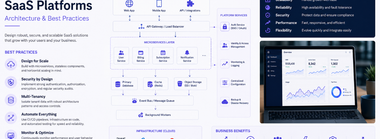
Building Scalable SaaS Platforms: Architecture That Preserves the Business Model
Design SaaS architecture around tenant lifecycle, isolation, entitlements, billing, data growth, reliability, security, delivery, observability, and operating cost per customer.
8 min read
24 Jul 2026
Business Automation Solutions for Controlled, Measurable Work
A practical guide to selecting and designing business automation: workflow states, rules, human decisions, integrations, data authority, reliability, security, observability, metrics and staged adoption.

8 min read
24 Jul 2026
The Future of AI in Enterprise Software: From Copilots to Governed Workflows
A practical guide to the next enterprise AI architecture: assistants, bounded agents, model portfolios, retrieval, evaluation, security, human authority, cost control and regulatory evidence.

10 min read
24 Jul 2026