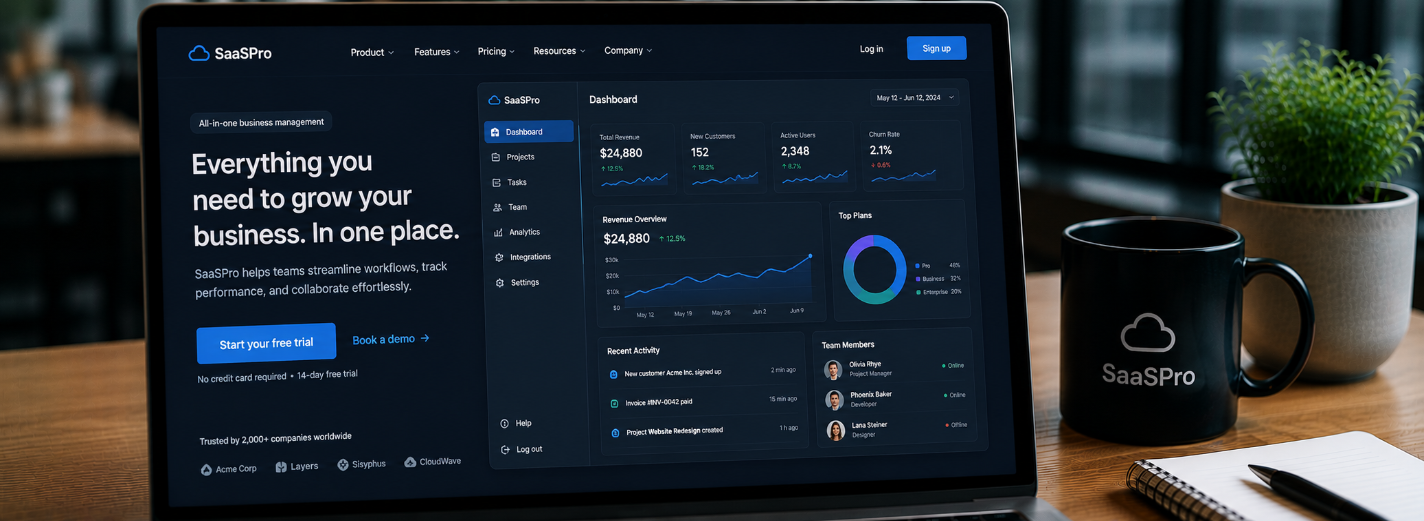
SaaS Solutions: From a Valuable Workflow to an Operable Platform
- SaaS solutions
- SaaS development
- custom SaaS platform
- multi-tenant architecture
- subscription billing
- cloud software
- B2B SaaS
- SaaS integrations
A SaaS product is a promise to deliver evolving software as a dependable service. Customers experience a workflow, but the provider must operate identity, tenant boundaries, data, entitlements, billing, integrations, releases, support, security and recovery as one product. The code is only part of the offer. Onboarding time, reliability, adoption, support effort, gross margin and the ability to change safely determine whether the model scales.
Begin with a narrow customer outcome and an economic hypothesis. Name the buyer, user, painful job, current alternative, reason to switch, path to first value, pricing unit and cost drivers. Validate the workflow before building a broad platform. A production-shaped vertical slice should prove the risky domain rule, tenant and permission model, one integration, observability and the route from signup to a measurable outcome. It should also reveal what must stay manual until demand justifies automation.
Multi-tenancy is an architectural option, while SaaS is a business and operating model. A product may pool most resources, isolate selected data or workloads, or provision a complete silo for a regulated tier. The important SaaS property is repeatability: tenants receive a controlled product version, onboarding, policy, telemetry, support and upgrades through a unified operating model rather than a collection of customer-specific installations.
Connect product metrics to unit economics from the beginning. Track acquisition source, activation cohort, retention, expansion, contraction and churn beside infrastructure, provider, support and success cost. Attribute variable consumption to tenants and plans without turning every request into a billing dependency. The goal is to learn which workflows create durable value and which customers or features require disproportionate service. Growth in accounts is not healthy scale when gross margin, reliability or support capacity deteriorates faster.
Design SaaS as a Business and Operating Model
Tenant identity must be a first-class context. Define what a tenant represents, how users can belong to one or several tenants, who administers membership, and how roles, groups and resource relationships affect permission. Authenticate the user, then carry verified tenant context through application, background work, data access, cache keys, files, search, events, logs and support tooling. A tenant ID supplied by the browser is routing input, not authorization. Enforce isolation through shared policy and data-access mechanisms so every feature author does not have to remember the same filter.
Entitlements translate the commercial model into product behavior. Separate identity, permissions, plan entitlements, feature rollout and consumption limits. A person may be allowed to administer billing but not use a premium capability; a tenant may own a feature but exceed a metered quota; a beta flag may expose behavior independent of price. Store effective-dated decisions and evidence, and make enforcement consistent across UI, APIs and asynchronous work. Otherwise invoices, contracts and actual access drift apart.
Subscription billing is an asynchronous financial workflow. Model customers, subscriptions, items, quantities, trials, coupons, tax, invoices, credits, payment attempts, grace periods, cancellation and reactivation according to the real commercial policy. Treat provider webhooks as untrusted, retryable and possibly duplicated input; verify them, persist event identity, process idempotently and reconcile against provider state. Do not grant permanent access from a browser redirect or a single event. Finance and support need an auditable timeline and tools to correct exceptional states.
Onboarding and administration are product surfaces. Design organization creation, invitation, domain or SSO setup, data import, configuration, training, first value, offboarding and export. Give tenant administrators clear controls and give internal teams a safe management plane with audited impersonation, support access and repair actions. Measure activation steps, time to value, abandonment and recurring support. Enterprise onboarding may include procurement, security review and migration; automate the repeatable parts without hiding decisions that need accountable human approval.
Data lifecycle is part of the customer contract. Classify content, operational records, audit evidence, analytics and backups; define ownership, residency, retention, legal hold, export, correction and deletion. Make tenant offboarding reversible during an agreed recovery window and provably complete afterward. Separate product telemetry from customer content, minimize sensitive data and document subprocessors and transfer paths. A customer should be able to understand what the platform stores, why it stores it and how the relationship can end without captivity.
Build Isolation, Scale, and Change into the Architecture
Choose a tenancy model per resource rather than applying one slogan to the whole system. Pooled compute and storage can improve utilization; schema, database, account or full-stack silos can strengthen boundaries or satisfy performance and regulatory needs at greater operating cost. Bridge models combine them by tier or capability. Document isolation, encryption, backup, restore, residency, deletion, noisy-neighbor and cost requirements for data, files, search, cache, queues and analytics. Test cross-tenant access and restore a single tenant where the design promises it.
Start with a modular architecture sized for the present product. A modular monolith with separate workers often gives an early team clearer transactions and lower operational cost than premature microservices. Define domains for identity, tenancy, catalog, workflow, entitlements, billing, notifications, integrations and reporting; assign each authoritative data and contracts. Extract a service only when independent scale, failure isolation, deployment, security or stable team ownership makes the lifetime cost worthwhile.
Integrations need explicit state. CRM, payment, accounting, email, identity, data warehouse and customer APIs will fail, retry, reorder and disagree. Use stable identifiers, idempotent commands, bounded retries, dead-letter handling, reconciliation and repair tools. Commit the authoritative business change before publishing its notification through a transactional outbox or equivalent pattern where loss matters. Version public APIs and events, define rate limits and deprecation, and provide webhooks that customers can verify and replay safely.
Operate through a tenant-aware lens. Measure activation, feature adoption, workflow outcomes, errors, latency, saturation, consumption and cost by tenant and tier without creating unsafe or unbounded telemetry. Detect a noisy neighbor before it becomes a shared outage. Establish service objectives, quotas, admission control, capacity forecasts, backups, restore exercises, incident roles and staged deployment. Progressive rollout by internal accounts, cohorts, tier or tenant can constrain blast radius when the platform and feature model support it.
Design recovery across the whole service, not only the database. Record recovery objectives for identity, configuration, files, search, queues, integrations and billing state; know which stores are authoritative and how derived indexes are rebuilt. Backups without restore exercises are assumptions. Rehearse regional or provider failure where the business requires it, verify tenant isolation during recovery and preserve an auditable sequence of administrative actions. Communicate degraded behavior so support can distinguish a delayed integration from lost customer work.
Develop the Platform by Buying Down Risk
Discovery frames the product and its risks. Map the customer journey, domain rules, alternatives, willingness to pay, pricing and cost drivers, tenant model, data classes, compliance claims, integrations, nonfunctional needs and operating ownership. Define a small set of business and service measures: activation, time to first value, conversion, retention, successful workflow completion, support demand, gross margin, reliability and recovery. Rank assumptions by consequence and uncertainty.
A prototype tests understanding; a technical proof tests uncertainty. Use a prototype to test language, workflow and usability without pretending it is production. Use focused proofs for the hardest identity, billing, isolation, migration, integration, performance or rendering question. Give each experiment a maximum investment, acceptance evidence and stop condition. A demo that avoids failure, permissions and realistic data has not validated an operating product.
The first release should be a complete narrow service. Deliver one valuable outcome through tenant creation, identity, authorization, persistent data, entitlement, billing or its temporary manual control, telemetry, deployment, support and recovery. Defer breadth while preserving integrity. Instrument the funnel and workflow, talk to users and operators, and update scope from evidence. Avoid a long fixed specification that consumes the budget before the riskiest assumptions meet reality.
Growth turns product learning into platform investment. Automate onboarding and support actions that repeat, strengthen isolation and compliance evidence, add tenant-aware cost and reliability views, and expand integration and data capabilities in response to validated demand. Revisit pricing against actual consumption and support. Fund upgrades, security, capacity, incident response and data lifecycle as continuing product work. Scale architecture when measured limits appear, not when a diagram makes the company look mature.
Govern customer-specific needs through product policy. Classify each request as configuration, entitlement, integration, extension or core product behavior. Give configuration schemas, validation, defaults, versioning and support boundaries; avoid per-customer branches that block unified releases. When an enterprise commitment is justified, record its revenue, operating cost, security impact, owner and path back to a shared capability. A SaaS roadmap stays coherent when sales promises, architecture and support obligations use the same decision process.
A SaaS platform scales when every new tenant receives reliable value through repeatable onboarding, isolation, billing, support, deployment and recovery—not merely when the infrastructure accepts more traffic. Durable growth joins product value, tenant safety, unit economics and the ability to diagnose and repair the service under pressure. Product and operating capability must improve together.
— GARNO.TECH Engineering Team
Build an Owned SaaS Capability with GARNO.TECH
GARNO.TECH can help validate a SaaS opportunity, deliver a production-shaped MVP, scale a live platform or modernize a product whose billing, tenancy or operations no longer fit. Share the customer and buyer, critical workflow, current evidence, commercial model, tenant and identity requirements, data and compliance constraints, integrations, expected demand, incident history, team and budget. We will identify the riskiest assumptions and propose the smallest stage that can resolve them.
A credible engagement should leave the client in control. Repositories, cloud and vendor accounts, domains, data, keys, telemetry, billing configuration and production approval should remain under client ownership. Expect architecture and decision records, measured acceptance criteria, security and recovery evidence, a prioritized roadmap, operating runbooks and paired knowledge transfer. Success is a product that customers can adopt and the organization can deploy, observe, support, recover and evolve without dependence on its original builders.
Explore our NestJS services for SaaS and business platforms, Azure cloud engineering and product scaling services, or bring the workflow directly. The first decision is not which cloud or framework to select; it is which customer outcome is valuable enough to operate as a service.
Evaluate a delivery partner with production evidence. Ask for examples of tenant isolation, billing reconciliation, data migration, incident response, capacity testing and customer handover, then use a short paid exercise on sanitized context. Confirm the named team, allocation, senior review, subcontracting, security practices and continuity plan. Compare proposals on the same lifecycle scope, including discovery, product design, environments, observability, support, upgrades, cloud and provider cost. A low build estimate that omits operation simply moves cost beyond the proposal.
Publications
Our research
Research and development of AI-powered solutions to optimize business workflows and enhance decision-making processes.
Analysis of machine learning models for predictive analytics in finance, e-commerce, and SaaS platforms.
Exploration of natural language processing and computer vision technologies to strengthen automation, personalization, and customer support.
Building Scalable SaaS Platforms: Architecture That Preserves the Business Model
Design SaaS architecture around tenant lifecycle, isolation, entitlements, billing, data growth, reliability, security, delivery, observability, and operating cost per customer.
8 min read
24 Jul 2026
Real Estate Software That Reflects How Property Operations Actually Work
Design PropTech around property data, listing rights, search, leads, leases, tenants, maintenance, payments, integrations, analytics, privacy, and operational exceptions.

8 min read
24 Jul 2026
Logistics and Supply Chain Software: From Fragmented Events to Operational Control
A practical guide to designing logistics software around orders, inventory, shipments, warehouses, partners, exceptions, traceability, and decisions that operators must make in real time.

8 min read
24 Jul 2026