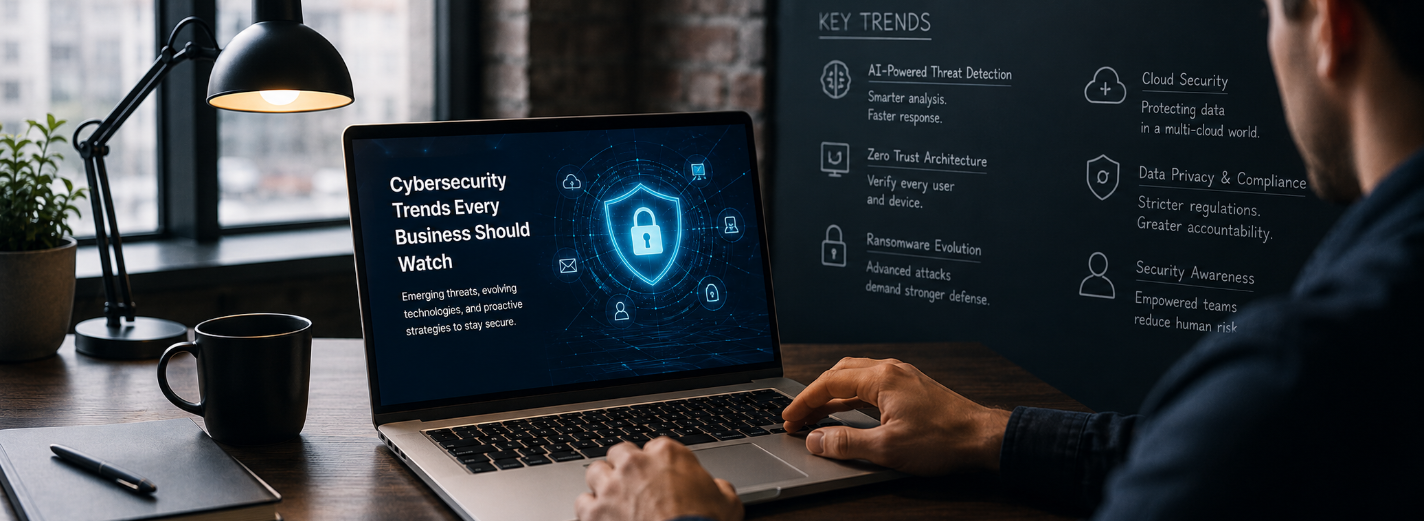
Cybersecurity Trends: Turn Threat Signals into Business Decisions
- cybersecurity trends
- business cybersecurity
- AI cyber threats
- ransomware protection
- identity security
- zero trust
- software supply chain security
- cloud security
- API security
- cyber resilience
Cybersecurity trends matter only when they change a decision. Attackers continue to exploit credentials, exposed services, unpatched vulnerabilities, third parties and human trust; AI and automation can increase the speed, personalization and reach of those familiar paths. Meanwhile, cloud platforms, SaaS, APIs, CI/CD, connected devices and AI systems add identities and dependencies faster than many organizations can inventory them.
Start with business services rather than a list of products. Name the customer and operational journeys whose loss, manipulation or disclosure would cause material harm. Map their data, human and machine identities, applications, infrastructure, vendors and recovery dependencies. Record accountable owners, maximum tolerable outage, recovery point and time objectives, legal obligations and the decisions required during an incident. Threat intelligence then has a place to land.
Use a baseline such as the NIST Cybersecurity Framework or applicable sector requirements to organize governance, identification, protection, detection, response and recovery. Measure exposure and outcomes: externally reachable assets, known-exploited vulnerability age, phishing-resistant MFA coverage, privileged and dormant accounts, secrets and certificate age, critical logging gaps, restore success, incident containment time and overdue supplier findings. Trend reports can inform priorities, but your asset graph and tested recovery determine whether risk is actually falling.
AI Scales Social Engineering—and Expands the Asset Inventory
Generative AI lowers the effort needed to create plausible messages, translate lures, imitate roles and sustain high-volume interaction. Synthetic voice or video can add urgency to payment, credential or access requests. The defensive implication is not to rely on employees spotting awkward language. Treat high-consequence requests as transactions that require verification independent of the message: known-channel callbacks, dual approval, destination controls, transaction limits and clear escalation.
Make phishing-resistant authentication the default for email, administrators, remote access, finance and other critical systems. Reduce the value of stolen sessions with device posture, conditional access, short-lived privileges, token protection where available and rapid revocation. Provide a one-step reporting path and measure reporting plus containment, not quiz completion. Train through the organization’s real workflows, including help desk resets, executive impersonation, vendor bank-detail changes and consent grants.
AI adoption also creates assets to defend. Inventory approved models, agents, plugins, data connectors, retrieval sources, prompts, tool permissions, service accounts and generated-code paths. Separate public, internal, confidential and regulated data. Constrain what an agent may read and execute, require human approval for consequential actions, log tool use, test prompt injection and data leakage, and define a kill switch. Review generated code and dependencies through the same secure-development controls as human work.
Attackers using AI do not make every defense obsolete. Strong identity, hardened endpoints, patched edges, segmented access, protected logs and practiced response still interrupt the attack chain. Fund controls by the loss they prevent and evidence they produce instead of purchasing an “AI security” label.
Identity Is the Control Plane Attackers Try First
Identity connects employees, customers, partners, workloads, automation and vendors to nearly every business service. That makes authentication tokens, sessions, API keys, service principals, OAuth grants and recovery processes valuable targets. An attacker who signs in through a legitimate path can bypass controls built only to detect malicious files or network locations.
Build an identity inventory across directories and cloud tenants. Require phishing-resistant MFA where supported, disable legacy authentication, separate administrator accounts, use just-in-time privilege and enforce least access by resource and action. Review dormant, shared, guest and emergency accounts. Tie joiner, mover and leaver events to authoritative HR or partner records and measure revocation delay. Protect the help desk from social engineering with stronger reset evidence and escalation for high-value roles.
Machine identity deserves the same discipline. Assign unique workload identities, prefer short-lived federation over static secrets, scope permissions, rotate keys and certificates, and prevent secrets from entering repositories, logs or images. Inventory non-human owners and expiry. A service account that cannot be linked to an application, environment and responsible team is an unmanaged asset.
Monitor for impossible or unusual sign-ins, new MFA methods, consent grants, privilege changes, token reuse, mailbox rules and access from unmanaged devices, while respecting privacy and local law. Detection needs a response: revoke sessions, contain the device, rotate dependent credentials, preserve evidence and examine lateral movement. Test this chain before compromise.
Ransomware Is a Business-Disruption and Recovery Test
Ransomware is no longer only file encryption. Operations can include credential theft, data exfiltration, extortion, destruction, harassment and pressure on customers or partners. The relevant business question is how long critical services can operate safely while systems, identities and data are untrusted—and whether recovery avoids reinfection.
Reduce initial access through fast remediation of known-exploited internet-facing vulnerabilities, phishing-resistant MFA, hardened remote management, restricted administration and monitored endpoints. Segment critical services and backup administration. Limit lateral movement through least privilege, separate management paths and controlled service accounts. Protect logs and recovery systems from the same identities that administer production.
Backups are useful only when they are complete, isolated, protected from deletion and repeatedly restored. Define RPO and RTO per service, map configuration and identity dependencies, keep clean recovery materials and test rebuild order. A database restore is not service recovery if DNS, certificates, secrets, SaaS configuration or operator access is missing. Measure restored business transactions, data reconciliation and security validation.
Exercise decisions with executives, legal, communications, finance, operations, security, insurers and relevant suppliers. Define who can isolate systems, contact authorities, notify customers, approve extraordinary spending and decide whether evidence supports restoration. Preserve out-of-band communications and current contacts. After exercises and incidents, assign each gap an owner and due date; resilience improves through closed actions, not the existence of a plan.
Software Supply-Chain Risk Reaches Every Build
Every software build depends on source repositories, package registries, build runners, container bases, plugins, actions, artifact stores, signing systems and maintainers. Compromise at one point can travel through trusted update paths. Third-party involvement and dependency exploitation deserve board attention because the organization may inherit exposure without receiving a direct warning.
Maintain an inventory of direct dependencies, critical transitive packages, build services and deployment privileges. Pin and review versions, verify provenance and integrity where the ecosystem supports it, scan code and artifacts, protect branches and releases, and isolate CI credentials. Prefer ephemeral least-privilege runners and prevent untrusted pull-request code from reaching production secrets. Generate an SBOM as evidence for investigation and supplier communication, not as a substitute for prioritization.
Prioritize vulnerabilities through exploitability, reachability, asset exposure and business consequence. A known-exploited flaw on an internet-facing control plane outranks a theoretical issue in unreachable development code. Track time from advisory to inventory match, owner assignment, mitigation and verified remediation. Keep emergency paths for configuration change, dependency removal, credential rotation and rollback.
Evaluate suppliers by the service dependency they create: data and access, subcontractors, development practices, incident notification, recovery objectives, evidence, support and exit. Test how the business operates when the supplier is unavailable or untrusted. Contracts should support action, but architecture should limit blast radius.
Cloud, APIs and Machine Identities Share One Exposure Surface
Cloud incidents often cross layers: an overbroad identity reaches an exposed API, a leaked secret changes infrastructure, or a public object store contains data copied by an integration. Security teams need a joined view of asset, identity, configuration, vulnerability, data and runtime evidence across accounts and providers. A misconfiguration count without exposure or consequence creates noise.
Establish organization-level guardrails: separate environments and accounts, deny dangerous defaults, centralize identity and logs, encrypt appropriately, restrict public access and record changes. Use infrastructure as code with review and policy checks. Detect drift, but define who can remediate it without breaking a critical service. Protect logging and security tooling in separate administrative boundaries.
APIs are business interfaces, not implementation details. Inventory public, partner, internal and shadow APIs; assign owners; document authentication, authorization and data class; and retire obsolete versions. Test object-level and function-level authorization on every request, validate input, constrain output, limit abuse and keep secrets off clients. Monitor unusual enumeration, token use, errors and data volume. Gateway controls cannot repair missing authorization inside the service.
Count machine identities and credentials as attack surface. Workloads, pipelines, bots, certificates and webhooks often outnumber people and can hold broad access indefinitely. Prefer federated short-lived credentials, automated rotation, scoped permissions and clear ownership. Include SaaS integrations and OAuth applications: a convenient connector can become a durable cross-system path.
Zero Trust and Continuous Monitoring Must End in Resilience
Zero Trust is an access architecture, not a product purchase or a rule that blocks everything. Evaluate each request using identity, device, resource, context and policy; grant the minimum access needed; and continue assessing the session. Start with a high-value service and a measurable problem such as unmanaged remote access or standing administration. Map flows, strengthen identity and device evidence, segment resources and preserve an emergency path.
Continuous monitoring must connect signals to decisions. Collect authentication, endpoint, cloud control plane, API, application, network and data events required for specific detections. Normalize time and identity, protect retention and test whether analysts can retrieve evidence. Tune rules against real behavior, automate low-risk enrichment and containment, and retain human authority for ambiguous high-impact action. Measure detection coverage, false-positive cost, time to triage, containment and recovery.
Assume prevention will sometimes fail. Maintain incident roles, decision thresholds, forensic readiness, isolated recovery capability, dependency contacts and manual continuity for critical work. Run tabletop, technical containment and full restore exercises. Include night and weekend staffing, unavailable leaders, compromised collaboration tools and a supplier failure. Feed results into architecture, budgets and supplier decisions.
Report security in business language: services at risk, exposure age, control coverage, plausible loss, recovery evidence and unresolved decisions. Avoid treating blocked events or tool counts as outcomes. A resilient organization knows which failure it can tolerate, which it must prevent and how it will continue operating when assumptions break.
Cyber resilience is demonstrated when the organization can contain a compromised identity, restore a critical service from trusted evidence and continue essential work under pressure—not when a dashboard shows more tools.— GARNO.TECH
Build a Security Program the Business Can Operate
GARNO.TECH helps organizations turn cyber risk into owned engineering and operating work. An effective engagement starts with critical services, architecture, identity and asset inventories, recent incidents, vulnerabilities, supplier dependencies, cloud and API exposure, existing controls, regulatory duties and recovery evidence. We then identify the smallest changes that reduce material risk and improve the quality of detection and recovery.
A first milestone may harden one identity path, secure a critical API, protect a delivery pipeline, establish service-specific telemetry or prove recovery for one business journey. It should include normal and failure cases, measurable acceptance, responsible owners, runbooks and knowledge transfer. Findings become sequenced work packages rather than an unranked list of weaknesses.
Keep decisions with the organization. Security architecture, infrastructure as code, alert logic, incident artifacts, recovery procedures and supplier evidence should remain understandable and operable by internal teams. External expertise is successful when it leaves stronger ownership and a repeatable method for the next risk.
The trends to watch are the ones that change your attack surface or your ability to recover: scalable impersonation, stolen identities, extortion, compromised dependencies, cloud and API exposure, unmanaged machine credentials and fragile business continuity. Review them through the services the company must protect, then fund the controls and exercises that produce evidence.
Reassess quarterly and after material architecture, supplier or threat changes. Retire stale access, close exposed paths, remediate exploited vulnerabilities, restore critical services and track whether actions remain open. Cybersecurity becomes durable when governance, engineering and operations share the same map of risk and can act on it under pressure.
Publications
Our research
Research and development of AI-powered solutions to optimize business workflows and enhance decision-making processes.
Analysis of machine learning models for predictive analytics in finance, e-commerce, and SaaS platforms.
Exploration of natural language processing and computer vision technologies to strengthen automation, personalization, and customer support.
Building Scalable SaaS Platforms: Architecture That Preserves the Business Model
Design SaaS architecture around tenant lifecycle, isolation, entitlements, billing, data growth, reliability, security, delivery, observability, and operating cost per customer.
8 min read
24 Jul 2026
The Future of AI in Enterprise Software: From Copilots to Governed Workflows
A practical guide to the next enterprise AI architecture: assistants, bounded agents, model portfolios, retrieval, evaluation, security, human authority, cost control and regulatory evidence.

10 min read
24 Jul 2026
Microservices vs Monolith: Choosing the Right Architecture
Compare monoliths, modular monoliths, and microservices through delivery, domain boundaries, data, reliability, scaling, team ownership, cost, and migration evidence.
8 min read
24 Jul 2026