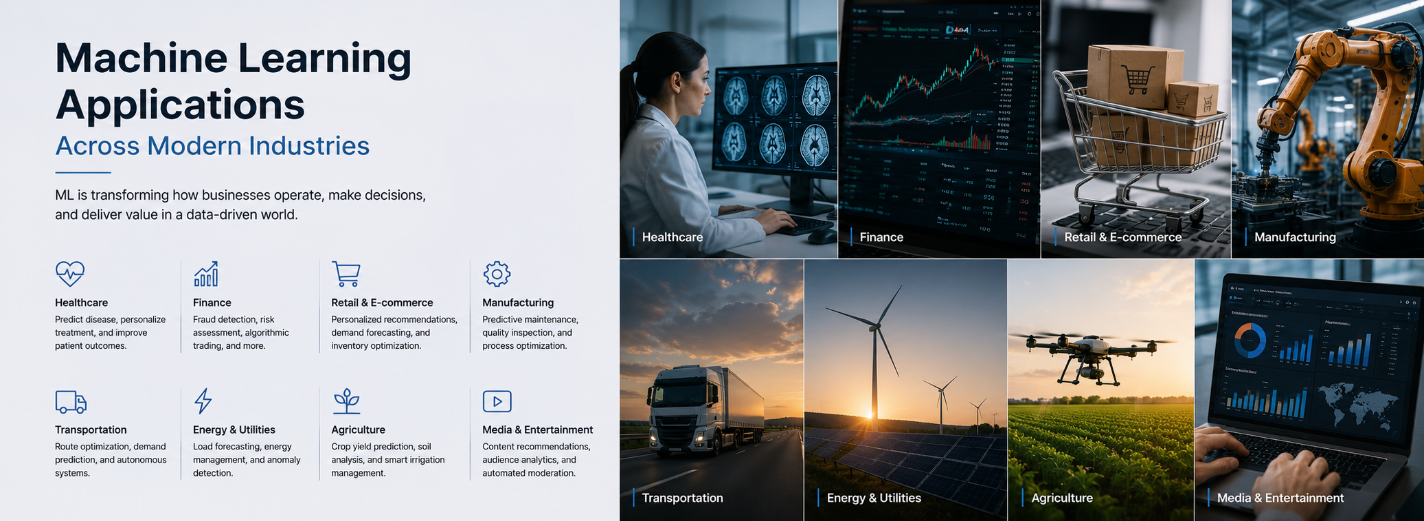
Machine Learning Across Industries: From Prediction to Better Decisions
- machine learning applications
- AI in business
- predictive analytics
- industry automation
- healthcare AI
- fintech machine learning
- retail analytics
- manufacturing AI
- logistics optimization
- enterprise AI
Machine learning is most useful when a business must make the same kind of judgment many times, the relevant history can be observed, and a better estimate changes an action. The model may rank cases, forecast demand, detect an anomaly, retrieve a document, recommend an item, or estimate a probability. Value appears only when that output reaches a person or system early enough to choose differently.
Begin with the decision, not the algorithm. Name who acts, what they decide today, what evidence they use, the cost of each error, the time available, and the fallback when confidence is low. Predicting churn has little value without a retention action; predicting equipment failure too late to schedule maintenance is merely an accurate post-mortem. The unit of design is the complete decision loop: data, model, interface, authority, action, outcome, and feedback.
The same technical pattern changes meaning across industries. A ranking error in entertainment may produce an irrelevant recommendation; in healthcare it may delay attention; in credit it may restrict access to an essential service. Evaluation must therefore include operational and human consequences, not only average model accuracy. Segment performance, latency, capacity, manual workload, fairness, privacy, security, and the ability to contest or override a result may matter more than a small improvement in a benchmark.
A sustainable system also expects change. Customers adapt, markets move, sensors are replaced, policies evolve, and the model influences the data it later learns from. Treat machine learning as maintained software and a governed business process—not as a one-time analytical experiment.
Healthcare: Assist Decisions Without Hiding Uncertainty
Healthcare applications divide into clinical and operational decisions. Clinical systems may support image review, pathology, deterioration alerts, treatment selection, or documentation. Operational models can forecast patient arrivals, bed demand, appointment nonattendance, staffing, supplies, and claim-processing workload. The second category may carry less direct clinical risk, yet a poor staffing forecast can still affect access and safety.
Define the intended use with clinical precision: population, setting, user, input, output, decision, and excluded use. Evaluate sensitivity and specificity at a threshold that reflects the harm of missed and false alerts; show positive predictive value under the real prevalence; inspect performance by site, device, demographic group, disease stage, and data quality. A model validated on retrospective data from one institution has not automatically proved itself in another workflow.
Human review must be substantive. Show the evidence and uncertainty a clinician needs, make disagreement easy, record overrides, and prevent automation bias from turning “advisory” software into an unexamined order. Monitor alert burden as well as accuracy: even correct alerts fail when they arrive too often, at the wrong moment, or without a feasible action.
Regulatory classification depends on intended use and jurisdiction. FDA guidance for AI-enabled medical devices emphasizes lifecycle management, while EU rules for high-risk and product-integrated AI apply progressively. Treat privacy, cybersecurity, data provenance, clinical evaluation, change control, post-deployment monitoring, and safe rollback as parts of the product from the beginning.
Finance: Detect Risk and Preserve Explainability
Financial machine learning commonly ranks fraud alerts, estimates credit or loss risk, monitors accounts, extracts documents, routes support, forecasts liquidity, and identifies unusual transaction networks. These tasks differ in feedback and error cost. Confirmed fraud may arrive weeks after a transaction; suspicious activity labels reflect investigator practice; repayment history excludes people who were previously denied credit. Historical data records earlier policy as well as customer behavior.
Evaluate the complete decision at the operating threshold. For fraud, measure prevented loss, false declines, customer friction, investigator capacity, recovery, and adversarial adaptation. For credit, examine calibration, stability, segment outcomes, reason codes, and the effect of policy overlays. A model with a stronger aggregate score can create worse business results if it floods a fixed review team or shifts errors toward a protected or vulnerable group.
Keep an auditable chain from source data and feature definition to model version, score, policy rule, human action, notice, and final outcome. Explanations must be faithful enough for the actual decision and suitable for applicable obligations; a generic feature-importance chart is not automatically a valid adverse-action reason. Separate legal interpretation and risk acceptance from model engineering, but make the technical evidence available to those owners.
Monitor data quality, calibration, approval and decline rates, fraud patterns, overrides, complaints, and outcomes by meaningful segments. Use champion-challenger or shadow evaluation before replacing a decision system, limit automated authority, and preserve a tested route to rules or manual review when the model or a critical data provider fails.
Retail: Optimize the System, Not a Single Metric
Retail models forecast demand, recommend products, rank search results, optimize replenishment, identify likely churn, classify catalog items, and support pricing or promotion decisions. Their outputs interact. A recommendation can raise clicks while reducing margin; a promotion can shift demand between products; a forecast can appear accurate because stockouts hid unmet demand. Optimize the commercial system rather than celebrating a local metric.
Demand forecasting needs the distinction between observed sales and true demand. Record stock availability, price, promotion, placement, returns, holidays, weather, store events, assortment changes, and substitution. Evaluate forecasts at the level where someone orders inventory, and compare them with a seasonal or moving-average baseline. Track the asymmetric cost of excess stock, missed sales, spoilage, and emergency replenishment.
Recommendations and ranking require experiments that measure incremental behavior. Offline relevance is useful for screening, but production tests should inspect conversion, revenue, margin, diversity, discovery, returns, latency, and long-term customer effects. Preserve editorial and commercial constraints without allowing paid placement to masquerade as personal relevance. Give new products and new customers a cold-start strategy.
Pricing deserves explicit guardrails: eligible products, minimum and maximum change, frequency, inventory conditions, protected cases, approval, customer communication, and rollback. Monitor outcomes by geography and customer segment. The goal is a decision system that merchants can understand and challenge, not an opaque mechanism that changes prices faster than the organization can explain them.
Manufacturing: Join Sensor Evidence with Engineering Context
Manufacturing applications include predictive maintenance, visual inspection, process control, yield prediction, energy optimization, scheduling, and anomaly detection. The hard problem is rarely choosing a model. It is connecting sensor and image evidence to equipment identity, operating mode, material batch, maintenance history, production order, environmental conditions, and the engineer’s eventual diagnosis.
For maintenance, define the action horizon. An alert must arrive early enough to inspect, obtain a part, and schedule downtime, yet not so early that crews chase noise. Evaluate warning time, missed failures, false work orders, avoided downtime, part consumption, and maintenance capacity. Beware of censored history: equipment repaired before failure does not provide the same label as equipment that failed, and a new maintenance policy changes future data.
For visual quality, build the dataset around defect definitions and consequences. Include normal variation, different lines, cameras, lighting, products, shifts, and rare but costly defects. Route uncertain cases to trained reviewers, capture their decision, and monitor whether the system changes inspector attention. A high image-level score can still miss the defect that matters to a customer.
Keep safety interlocks and validated control logic separate from experimental predictions unless the full system has been engineered and approved for that authority. Start in observation or advisory mode, compare recommendations with engineers, define degraded operation, and preserve traceability from alert through inspection, work order, repair, and outcome.
Logistics: Predict Under Real Operational Constraints
Logistics combines forecasting with constrained optimization. Models can estimate volume, arrival time, failed-delivery risk, dwell time, damage, capacity, or maintenance needs. An optimizer then chooses routes, loads, slots, or work priorities under vehicle capacity, driver rules, time windows, skills, depot hours, inventory, service commitments, and changing road conditions. A prediction is an input to the plan, not the plan itself.
Evaluate at the point of action. An arrival estimate should be calibrated for the lane and horizon where a dispatcher or customer uses it. A route should be judged by completed service, lateness, distance, cost, overtime, utilization, emissions, and plan stability—not distance alone. Frequent “optimal” replanning can make warehouse and driver execution worse by destroying predictability.
Capture real exceptions: refused delivery, inaccurate address, inaccessible site, damaged item, border delay, missing document, temperature excursion, vehicle fault, late supplier, and urgent insertion. Give dispatchers a visible reason for recommendations and a structured override. Their context is valuable only if the system records why the recommendation failed and whether the override improved the outcome.
Use scenario models for resilience, not as oracles. Test loss of a depot, carrier, lane, supplier, region, or inventory source with stated assumptions. Connect results to contingency owners, contractual options, customer communication, and rehearsal. Fresh operational feedback matters more than a sophisticated model trained on a network the company no longer operates.
Real Estate, Education, and Professional Work
Real-estate models can estimate value, rank leads, forecast vacancy, and prioritize maintenance. Separate descriptive market estimates from decisions that affect access to housing or finance. Location variables and historical prices can encode past exclusion; unusual properties may have no valid comparable data. Show uncertainty, source dates, comparable evidence, and a route for correction rather than presenting a precise number as objective truth.
Education systems can recommend practice, identify learners who may need support, group resources, and assist teachers with administrative work. Optimize learning and timely support rather than clicks or time on platform. Never turn a risk score into a self-fulfilling label: let educators inspect its evidence, add context, and see whether intervention helped. Student privacy, age, accessibility, language, and unequal access to devices shape both data and outcomes.
Professional services often gain first from document intake, classification, extraction, search, workload forecasting, and draft assistance. Define the authoritative source, citation behavior, confidentiality boundary, retention, and reviewer responsibility. Measure correction time and consequential omissions, not just field-level accuracy. A system that extracts ninety-nine routine clauses but misses the rare termination condition can create more risk than the average score suggests.
Energy, agriculture, media, and other sectors use the same patterns under different constraints: forecast demand or yield, detect abnormal consumption or disease, recommend content, or plan storage. The transferable skill is not a catalog of models. It is the ability to translate a business decision into observable evidence, an honest evaluation, a safe workflow, and a feedback loop.
Implement Machine Learning as a Maintained Decision System
Write a decision brief before building. It should name the user, decision, present method, action after the output, time constraint, error costs, affected groups, authority, data available at decision time, baseline, target outcome, and stop condition. Compare machine learning with a rule, search, workflow redesign, better data capture, and a basic statistical method. Complexity earns its place only when it changes the business result enough to justify ongoing ownership.
Audit the data-generating process. Identify who created each field, for what purpose, under which policy, what is missing, when the value becomes known, and whether deployment can observe it without leakage. Define labels independently where possible and sample difficult periods, locations, devices, and populations. Split evaluation by time or entity to reflect future use; a random split can let near-duplicate customers, machines, or events appear on both sides.
Evaluate the system offline and in the workflow. Compare against the current process, simple baselines, and human performance with the same information. Choose thresholds from capacity and error cost. Test calibration, robustness, segments, latency, missing data, abuse, privacy, security, and fallback. Run in shadow or advisory mode before granting authority, then use a controlled experiment or phased rollout when consequences allow it.
Govern the lifecycle. Assign owners for purpose, data, model, integration, policy, operations, risk, and incidents. Version datasets, code, features, models, prompts where relevant, thresholds, and decision rules. Record approvals and limitations. NIST’s AI Risk Management Framework organizes this work around govern, map, measure, and manage; the useful principle is continuous evidence, not a ceremonial checklist.
Monitor input quality, distribution, calibration, segment performance, output volume, overrides, latency, business outcomes, complaints, and harm indicators. Predefine alert owners and responses: investigate, limit scope, adjust a threshold, retrain, return to a previous version, switch to rules, or stop. Review whether users still understand the system and whether its benefit exceeds review effort, infrastructure, vendor cost, and risk.
The best machine-learning system is not the model with the most impressive benchmark. It is the maintained decision system that delivers reliable evidence at the right moment, makes uncertainty visible, and improves an outcome without creating hidden harm.
— GARNO.TECH
Build a Practical Machine Learning Product with GARNO.TECH
GARNO.TECH builds machine-learning capabilities around a decision that matters, not around a demonstration model. Discovery defines the user, workflow, business baseline, risk class, and adoption constraint. Data assessment traces sources, labels, permissions, quality, leakage, representativeness, and the feedback needed after launch. A feasibility stage compares simple rules and statistical baselines with model candidates before the company commits to a production architecture.
Delivery can include data pipelines, forecasting, ranking, recommendations, anomaly detection, computer vision, document processing, intelligent retrieval, model services, user interfaces, human-review queues, cloud infrastructure, security controls, testing, observability, and integration with existing platforms. We design the fallback and operational tools with the prediction because operators will encounter the uncertain cases the benchmark hides.
We define acceptance in business and risk terms: which outcome must improve, for whom, at what threshold, within what latency and cost, under which guardrails. Production rollout begins with bounded exposure and evidence. Monitoring links model behavior to decisions and eventual outcomes; incident and change procedures make retraining, vendor changes, or rollback controlled rather than improvised.
Bring one repeated decision, examples of its inputs and outcomes, the people who act on it, and the cost of being wrong or late. We will determine whether machine learning is warranted and, if it is, turn the opportunity into a maintained product whose value can be inspected in daily work.
Publications
Our research
Research and development of AI-powered solutions to optimize business workflows and enhance decision-making processes.
Analysis of machine learning models for predictive analytics in finance, e-commerce, and SaaS platforms.
Exploration of natural language processing and computer vision technologies to strengthen automation, personalization, and customer support.
Cybersecurity Trends: Turn Threat Signals into Business Decisions
A practical guide to the cybersecurity trends businesses should act on: AI-assisted social engineering, identity attacks, ransomware disruption, software supply-chain risk, cloud and API exposure, machine identities, Zero Trust and tested resilience.

9 min read
24 Jul 2026
Microservices vs Monolith: Choosing the Right Architecture
Compare monoliths, modular monoliths, and microservices through delivery, domain boundaries, data, reliability, scaling, team ownership, cost, and migration evidence.

8 min read
24 Jul 2026
Building Scalable SaaS Platforms: Architecture That Preserves the Business Model
Design SaaS architecture around tenant lifecycle, isolation, entitlements, billing, data growth, reliability, security, delivery, observability, and operating cost per customer.

8 min read
24 Jul 2026