Main Our Publications
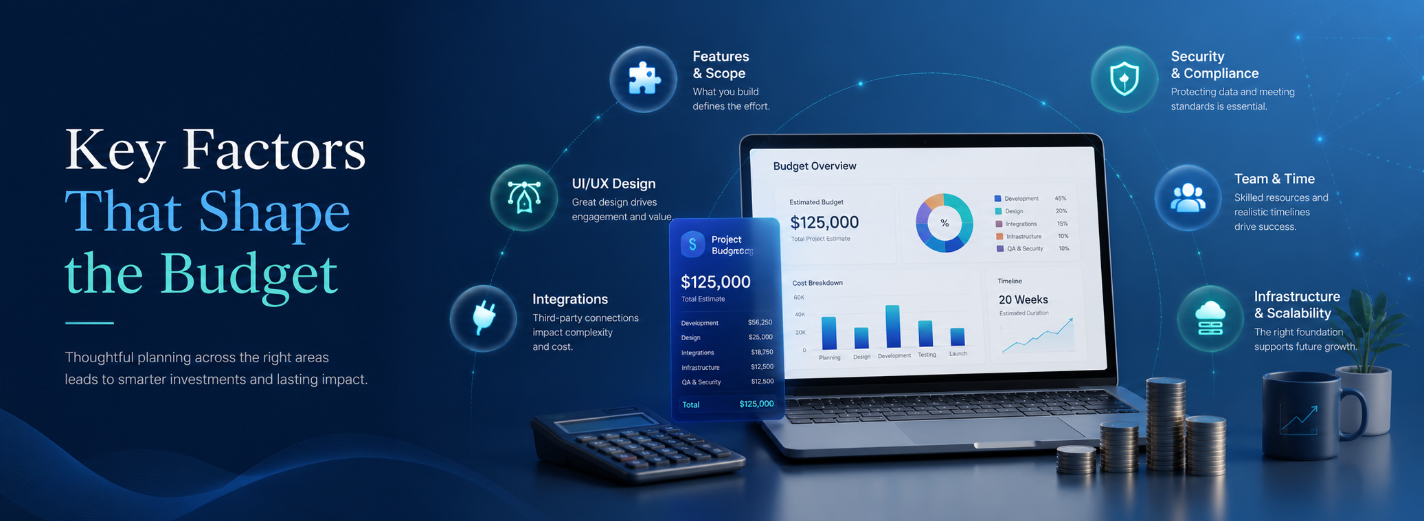
Key Factors That Shape the Budget

Key Factors That Shape the Budget

  • saas development cost
  • saas development services
  • custom saas development
  • SaaS budget
  • SaaS platform development
  • SaaS product development
Key Factors That Shape the Budget

Learn which product, architecture, integration, security and delivery decisions have the greatest impact on a SaaS development budget.

Estimating a SaaS product is not a matter of multiplying a developer rate by a rough number of weeks. The final budget reflects product scope, technical risk, security requirements, infrastructure and the operational work required after launch.

Two platforms that look similar on the surface can require very different investments because their workflows, integrations, user roles and growth expectations are not the same. A reliable estimate begins with business priorities: who will use the product, which problem it solves and which capabilities are essential for the first release.

Product scope and feature complexity

Scope is usually the strongest factor behind the overall saas development cost. A focused MVP with authentication, one core workflow and basic billing is fundamentally different from an enterprise platform with multiple roles, advanced reporting, workflow automation and regional settings.

Every feature affects more than the user interface. It may require database changes, backend rules, permissions, notifications, analytics, administration tools and automated tests. Clear priorities reduce unnecessary work and help the team invest first in functionality that validates demand or generates revenue.

Architecture and scalability expectations

Architecture decisions shape both the initial budget and the cost of future growth. Multi-tenant data isolation, subscription management, audit logs, background processing, file storage and external APIs must be designed around realistic product requirements.

Early products often benefit from a modular monolith and managed cloud services. Premature microservices can increase deployment, monitoring and communication overhead without measurable value. Products with heavy workloads, strict availability targets or regional data requirements may need more advanced infrastructure from the beginning.

UX, interface and product design

Design complexity is another major budget driver. A standard dashboard built from a consistent component library is faster to deliver than a product with highly customized interactions, complex data visualization or separate experiences for several user roles.

Good UX work includes user flows, information architecture, responsive behavior, validation states, empty states and accessibility. Skipping these details rarely saves money in the long term because unclear workflows return later as development changes and support requests.

Integrations and external dependencies

Third-party integrations can significantly change the estimate. Payment providers, CRM systems, identity services, accounting tools and communication platforms each introduce their own APIs, limits, webhook behavior and failure scenarios.

Professional saas development services should include more than connecting endpoints. The implementation must verify incoming events, prevent duplicate processing, handle timeouts, store audit data and provide recovery paths when an external service is unavailable.

Security and compliance requirements

Security and compliance requirements must be considered before development begins. Role-based access, tenant isolation, encryption, audit logging, backup policies and secure secret management are normal platform responsibilities, not optional additions.

Products handling financial, healthcare or other regulated information may require stronger controls, penetration testing and jurisdiction-specific data handling. Adding these capabilities after launch is usually more expensive because architecture and workflows may need to be redesigned.

Team composition and delivery model

The delivery model also affects the budget. A low hourly rate does not guarantee a lower final cost if the team needs constant supervision, produces unstable releases or repeatedly rebuilds misunderstood features.

A custom saas development project normally involves product analysis, UX/UI design, frontend and backend engineering, quality assurance, DevOps and project coordination. Not every role must be full-time, but the estimate should account for all responsibilities required to release and operate the product successfully.

How to keep the SaaS budget under control

A useful SaaS estimate should show assumptions, scope boundaries, delivery stages and the factors that may change the price. The most effective way to control the budget is to define a focused first release, validate high-risk assumptions early and choose architecture appropriate for the next realistic stage of growth.

GARNO.TECH helps companies plan and build SaaS products from discovery to production launch. We focus on transparent estimates, maintainable architecture and delivery decisions that support both current business goals and long-term product development.

Need a realistic SaaS development budget?
We align product requirements, architecture, integrations, security, quality, delivery, observability, and operations with measurable business outcomes.