/ 01
Transaction Lifecycles
Pending, rejected, reversed, disputed, reconciled, and repaired states need explicit invariants, audit evidence, idempotency, customer communication, and operator workflows.
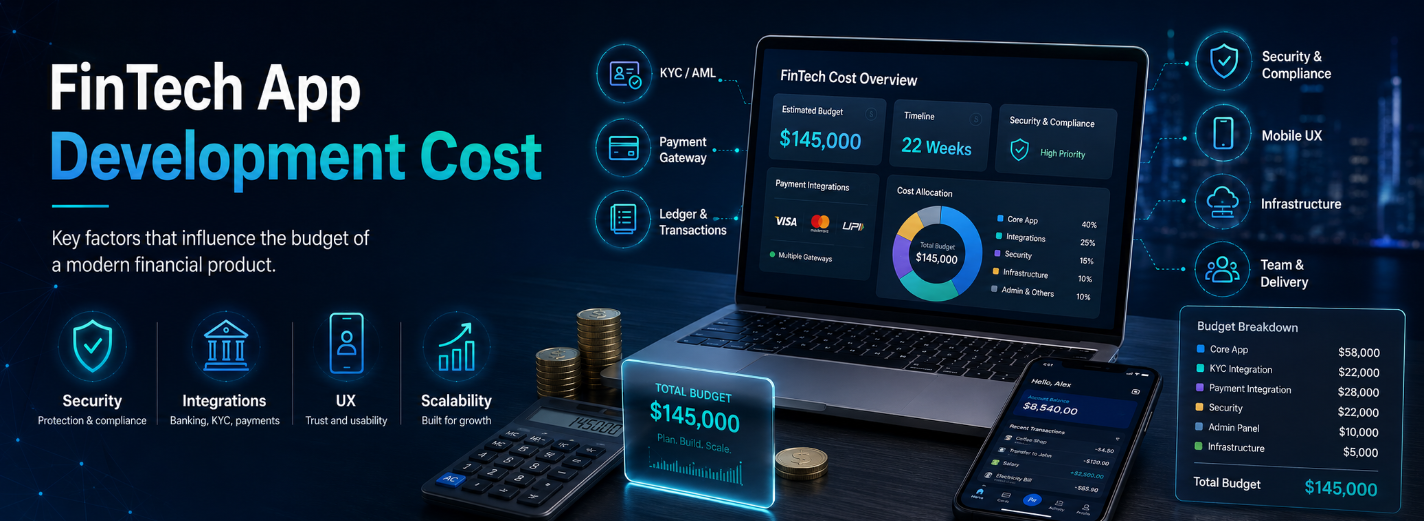
A FinTech budget cannot be inferred from screen count. A simple transfer form may depend on identity proofing, sanctions screening, account ownership, limits, fees, exchange rates, ledger entries, bank or processor APIs, asynchronous confirmation, reversal, reconciliation, support tooling, audit evidence, notifications, and recovery. Each obligation adds states, failure paths, tests, operations, and third-party cost that the interface does not reveal.
Begin with the regulated business model and money flow. Define markets, legal entities, customer types, currencies, products, who holds or moves funds, licensed responsibilities, providers, transaction volume and value, risk appetite, data classes, availability, recovery, support hours, and launch commitments. Confirm legal and regulatory scope with qualified counsel and assessors in each jurisdiction; a generic checklist cannot decide whether a product is a payment institution, technical service provider, lender, broker, custodian, or another regulated role.
Create three budgets rather than one headline: discovery and assurance, build and launch, and recurring operation and change. Express each as a range tied to assumptions, exclusions, uncertainty, and acceptance evidence. Include a contingency owned by named risks, not an arbitrary percentage. A smaller first release is cheaper only when it preserves a coherent transaction and control boundary. Deferring reconciliation, privileged operations, monitoring, recovery, or security creates hidden debt rather than an MVP.
Model every transaction as a state machine. Name initiation, authentication, validation, reservation, submitted, pending, authorized, captured or settled, rejected, expired, cancelled, reversed, refunded, disputed, reconciled, and manually repaired states that apply. Define allowed transitions, actor and authority, timestamps, immutable identifiers, amount and currency rules, fees, rounding, balances, limits, duplicate handling, notification, evidence, and the user-visible meaning of each state.
Estimate normal and exceptional journeys together: onboarding, login and recovery, account linking, deposit or withdrawal, transfer, payment, beneficiary changes, card controls, statements, chargeback or dispute, closure, and operator intervention. Add insufficient funds, partial provider success, delayed webhook, duplicate request, timeout after provider acceptance, out-of-order event, currency change, limit breach, expired verification, locked account, and correction. Support and operations need search, queues, reason codes, approval separation, notes, evidence, safe retry, and compensation.
Use vertical slices to expose cost early. Implement one real transaction through client, API, identity, ledger, provider sandbox, webhook, notification, telemetry, operator view, reconciliation, failure injection, deployment, and recovery. Measure provider behavior and missing requirements. A clickable prototype can validate language and flow; it cannot validate money movement, controls, settlement, or operational ownership.
Security and compliance scope depends on role, jurisdiction, customer, data, payment rail, and outsourcing model. Identify applicable obligations for identity proofing, authentication, KYC or KYB, anti-money-laundering and sanctions controls, fraud, consumer protection, consent, privacy, accessibility, record retention, reporting, complaints, incident notification, outsourcing, operational resilience, and payment account data. Standards such as PCI DSS provide technical and operational baselines for entities that store, process, transmit, or can affect cardholder data; reducing the card-data environment can materially change cost.
Translate obligations into acceptance criteria and evidence. Threat-model customer, operator, support, developer, provider, CI/CD, and administrative paths. Budget for secure architecture and code review, dependency and secret controls, encryption and key lifecycle, MFA and privileged access, device and session risk, authorization, audit trails, vulnerability management, penetration testing, logging, incident exercises, supplier review, data inventory, retention and deletion, and remediation. A compliance report without implemented control ownership is not assurance.
Choose identity assurance by risk. Enrollment, proofing, authentication, federation, account recovery, and fraud signals are different decisions; stronger friction is not automatically safer if it drives users into weak recovery or support bypass. Include vendor fees, manual review, false positives, abandonment, re-verification, document coverage, regional fallback, accessibility, and appeal. Regulatory and provider change continues after launch, so assign an owner and change budget.
A provider integration is an operational relationship, not one API call. Price onboarding, contracts, certification, sandbox quality, credentials and key rotation, IP allowlists, network controls, data mapping, rate limits, idempotency, asynchronous events, webhook authentication, retries, timeouts, pagination, version change, reporting, settlement files, disputes, support, and production escalation. Some work cannot begin until a bank, processor, verification service, or scheme approves access.
Assume ambiguous outcomes. A request can time out after the provider accepts it; a webhook can be late, duplicated, missing, or out of order; a response can conflict with a settlement file. Give every command and event stable identifiers, store raw evidence safely, authenticate sources, make handlers idempotent, separate provider state from internal state, and implement reconciliation against an authoritative source. Retries need classification and bounds; blind retry can move money twice.
Evaluate commercial as well as technical dependency: per-transaction and minimum fees, reserves, chargebacks, foreign exchange, payout timing, data export, geographic coverage, service objectives, scheduled maintenance, liability, termination, and replacement cost. Design a provider abstraction only around proven variation; a universal layer can be more expensive than a deliberate integration. Keep client-controlled accounts and an exit inventory.
If the product owns balances or financial positions, the ledger is a core control system. Define the unit of account, double-entry or other invariant, accounts, postings, holds, effective and recorded time, immutable history, correction through compensating entries, fee and FX treatment, rounding, negative-balance rules, and relationship to provider settlement. Separate ledger truth from a convenient cached balance. Test invariants under concurrency, retries, partial failure, replay, and migration.
Design reconciliation at every boundary: product to ledger, ledger to provider events, provider events to statements or settlement files, and financial records to reporting. Define frequency, tolerance, aging, break classification, owner, repair authority, evidence, and escalation. Reconciliation is both software and an operating process; omitting the operator workflow merely moves cost into incident response.
Set availability and recovery targets from financial consequences. Budget backups, point-in-time recovery, key recovery, multi-zone or multi-region architecture where justified, capacity, load and resilience tests, graceful degradation, observability, on-call, runbooks, incident communication, and recovery exercises. Higher redundancy increases infrastructure and operational complexity. Fund only the reliability the business requires, but prove restoration and failover rather than relying on architecture diagrams.
A credible team usually spans product and domain analysis, UX and accessibility, client applications, backend and integrations, data or ledger design, quality engineering, platform and delivery, security, compliance or risk, and operational readiness. Specialists may be fractional, but their decisions must occur at the right time. Adding them only before launch makes architecture and evidence rework expensive.
Estimate throughput of the delivery system rather than multiplying feature hours. Include discovery, decision review, provider wait, environment and test data, security and compliance evidence, code review, integration and resilience testing, release, remediation, documentation, and knowledge transfer. Map dependencies and confidence ranges. A lower day rate can cost more when communication delay, weak review, rework, and missing operations extend the calendar.
Choose internal, external, or hybrid delivery by capability, urgency, continuity, and authority. Keep product, risk acceptance, provider relationships, accounts, repositories, infrastructure, keys, telemetry, and production approval under client control. Define who decides, builds, reviews, operates, handles incidents, and maintains each control. Acceptance should include internal engineers successfully deploying, diagnosing, reconciling, restoring, and changing the product.
Launch begins the longest cost phase. Budget cloud and managed services, provider and scheme fees, identity and fraud checks, observability, support, on-call, reconciliation, disputes, manual review, reporting, audits, insurance, vulnerability and dependency remediation, operating-system and platform upgrades, certificates and keys, data retention, backups, disaster-recovery exercises, incident response, customer communication, and regulatory change.
Model costs by business driver: active customers, verification attempts, accounts, transactions, payment value, API calls, events, storage, log volume, support contacts, disputes, regions, recovery tier, and peak capacity. Include failed and repeated attempts, nonproduction environments, data transfer, minimum contracts, reserves, and human operations. Track unit economics such as cost per active account and successful transaction, plus cost of fraud loss, false positives, support, and downtime.
Fund change capacity separately from keep-the-lights-on work. Banks and providers change APIs; threat and fraud patterns evolve; stores, browsers, mobile platforms, and frameworks require updates; policy and reporting change. Maintain an asset and dependency inventory, supported-version policy, patch objectives, capacity forecast, control calendar, and reserve for urgent provider or regulatory work. A product without an operating owner is unfinished regardless of release status.
Build an estimate from a structured scope: markets and role, user groups, transaction catalogue and states, money and data flows, identity assurance, compliance assumptions, providers, ledger, operator workflows, reporting, nonfunctional objectives, infrastructure, migration, delivery team, assurance, launch, and operations. For every item, state included behavior, excluded behavior, dependency, assumption, range, risk owner, and acceptance evidence.
Use phases that buy information. Discovery should resolve regulatory and provider constraints, model transaction states and controls, and identify the riskiest vertical slice. The proof should exercise real integrations and failure modes. The first release should deliver a coherent product and operational boundary. Expansion follows measured adoption, risk, and economics. Define decision gates and stop conditions before spending the full budget.
Separate estimation uncertainty from management reserve. Use scenarios for provider approval, integration behavior, transaction volume, regulatory interpretation, data migration quality, security remediation, and launch scope. Record a most-likely range and the events that move it, then refresh the forecast at each evidence gate. Do not silently consume contingency to fund added features. Track approved scope change, resolved uncertainty, realized risk, rework, provider delay, and remaining exposure so sponsors can decide whether to continue, narrow, sequence, or stop.
Finance the option to learn. A short discovery, sandbox experiment, assessor consultation, data sample, migration rehearsal, or resilience test can be valuable when it removes a large uncertain branch. Conversely, detailed estimation of unresolved requirements creates false precision. Price the next decision as carefully as the final system, and make every phase leave reusable models, code, evidence, or operating capability.
Compare supplier estimates on the same basis. Normalize scope, quality attributes, environments, provider work, security verification, compliance evidence, data migration, support tooling, rollout, warranty, knowledge transfer, intellectual property, third-party fees, cloud cost, maintenance, and contingency. Ask which assumptions most affect the range and what evidence will narrow them. The best estimate is not the smallest number; it is the one that makes uncertainty, ownership, and lifetime cost visible enough to manage.
Share the markets, operating role, user and transaction journeys, money and data flows, providers, identity and compliance assumptions, ledger needs, volumes, reliability targets, launch constraints, current team, and operating model. GARNO.TECH can turn them into a scoped architecture, risk register, production-shaped proof, phased estimate, acceptance evidence, and lifecycle cost model.
Research and development of AI-powered solutions to optimize business workflows and enhance decision-making processes.
Analysis of machine learning models for predictive analytics in finance, e-commerce, and SaaS platforms.
Exploration of natural language processing and computer vision technologies to strengthen automation, personalization, and customer support.
Compare Azure App Service, Container Apps, and AKS through workload shape, operational responsibility, scaling, networking, isolation, deployment, recovery, observability, and total ownership cost.

9 min read
Choose an Interim or Fractional CTO by the leadership gap, decision load, required authority, availability, transition plan, and evidence of outcomes.

13 min read
A practical guide to planning Azure applications from workload evidence: architecture, migration, identity, delivery automation, reliability, operations and cost.

8 min read