
/ 01
Small, Reversible Changes
Short-lived branches, focused checks, versioned artifacts, progressive delivery, and cleanup reduce batch size and make failure easier to locate, contain, and reverse.
Digital transformation creates business value only when an organization can change a live product repeatedly without losing control. Buying cloud capacity, installing a pipeline or renaming an operations group does not shorten the distance between a customer need and a reliable outcome. That distance depends on how decisions, code, infrastructure, security, release, telemetry and support work together.
DevOps improves the system of change. Small batches make feedback cheaper; automation makes repeatable checks consistent; versioned environments reduce hidden variation; observability reveals customer and operational effects; tested recovery limits the cost of failure; shared ownership moves evidence to someone able to act. The business benefits—faster learning, fewer damaging releases, quicker restoration, lower waste and stronger accountability—appear only when those mechanisms alter daily work.
Start with a value stream rather than a tool list. Choose one important journey, trace it from idea to production outcome, and establish a baseline for waiting, rework, lead time, release frequency, change failure, recovery, reliability, cost and customer success. Find the constraint and improve it with a bounded intervention. A metric is useful when it guides a decision; used as a target for individual teams, it encourages gaming and local optimization.
Start with one valuable journey: opening an account, submitting an order, approving a claim, onboarding a tenant, or resolving a support case. Map the path from product decision to customer evidence, including queues, handoffs, environments, tests, approvals, deployments, and production validation. Measure work age, blocked time, change lead time, deployment frequency, failed-change recovery, change failures, rework, and the journey outcome. Use metrics to find the constraint, not to rank people.
Reduce batch size by delivering vertical slices that include behavior, data, integration, security, telemetry, release, and support. Short-lived branches, continuous integration, focused automated checks, versioned artifacts, and progressive delivery can shorten feedback and reduce the blast radius. A feature flag controls exposure; it does not excuse unfinished cleanup, indefinite branches, or untested combinations. Every flag needs an owner and removal condition.
A pipeline should produce traceable evidence. The team must know which source, dependencies, build environment, tests, policies, approvals, and configuration created an artifact; who promoted it; and how to reproduce or reverse the release. Keep high-consequence human decisions explicit while automating deterministic checks. Faster automation of an ambiguous process only makes the ambiguity arrive sooner.
Infrastructure as code turns environments into reviewable, versioned, repeatable definitions. Treat network, identity, compute, data services, secrets references, observability, policy, budgets, and recovery configuration as one product boundary. Plan and review effective changes before applying them, use narrow deployment identities, retain traceability, and separate environment values without copying architectures into unrelated scripts.
Reproducibility does not mean every environment is identical. Development, testing, staging, and production have different data, exposure, scale, cost, and access, but meaningful differences should be intentional and testable. Validate modules, scan for risky configuration, exercise deployments in representative conditions, and detect drift. Import or deliberately replace existing resources rather than pretending unmanaged state does not exist.
Build a platform only where repeated product needs justify it. Golden paths can provide supported templates, environments, identity, delivery, telemetry, and compliance controls while preserving escape paths for legitimate exceptions. Measure platform success through software delivery outcomes, task success, adoption, and developer experience. A portal that exposes more cloud complexity without reducing cognitive load is another dependency, not a platform product.
Reliability begins with critical user and operator journeys, not infrastructure uptime alone. Define service-level indicators and objectives for completion, latency, correctness, freshness, and availability where they matter. Use error budgets or another explicit policy to balance feature change with reliability work. A healthy container is insufficient if customers cannot authenticate, data is stale, or a provider silently rejects transactions.
Connect deployments to structured logs, metrics, traces, runtime profiles, business events, and configuration changes with stable identifiers. Alerts need a user consequence, owner, severity, response expectation, and runbook. Tune them against incidents and false positives. Telemetry that no one can access, interpret, or afford to retain does not create operability.
Design recovery before failure: timeouts, bounded retries with jitter, idempotency, backpressure, queues, circuit behavior, graceful degradation, rollback or safe roll-forward, backup restoration, failover, and reconciliation. Exercise representative dependency, zone, data, and deployment failures. Blameless learning still needs accountable corrective work: name the systemic cause, owner, acceptance evidence, and retest date.
Cloud elasticity changes the shape of cost; it does not make cost self-managing. Assign ownership, tagging or equivalent allocation, budgets, anomaly detection, and review cadence before scaling. Connect spend to useful demand such as an active tenant, processed order, document, inference, or API customer. Include licences, third parties, observability, data transfer, backups, support, and engineering effort in the total cost.
Optimize from evidence: remove abandoned resources, right-size from telemetry, schedule nonproduction use, tier data, bound autoscaling, control log volume and cardinality, and repair inefficient code or queries. Use reservations or commitments for stable understood demand. A cost reduction that removes recovery capacity, security evidence, or production visibility is a risk decision and needs an accountable owner.
Test cost under exceptional modes. Backfills, retries, incident logging, load tests, regional recovery, data export, and sudden traffic may produce a different unit cost from normal operation. Set guardrails that inform or constrain changes without automatically breaking a critical journey. FinOps becomes useful when finance, product, platform, and engineering share definitions and can act on the result.
Security becomes part of delivery when controls appear at the earliest responsible boundary and remain visible in production. Model assets, identities, data flows, trust boundaries, threats, and obligations with the product. Give workforce, pipeline, and workload identities separate, least-privilege access; protect secrets and signing material; validate untrusted input; govern dependencies; and preserve evidence for consequential changes.
Automate stable checks such as secret detection, dependency and artifact analysis, policy validation, infrastructure review, and selected application tests. Triage results by exploitability and consequence rather than forwarding every finding to product teams. Suppressions need a reason, owner, expiry, and review. Automation should block a defined unacceptable risk, not create an opaque queue that everyone learns to bypass.
Some decisions still require specialist judgment: architecture and threat review, legal or privacy interpretation, penetration testing, incident response, high-risk exceptions, and supplier assessment. Put these reviews early enough to change the design. In production, detect identity misuse, public exposure, control changes, vulnerable artifacts, data anomalies, and missing telemetry; rehearse containment and recovery across team boundaries.
DevOps fails when it becomes a team that receives tickets from developers and throws production incidents back over the wall. Product teams should own the behavior and operation of their services within clear boundaries. Platform teams own shared capabilities as products. Security supplies policy, expertise, detection, and response partnership. Support and operations bring user and incident evidence into planning. Leaders decide priority and residual risk.
Make the interfaces explicit: service ownership, service objectives, on-call roles, escalation, platform support, release authority, data stewardship, vendor responsibility, and incident command. Provide client and team access to source, environments, dashboards, runbooks, and decisions. Rotate operational participation and use pairing or game days to transfer judgment without forcing every engineer to master the entire estate.
Psychological safety matters because early warnings often arrive as uncertainty: “this migration may not finish,” “the alert is unreliable,” or “the vendor outcome is unknown.” Reward surfacing weak signals and changing the plan. Pair that safety with accountability for follow-through. Collaboration is visible when a signal reaches an owner and changes a decision, not when more people attend the same meeting.
Digital transformation becomes durable when every software change carries evidence, ownership, a safe path to production, and a tested path back to control.— GARNO.TECH
The strongest business case for DevOps is not “more deployments.” It is a shorter, safer and more legible path from an assumption to evidence. A team can release a narrow change, see whether customers benefit, detect harm, restore control and decide what to do next. That capability reduces the cost of learning and makes digital investment less dependent on large forecasts and heroic launches.
Measure the causal chain. If delivery becomes faster, verify whether useful outcomes arrive sooner. If reliability improves, measure journey success, incident impact and restoration. If cloud spend falls, confirm that resilience and visibility remain adequate. If security checks shift earlier, examine remediation time and escaped risk. Improvements that only move work to another queue are not benefits; they are accounting changes.
Adopt DevOps through one constrained product flow. Give it an owner, baseline, target, guardrails and review date. Improve the governing bottleneck, use the new path under real demand, document exceptions, and transfer the capability into the team. Expand only what several products genuinely repeat, and retire the old route once the replacement is proven. Digital transformation becomes durable when the organization can explain a change, release it with evidence, operate it responsibly, recover under pressure and make the next decision better.
Review the operating model as the product changes. New markets, regulations, dependencies, traffic patterns and team boundaries can invalidate a once-effective path. Watch for queues growing, incidents repeating, controls becoming ceremonial, cost detaching from demand or teams routing around the platform. Preserve the principles—evidence, ownership, reversibility and learning—while changing the implementation.
Share the critical journey, delivery path, infrastructure, dependencies, deployment and incident history, security controls, cloud costs, team boundaries, and current metrics. GARNO.TECH can identify the governing constraint and define a bounded improvement with ownership, acceptance evidence, and knowledge transfer.
Research and development of AI-powered solutions to optimize business workflows and enhance decision-making processes.
Analysis of machine learning models for predictive analytics in finance, e-commerce, and SaaS platforms.
Exploration of natural language processing and computer vision technologies to strengthen automation, personalization, and customer support.
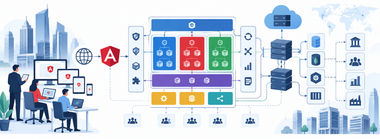
A practical guide to structuring large Angular applications with business domains, dependency rules, lazy routes, scoped state, platform adapters, team ownership, and automated architecture checks.
8 min read
A build-versus-buy framework for deciding when distinctive domain rules, integrations, data ownership, security, performance, and product economics justify a tailored NestJS backend.

8 min read
A production guide to Angular state management across local UI state, business workflows, server cache, normalized entities, RxJS concurrency, persistence, debugging, and testing.
11 min read