
/ 01
Identity-First Access
Use distinct human, delivery, and runtime identities; managed identities where suitable; narrow RBAC and data-plane permissions; controlled privilege; regular access review; and auditable emergency paths.
Cloud development is not the act of moving an application from a company-owned server to an Azure resource. It is the design of a workload—application code, data, identity, infrastructure, delivery, telemetry, and operating procedures—that can meet a defined business purpose as demand and failure conditions change.
The difficult decisions are connected. Stronger availability can require more replicas, zones, or regions and therefore more cost and operational complexity. Aggressive cost reduction can shrink recovery margins. Network isolation can protect a boundary while making diagnostics and delivery harder. Autoscaling can add application instances while overwhelming a database or paid provider. A sound architecture makes those trade-offs explicit.
Microsoft’s Azure Well-Architected Framework groups the discussion into reliability, security, cost optimization, operational excellence, and performance efficiency. Use the pillars as questions, not a compliance score. A useful design explains which requirements matter most, where the workload intentionally accepts risk, who owns that risk, and what evidence will prove the system ready.
Our Azure cloud development services connect these decisions in one delivery boundary, from discovery and landing-zone fit through application implementation, release, and operational handover.
Begin with critical user and operational journeys: sign in, submit an order, process a payment, import a file, run a report, restore a tenant, deploy a change, and investigate an incident. For each journey, record actors, data classification, geographic and regulatory constraints, dependencies, traffic shape, payloads, latency, availability, acceptable degradation, and the consequence of failure.
Translate business language into service targets. “Always available” becomes a defined service-level objective, measurement window, excluded conditions, and error budget. “No data loss” becomes a recovery point objective, replication and backup design, plus a tested restore. “Recover quickly” needs a recovery time objective, incident authority, dependencies, and a runbook. Security needs named assets, threats, trust boundaries, and response obligations.
Model demand rather than quoting one request-per-second number. Include normal, peak, burst, seasonal, batch, and recovery traffic; concurrent connections; background jobs; data growth; geographic paths; and external quotas. State the forecast horizon and the threshold that triggers review. Capacity for a marketing event differs from capacity for steady multi-tenant growth.
Map organizational constraints too: existing landing zone, tenant and subscription model, platform services, networking, approved regions, Azure Policy, identity administration, support model, skills, and budget ownership. A workload that ignores its cloud estate may work in a sandbox yet fail governance, connectivity, or operations before production.
Select services from workload characteristics. A conventional web application may fit App Service; containerized APIs and event-driven workers may fit Container Apps; Functions can suit bounded event or scheduled execution; AKS earns its operational cost when Kubernetes capabilities and organizational maturity are real requirements. Virtual machines remain appropriate for workloads that need operating-system control. The decision should compare runtime, networking, scaling, deployment, observability, portability, team skill, and total ownership—not fashion.
Prefer managed data and messaging services when their operational model fits, but understand the responsibility boundary. Azure can manage the service infrastructure while the workload team still owns schema, indexes, access, encryption choices, retention, backup configuration, restore evidence, capacity, query behavior, and application resilience. “Managed” never means “unowned.”
Start with the smallest topology that meets the targets. A modular application, one primary data store, a reliable queue for bursty work, and a small number of well-chosen managed services often outperform an early microservice estate in delivery and reliability. Split components when independent scale, isolation, technology, or team ownership produces measurable value.
Fit the workload into a landing zone with explicit subscription, resource-group, policy, identity, networking, DNS, logging, tagging, and budget boundaries. Separate production from non-production access and blast radius. Reuse platform capabilities where they meet workload requirements, and document exceptions rather than building a private platform inside every project.
Identity should protect every control and data path. Use Microsoft Entra ID for workforce and workload identities where appropriate. Prefer managed identities over embedded credentials, then grant each identity the smallest Azure RBAC and data-plane permissions it needs at the narrowest practical scope. Choose system-assigned or user-assigned identity from lifecycle and sharing requirements, not as a universal rule.
Separate human administration, deployment automation, and runtime access. Use groups and controlled privileged elevation for people; distinct identities for environments and workloads; short-lived federation for delivery systems where supported; and auditable emergency access. Review role assignments, unused identities, credentials, and ownership throughout the lifecycle. A managed identity with subscription-wide Contributor remains over-privileged.
Validate authorization inside the application as well as at Azure boundaries. Authenticating a user or service does not prove access to a tenant, record, operation, or field. Enforce deny-by-default policy close to the protected data, validate untrusted input, constrain uploads and outbound calls, protect keys and certificates, and prevent secrets or personal data from leaking into logs.
Use network controls to reduce exposure and blast radius, not as the only trust decision. Define public and private endpoints, ingress and egress, DNS, firewall rules, service endpoints or private links, and administrative paths from actual data flows. Add encryption, threat monitoring, vulnerability and dependency management, incident response, retention, and evidence required by the workload’s risk model.
Scaling is the controlled relationship between demand, supply, and dependencies. Make stateless compute replaceable where possible; bound connection pools, concurrency, payloads, memory, and execution time; move slow or bursty work to queues with back-pressure; and give every autoscaling rule a tested signal, minimum, maximum, cooldown, and expected startup delay.
Application replicas help only when the database, cache, broker, storage, network, and external providers can support the resulting load. Protect dependencies with admission control, deadlines, limited retries with jitter, idempotency, circuit breaking where appropriate, and graceful degradation. Prevent retry storms and unbounded queues. Prioritize critical work when the system cannot serve everything.
Design reliability from failure modes and business targets. Availability Zones can reduce exposure to a zone failure, but only for supported services and correctly configured resources. Multi-region architecture is justified by regional-failure requirements, data constraints, and tested operating ability; it adds replication, routing, consistency, cost, and recovery complexity. Redundancy without failover exercises is an assumption.
Test realistic peaks, cold starts, scale transitions, dependency slowness, quota exhaustion, zone or component loss, deployment, backup restoration, and accumulated queue work. Measure user-visible latency and success, saturation, consumer lag, data freshness, and recovery progress. Write runbooks with decision authority and practice them before an incident.
Represent Azure resources, identities, policies, networking, diagnostic settings, and alerts as versioned infrastructure code. Bicep, Terraform, or another governed tool can make environments reviewable and repeatable when modules are tested, state is protected, provider changes are controlled, and emergency modifications are reconciled back into code. Infrastructure as code does not help if production routinely drifts from it.
A delivery pipeline should build one traceable artifact, record dependencies and provenance, run focused tests and security checks, preview infrastructure changes, validate migrations, deploy through controlled environments, verify health, and support rollback or forward recovery. Separate deployment from customer exposure when a feature flag or revision can reduce risk. Protect pipeline identity with minimal access and environment approvals.
Observability should follow critical journeys and the workload health model. Correlate requests, jobs, messages, dependencies, and deployments through structured logs, metrics, and traces while controlling sensitive data and label cardinality. Dashboards should show service objectives, saturation, queues, dependency behavior, data freshness, recovery status, and cost signals. Alerts need action, ownership, severity, and a tested runbook.
Automate recovery as carefully as deployment. Verify backups by restoring them, test infrastructure recreation, document regional and provider decisions, and rehearse incident communications. Keep platform and workload responsibilities explicit: the central team may own landing-zone policy and connectivity while the workload team owns application health, data, scaling, and customer recovery.
Cost is an architectural constraint and an operating signal. Build an initial model from compute profiles, database tiers, storage volume and transactions, network egress, messaging, observability ingestion and retention, security services, environments, backup, support, and expected growth. Include licensing and external providers. Express the result as a range with workload assumptions.
Assign subscription and resource ownership, mandatory tags or equivalent metadata, budgets, anomaly detection, and a review cadence before launch. Connect spend to a useful unit—active tenant, successful order, processed document, API customer, or batch—so growth can be distinguished from waste. Total cost also includes engineering and incident effort; a cheaper service that needs constant manual care may be the expensive choice.
Optimize in the right order: remove abandoned resources and accidental duplication, right-size from telemetry, schedule non-production capacity, control log volume and retention, tier data, bound autoscaling, and improve inefficient application or query behavior. Use reservations or savings commitments only for stable, understood demand. Avoid reducing redundancy, security, or observability without accepting the changed risk explicitly.
Forecast cost during load and recovery tests. A replay, backfill, regional failover, retry storm, high-cardinality metric, or data export can create a very different bill from normal traffic. Establish cost guardrails that inform decisions without automatically breaking a critical workload. FinOps works when product, engineering, platform, and finance share definitions and authority.
A scalable cloud application is not the one with the most Azure services. It is the one whose demand, limits, failure, recovery, security, ownership, and cost are understood and tested.— GARNO.TECH
A secure and scalable Azure application begins with prioritized outcomes and measurable workload targets. It fits the organization’s landing zone, grants identity-based least privilege, chooses services from actual operating characteristics, and uses the smallest topology that can satisfy reliability and performance without hiding cost.
The architecture becomes credible through evidence: representative load tests, dependency failures, restore and failover exercises, traceable deployments, security review, cost forecasts, actionable telemetry, and runbooks used by the people who own incidents. Diagrams and redundancy settings cannot substitute for those exercises.
Review the design as the product changes. New regions, data classes, tenants, integrations, traffic patterns, team boundaries, and service objectives alter the trade-offs. The goal is not maximum cloud sophistication. It is a workload that creates business value, exposes its limits, recovers predictably, and remains understandable enough for its team to operate and improve.
resource api 'Microsoft.App/containerApps@2024-03-01' = {
  name: 'product-api'
  location: resourceGroup().location
  identity: { type: 'SystemAssigned' }
  properties: {
    configuration: { ingress: { external: true, targetPort: 3000 } }
    template: { scale: { minReplicas: 2, maxReplicas: 10 } }
  }
}Research and development of AI-powered solutions to optimize business workflows and enhance decision-making processes.
Analysis of machine learning models for predictive analytics in finance, e-commerce, and SaaS platforms.
Exploration of natural language processing and computer vision technologies to strengthen automation, personalization, and customer support.
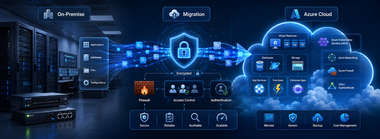
Plan an Azure migration around business outcomes, workload evidence, landing-zone governance, identity, data integrity, recovery, controlled waves, and sustainable cloud operations.
10 min read
Choose MongoDB through aggregate boundaries, access patterns, document growth, consistency, indexing, sharding, recovery, and operating evidence rather than schema flexibility alone.

8 min read
A practical guide to choosing custom WordPress development for distinctive content, conversion journeys, integrations, WooCommerce, performance, security, and maintainable growth.

9 min read