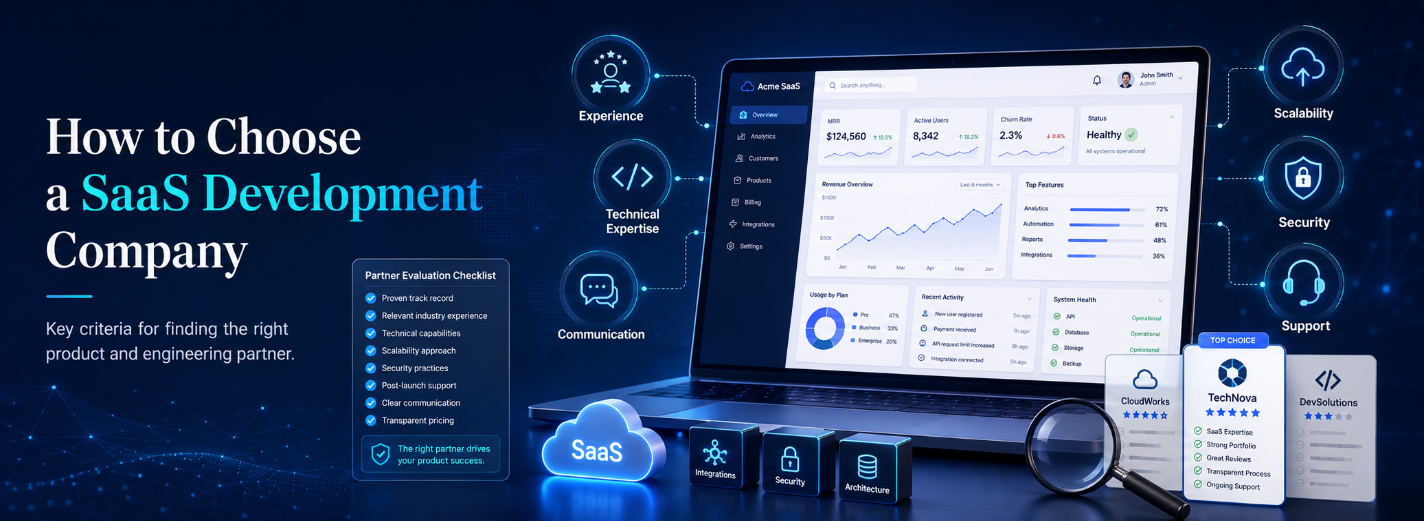
How to Choose a SaaS Development Company by Evidence
- saas development company
- saas development services
- custom saas development
- SaaS partner
- SaaS product development
Choosing a SaaS development company is an operating-model decision. The vendor will influence how customer problems become product bets, how tenants and permissions are separated, how data and billing behave, how releases are observed, and how the business responds when a dependency fails. A company that can produce screens quickly may still leave the product expensive to change or impossible to operate without it.
Write an evaluation brief before requesting proposals. Include target users and buyers, critical journeys, business model, data classes, tenant and entitlement needs, integrations, service objectives, regions, regulatory context, accessibility, AI features, existing assets, internal team capability, budget boundary and unresolved assumptions. State what success should look like in six and eighteen months.
Define the responsibility map as carefully as the product scope. Name owners for research, roadmap, UX, architecture, cloud and vendor accounts, privacy, security, testing, release, incidents, customer support, analytics, cost and knowledge transfer. Record what the client will supply. Without this map, companies price different jobs under the same headline and the lowest proposal often contains the largest omissions.
Look for Product Experience That Matches the Hard Part
Relevant experience means evidence from a similar constraint, not merely the same industry. Ask about multi-tenant authorization, usage or subscription billing, enterprise SSO, regulated records, high-volume ingestion, workflow state, complex integrations, localization, accessibility or a live migration—whichever carries your product risk. A healthcare logo says little if the proposed team only built its public website.
For each example, request the initial uncertainty, scale and service objective, options considered, decision, failure or incident, measurable result and the vendor’s exact role. Speak to references about forecasting, communication under pressure, staff continuity, post-launch support and handover. Confirm that the people in the case are related to the team being offered.
Ask to inspect sanitized working artifacts: a decision record, threat model, acceptance criteria, test report, service dashboard, incident review or migration plan. Strong evidence connects a customer outcome to architecture, code, operations and learning. Treat confidential details responsibly, but do not accept logos, testimonials or unsupported performance claims as proof.
Evaluate Discovery and Delivery as a Decision System
Discovery should turn expensive assumptions into decisions. The company should investigate the user and buyer, workflow, value, adoption barriers, data, integrations, compliance, operations and commercial model. Each uncertainty needs the cheapest credible evidence: interview, workflow observation, prototype, data sample, technical spike, pricing test or production-shaped experiment. Set decision dates so discovery does not become indefinite analysis.
Define the smallest release that proves one customer outcome end to end. Include onboarding, tenant and role setup, the core action, payment or entitlement where relevant, support, analytics, failure feedback, telemetry and deployment. A slice with real boundaries reveals more than a broad mockup or isolated API. Record what the first release intentionally excludes and what evidence will justify expansion.
Review the delivery loop: outcome definition, design and architecture review, backlog refinement, code review, automated checks, security work, preview environment, release gate, production observation and retrospective. Ask how estimates and risks change, how defects are prioritized and who can pause a release. You should see work, decisions and evidence continuously rather than receive a polished status report after decisions are already fixed.
Review Technical Capability Through a Real Journey
Use one critical journey to examine architecture. Follow identity and tenant context through client, API, authorization, data, cache, queue, integration and background processing. Ask what happens under duplicate requests, slow providers, retry, partial success, a noisy tenant and a regional failure. The answer should identify authoritative state, idempotency, timeouts, reconciliation, telemetry and the operator’s repair path.
Evaluate the architecture against actual demand: tenant size distribution, read and write peaks, data growth and retention, report and search needs, integration quotas, geography, recovery objectives and cost. A modular monolith may provide a safer first boundary than premature microservices. “Cloud-native” and “scalable” are not designs; require capacity assumptions, load scenarios, bottleneck evidence and thresholds that trigger change.
Inspect engineering foundations: version control, dependency policy, reproducible builds, environments, infrastructure as code, data migrations, feature controls, observability, backups and restore. Ask how an engineer joins the project, how a production change is approved, how an artifact reaches each environment and how a failed release is contained. These answers expose maturity more reliably than a technology list.
Demand Transparent Communication and Durable Ownership
Transparency is access to the system of work. The client should have appropriate access to the backlog, repository, designs, environments, CI/CD, cloud accounts, dashboards, incidents, decisions and spending. Communication should distinguish facts, assumptions, risks and decisions. Agree channels, meeting purpose, response expectations, escalation and who is authorized to change scope, architecture or budget.
Establish ownership from the first day. Repositories, domains, app registrations, tenant data, cloud and SaaS accounts, signing and encryption keys, deployment pipelines and documentation should be controlled by the client or transferable without negotiation. Use individual identities and auditable privileges, not shared vendor credentials. Senior contributors named in the proposal need defined allocation and a replacement process.
Track decisions and unresolved risks with an owner and date. Demonstrations should use acceptance evidence and production-like behavior, not only the happy path. Encourage early bad news by focusing reviews on what changed and what needs a decision. A vendor that hides uncertainty until an invoice or deadline creates more risk than one that updates the plan from evidence.
Test Security, Quality and Support Before Launch
Security and privacy belong in the product design. Classify data, define lawful purpose, minimization, retention, deletion, export, residency and audit, and map controller, processor and subprocessor roles. Review tenant isolation, object-level authorization, administrator access, identity federation, secrets, encryption, logging, vulnerability handling and incident notification. Compliance documentation supports assurance but does not secure custom code or configuration.
Ask for a risk-shaped test strategy. Domain logic needs focused tests, tenant and API boundaries need authorization and contract tests, important components need behavior and accessibility checks, and a small set of end-to-end scenarios should prove revenue and support journeys. Include load, dependency failure, backup restoration, migration, rollback and observability. Coverage percentage alone cannot show whether the product is safe to change.
Define post-launch service before the MVP. Agree support hours, severity, response and restoration objectives, on-call responsibility, maintenance, security remediation, upgrades, cloud cost review and post-incident action. Run one incident or restore exercise during delivery. A company is ready for long-term support when responsibilities, evidence and escalation work before a real outage.
Compare Expected Value, Risk and Lifecycle Cost
Normalize every proposal. Compare the same discovery, UX, product management, engineering seniority, integrations, data migration, environments, testing, security, accessibility, infrastructure, observability, third-party fees, documentation, release, support, contingency, ownership and exit. List assumptions and exclusions beside the price. A low rate can be expensive when the client must add missing leadership or rebuild omitted operations.
Model expected total cost: time to validated learning, time to revenue, internal effort, rework probability, change failure, infrastructure and vendor spend, support, opportunity cost and transition. Request a range with drivers and confidence rather than a precise number unsupported by discovery. Agree how new evidence changes scope, estimates and approval.
Choose the commercial model for the uncertainty. Fixed price can suit stable, testable deliverables; time-and-materials or dedicated capacity can suit evolving product work when priorities, visibility and spend limits are strong. A short paid discovery or technical proof can reduce risk before a large commitment. No pricing model compensates for unclear acceptance, weak access or missing ownership.
Choose a Company That Can Grow—and Let Go
Growth tests more than throughput. The company must support more tenants, roles, integrations, regions, data, support volume, regulation and contributors without turning each change into a platform project. Ask how architecture and teams evolve, how shared capabilities are governed, how costs are attributed, and how deprecations and migrations reach customers. Look for thresholds and owners instead of speculative complexity.
Continuity matters. Review hiring and retention, key-person exposure, subcontracting, documentation and succession. The contract should cover intellectual property, open-source obligations, security and data processing, incident notification, staffing changes, termination, data return, deletion evidence, transition support and access revocation. Define an exit budget and handover artifacts before leverage disappears.
The best partner can eventually become less essential. Internal engineers should learn architecture, deployment, incident response and product reasoning throughout delivery. Test portability by having the client reproduce the build, perform a release, find a request in telemetry and restore a backup. Transfer is an operating capability, not a final presentation.
A Four-Step SaaS Company Evaluation
- /01Map the Responsibility BoundaryName owners for discovery, UX, roadmap, architecture, cloud accounts, data protection, security, release, incidents, support, cost, handover and exit.
- /02Request Verifiable EvidenceAsk the proposed team to explain a relevant decision, quality gate, incident, rollback and trade-off with metrics and inspect sanitized operating artifacts.
- /03Run a Focused Paid SessionUse a real workflow to model tenants, permissions, data, billing, integrations, failure, telemetry, deployment and the smallest proof with acceptance.
- /04Compare Assumptions Before TotalsNormalize scope, exclusions, people, environments, tests, security, operations, support, ownership, change rules and exit; then compare total cost and risk.
What evidence should a SaaS development company provide?
What evidence should a SaaS development company provide?
Shortlist companies against the same weighted criteria, then run a paid workshop or production-shaped slice around the riskiest customer journey. Include real roles, tenant isolation, data lifecycle, an integration, telemetry, release, failure and rollback. Define acceptance before work and observe how the proposed team asks questions, makes trade-offs and leaves evidence.
Score product judgment, relevant engineering, delivery, security, quality, operations, communication, commercial clarity, continuity, ownership and exit. Verify references and legal terms after technical evidence, not instead of it. Choose the company whose assumptions are visible, whose critical path has been tested and whose model leaves the product stronger than the vendor relationship.
Separate mandatory gates from weighted preferences. A company that cannot meet a required data boundary, transfer ownership, provide named accountable staff or demonstrate recovery should not compensate with a lower price or attractive design. For the remaining candidates, write the evidence behind every score and record dissent. Sensitivity-test the result by changing the weights: if a small adjustment reverses the winner, the decision needs more evidence rather than another decimal place.
Close due diligence with explicit conditions for the next commitment. Resolve critical contract gaps, provision client-controlled access, agree the first outcome and acceptance, name decision makers, set the initial spending limit and schedule an early continuation review. Keep a credible second choice until these conditions are satisfied. Selection is complete when the operating relationship is testable, not when a proposal is signed.
Evaluate a SaaS Company on the Riskiest Journey
Bring the product brief, representative workflow, proposals, architecture constraints, regulatory context and unresolved assumptions. GARNO.TECH can normalize the options and structure a paid technical proof with measurable acceptance, ownership, lifecycle cost and exit.
Publications
Our research
Research and development of AI-powered solutions to optimize business workflows and enhance decision-making processes.
Analysis of machine learning models for predictive analytics in finance, e-commerce, and SaaS platforms.
Exploration of natural language processing and computer vision technologies to strengthen automation, personalization, and customer support.
What a Fractional CTO Does: Mandate, Decisions, Cadence, and Exit
A practical guide to the accountable outcomes, evidence, decision rights, weekly work, crisis controls, measures and exit criteria of a part-time technology executive.

8 min read
08 Sep 2026
Angular PWA vs Native App: Choose from Product Constraints
A production guide to Angular PWA and native mobile delivery covering offline data, synchronization, installation, push, device APIs, performance, distribution, cost, updates, security and lifecycle ownership.

10 min read
21 Sep 2026
Azure Application Architecture: Development, Delivery, and Operations
Design Azure applications as an operating system: governed landing zones, workload-led service choices, secure identities, incremental modernization, infrastructure as code, progressive delivery, observability, resilience, and cost ownership.

9 min read
05 Aug 2026