How to Choose a Mobile App Development Agency
- mobile app development
- mobile app development agency
- mobile app development services
- mobile app development company
- custom mobile app
Choosing the right partner for mobile app development affects much more than the quality of the first release. The team will influence product scope, user experience, technical stability, store approval, maintenance costs and the speed of future updates.
A strong mobile app development agency should combine product strategy, design, engineering and quality assurance. The best candidate is not necessarily the largest or cheapest company. It is the team that understands the business objective, explains risks clearly and can turn requirements into a reliable product.
Review relevant mobile product experience
Review projects that are similar in functionality, audience or operational complexity. Ask whether the agency has delivered applications with payments, subscriptions, maps, real-time communication, offline behavior, device hardware or external integrations.
Case studies should explain the original problem, the agency's responsibility and measurable results. Attractive screenshots are useful, but they do not prove that the team solved performance issues, handled store releases or supported the application after launch.
Choose product thinking, not only coding capacity
The agency should ask who the users are, which problem the application solves and which action creates value. Teams that begin with a long list of screens often reproduce assumptions without validating whether the workflow makes sense.
Professional mobile app development services usually include discovery, prioritization and technical analysis before implementation. A capable partner should help separate launch-critical functionality from improvements that can be added after real user feedback.
Evaluate the technical approach
Ask why the team recommends native iOS and Android, React Native, Flutter or another approach. The answer should consider performance, device features, delivery speed, team availability and long-term maintenance rather than personal preference.
The agency should also explain backend architecture, data synchronization, authentication, notifications, analytics and error monitoring. For a custom mobile app, technical decisions must support the expected product lifecycle without creating unnecessary complexity.
Check UX and interface design quality
Mobile UX must account for small screens, interruptions, slow networks, permissions and different device sizes. Review whether the agency designs complete user flows instead of isolated attractive screens.
Prototypes should be tested before expensive implementation begins. The team should define navigation, loading states, empty states, validation, error recovery and accessibility. Good design makes the application easier to understand and also reduces development ambiguity.
Demand a transparent delivery process
You should know who is responsible for product decisions, design, engineering and delivery. A reliable process includes visible priorities, short development cycles, regular demonstrations and documented changes.
Be cautious when an agency provides an instant fixed estimate without discussing integrations, platform differences or release requirements. A trustworthy partner explains assumptions, exclusions and risks, then updates the plan when new information appears.
Understand testing and release preparation
Testing should cover real devices, operating system versions, network changes, permissions, background behavior and integration failures. Ask how automated tests are combined with manual checks and how critical user flows are protected from regressions.
The agency should prepare store metadata, signing, privacy information and release builds. It must also monitor crashes and performance after publication because store approval does not guarantee that the application works reliably for every user.
Clarify ownership and post-launch support
Clarify ownership of source code, design files, store accounts, infrastructure, analytics and technical documentation. The client should retain the access required to operate the product or transfer it to another team.
Mobile platforms change continuously, so maintenance is unavoidable. Confirm how the agency handles operating system updates, dependency upgrades, urgent defects and new device requirements. Support terms should be defined before launch rather than negotiated during the first production incident.
Select a partner that can support product growth
The right agency combines product thinking, strong design, disciplined engineering and transparent communication. Before signing a contract, speak with the people who will actually work on the application and ask them to explain their proposed approach.
Compare candidates by relevant experience, process, ownership and long-term value rather than presentation quality or hourly rate alone. A careful selection process reduces delivery risk and creates a stronger foundation for an application that can evolve with users and business priorities.
What should a mobile app agency include in its estimate?
What should a mobile app agency include in its estimate?
Looking for the right mobile development agency?
We align product requirements, architecture, integrations, security, quality, delivery, observability, and operations with measurable business outcomes.
Publications
Our research
Research and development of AI-powered solutions to optimize business workflows and enhance decision-making processes.
Analysis of machine learning models for predictive analytics in finance, e-commerce, and SaaS platforms.
Exploration of natural language processing and computer vision technologies to strengthen automation, personalization, and customer support.
Angular Development Services: Enterprise Applications That Scale
How Angular helps businesses build secure, maintainable, and high-performance enterprise platforms that can evolve with growing teams and requirements.

5 min read
04 Aug 2026
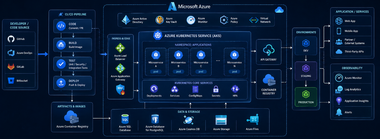
How DevOps and Azure Cloud Work Together for Modern Platforms
How automation, cloud infrastructure, CI/CD, monitoring, and security help businesses build reliable and scalable digital platforms.
5 min read
04 Aug 2026
Azure Cloud Development Services: Architecture, Development and DevOps
Learn how Azure architecture, application development, automation, and DevOps practices help businesses build secure and scalable cloud platforms.

8 min read
05 Aug 2026