Main Our Research
Digital Product Development Trends for 2026: From AI Experiments to Governed Systems
Digital Product Development Trends for 2026: From AI Experiments to Governed Systems
- digital product development trends 2026
- AI-native development
- agentic AI
- multi-agent systems
- platform engineering
- product engineering
- DevSecOps
- confidential computing
- digital provenance
- cloud-native development
In 2026, the decisive shift in digital product development is not that artificial intelligence can generate more code or text. It is that AI is becoming an actor inside delivery and operating systems. It proposes changes, calls tools, searches private knowledge, updates records, explains incidents, and sometimes takes action on behalf of a person. That makes architecture, identity, evidence, and recovery more consequential than the novelty of the interface.
The same year is exposing a useful limit to the hype. Faster generation does not repair ambiguous product strategy, fragile tests, inaccessible data, weak ownership, insecure credentials, or an unreliable release process. DORA’s research on generative AI frames the benefit as dependent on governance and strong software-delivery fundamentals. AI amplifies the system it enters.
The trends that matter therefore reinforce one another: bounded agentic workflows, internal platforms that serve human and non-human users, explicit identity and delegation, data locality and provenance, multimodal experiences with visible control, and economics measured per useful outcome. Competitive advantage comes from learning safely at production speed—not from adopting every new capability at once.
AI-Assisted Engineering Becomes a Managed Delivery System
AI coding tools are moving from personal autocomplete into managed engineering workflows. They can analyze a task, navigate a repository, propose implementation, generate tests, review changes, update documentation, and help investigate production evidence. The unit of value is no longer a generated line; it is an accepted change that solves the intended problem without increasing risk or future maintenance disproportionately.
Strong organizations connect assistants and coding agents to scoped repository access, architecture rules, dependency policy, secret scanning, reproducible builds, tests, code review, and deployment evidence. They preserve the requirement, prompt or plan, diff, tool actions, reviewer decision, and observed outcome where traceability matters. Generated work enters the same controls as human work because plausibility is not correctness.
Measure cycle time from accepted problem to production learning, review effort, escaped defects, rework, change failure, security findings, and maintainability—not prompts sent or code volume. Watch how the distribution changes: a faster first draft can create a slower review bottleneck or larger batches. Train engineers to decompose work, state invariants, design evaluation, interrogate dependencies, and explain the complete system. Judgment becomes more valuable as production gets easier to generate.
Agents Become Accountable Actors, Not Invisible Features
The useful progression in agentic products is from suggestion to bounded execution. An agent may collect evidence, construct a plan, prepare a transaction, call approved tools, wait for an outside event, ask for authorization, and verify the result. The product must distinguish proposed, approved, running, waiting, completed, failed, compensated, and cancelled work. A conversational answer is not a durable workflow state.
Choose tasks with a clear owner, permitted resources, success condition, time and cost budget, and reversible failure. Give each agent a unique identity, short-lived credentials, least privilege, explicit delegation from a user or system, and an audit trail that connects every action to its authority. NIST’s 2026 agent standards work makes identity and authorization foundational precisely because agents act across systems rather than merely generate text.
Persist plans and checkpoints outside model context. Treat tool responses, retrieved content, and user documents as untrusted input; protect against instruction injection and confused delegation. Use idempotency, timeouts, concurrency control, compensation, and an operator path for exceptions. Evaluate task completion, unauthorized-action rate, corrections, latency, cost, evidence quality, and recovery. Increase autonomy only after the current boundary earns trust.
Platforms Evolve From Golden Paths to Governance Layers
Platform engineering in 2026 is expanding beyond developer portals and deployment templates. The platform increasingly mediates access to models, data, tools, accelerators, secrets, evaluation, policies, and cost. CNCF discussions now describe AI agents as platform consumers alongside engineers: they request resources and invoke operations, so they need the same identity, scope, policy, and audit discipline.
A useful internal platform offers paved paths for common product shapes while preserving an escape route for justified exceptions. It may provide service templates, environments, CI/CD, software supply-chain controls, observability, databases, queues, identity, an AI gateway, model catalog, retrieval patterns, evaluation harnesses, prompt and response protection, quotas, and cost attribution. The interface can be portal, API, CLI, or Git-based; self-service matters more than one front end.
Treat the platform as a product. Identify users and their highest-friction journeys, publish service levels and ownership, measure adoption and task completion, and remove golden paths that no longer help. Avoid building a universal abstraction before demand exists. A platform succeeds when teams ship a compliant, observable service or AI workflow more safely and quickly, not when it owns the largest toolchain.
Security Moves Into Identity, Delegation, and Runtime Control
Security for autonomous and AI-enabled products begins with a complete actor model. Human users, services, agents, models, tools, datasets, and platform operators need distinct identities and owners. Authorization must express who delegated which action, for which resource and purpose, under what conditions, until when. A shared API key placed in agent context cannot answer those questions.
Use short-lived credentials, least privilege, policy checks at the tool boundary, egress controls, data classification, and step-up human approval for high-consequence operations. Bind an agent’s authority to the requesting principal without allowing it to inherit every permission. Protect tool descriptions and retrieved content as an attack surface. Validate arguments and outputs, limit recursion and spend, isolate execution, and preserve tamper-evident audit events.
Software supply-chain discipline becomes more important as generated changes and external components multiply: signed artifacts, protected build provenance, dependency and model inventories, policy on packages and licenses, secret scanning, reproducible paths, and controlled promotion. Test adversarial behavior throughout the lifecycle—prompt injection, data exfiltration, privilege escalation, unsafe tool sequences, poisoned retrieval, excessive agency, and denial of wallet—alongside familiar application threats. Runtime detection and rapid revocation complement pre-release checks.
Data Location, Provenance, and Permission Shape Architecture
Data architecture now determines which intelligent features can exist lawfully and reliably. Map each dataset by owner, subject, source, purpose, quality, sensitivity, residency, retention, deletion, allowed processors, and downstream products. A vector index, prompt log, model cache, evaluation set, and fine-tuning artifact are new copies or transformations that must remain inside the lifecycle rather than disappear into an “AI” exception.
Design regional boundaries from actual legal, contractual, and customer obligations. Know where primary data, replicas, backups, telemetry, support access, and model inference occur. Use data minimization and purpose-bound access before reaching for complex isolation. Confidential computing can protect selected data while it is processed, complementing encryption at rest and in transit, but it does not fix excessive collection, weak authorization, or an untrusted result.
Provenance should answer what source influenced an output, which model and configuration ran, what transformation occurred, who approved release, and whether rights permit reuse. Sign and attest software artifacts; attach lineage and quality indicators to data products; preserve citations for retrieval; label generated content where required. Build export, correction, retention, and deletion through derived stores and indexes. Reliable agents need documented contracts and fresh, permission-aware data more than they need a larger context window.
Multimodal Experiences Still Need Predictable Control
Multimodal interaction is becoming ordinary: a user can speak, type, upload a document or image, inspect structured results, and continue through conventional controls. The design challenge is not to make every screen conversational. It is to let people choose the most effective input while keeping state, consequences, and correction visible.
Use generated interfaces for explanation and adaptation, not for moving essential controls unpredictably. High-consequence work—money, healthcare, permissions, publishing, deletion, compliance—needs a reviewable plan, source evidence, editable parameters, explicit confirmation, durable status, and a receipt. Show whether the system is suggesting, drafting, executing, waiting, or finished. Stream progress or move long work to the background rather than trap a user behind an animated answer.
Accessibility is a design constraint across modalities. Preserve semantic structure, keyboard and switch access, focus order, labels, contrast, captions, transcripts, text alternatives, adjustable timing, and error recovery. Voice is not accessible to everyone; visual output is not sufficient for everyone; personalization can create disorientation. Test real tasks with people across abilities, languages, devices, bandwidth, and expertise. Measure completion, time, corrections, abandonment, trust calibration, and successful recovery—not delight at a demo.
Teams Optimize the Outcome, the Evidence, and the Unit Cost
Output metrics are losing their authority. Features shipped, story points completed, prompts executed, and tokens consumed do not show whether a product improved a customer’s work. Begin with the outcome and guardrails: time or error reduced, successful completion increased, loss prevented, revenue protected, support avoided, or a regulated decision made more reliable—without unacceptable harm, cost, or exclusion.
Connect product analytics to qualitative research, experiment design, service reliability, security events, support evidence, and financial data. AI behavior also needs versioned evaluation sets: representative tasks, boundary cases, adversarial inputs, scoring criteria, human review, and production sampling. Evaluate the complete workflow, including retrieval, tools, authorization, latency, fallback, and user correction. A model benchmark cannot certify a product.
Measure unit economics by useful outcome: model and tool cost per successfully completed case, infrastructure and human-review cost, retries, cache behavior, support burden, and cost of error. Track quality and cost distributions by segment, not only averages. Preserve small releases, feature flags, shadow evaluation, progressive exposure, observability, and rollback. The fastest teams are not those that skip controls; they are those whose controls produce trustworthy evidence early enough to change the decision.
A Practical Response: Strengthen the System Before Autonomy
Do not create a separate transformation program for every trend. Select one bounded workflow with a costly current problem, a responsible owner, available data, measurable success, and a safe manual path. Map its actors, decisions, systems, permissions, failure modes, latency, cost, and regulatory obligations before choosing a model or platform.
Strengthen the delivery foundation first: version control, review, reproducible builds, automated tests, progressive deployment, observability, incident response, secrets, identity, backups, and restore. Establish an approved route to models and data with evaluation, logging, retention, quota, and cost policy. Create reusable platform capabilities only after two or more teams show the same need; otherwise a documented reference implementation may be enough.
Introduce autonomy in stages. Begin with retrieval or recommendation, then a draft with sources, then an executable plan requiring approval, then automatic low-risk actions inside a narrow boundary. At every stage, compare quality, latency, cost, corrections, incidents, and user value with the existing process. Revoke capability when evidence deteriorates. Train product, engineering, security, legal, operations, and domain owners together because governance cannot be delegated to the model team after launch.
The defining product skill of 2026 is not generating more output. It is giving intelligent systems enough authority to create value, enough evidence to earn trust, and narrow enough boundaries to recover safely.— GARNO.TECH
Build for Change Without Designing for Every Future
Future-ready does not mean abstracting every provider or preparing for every imagined regulation. It means keeping the decisions likely to change behind clear contracts and preserving the evidence needed to change them safely. Models, prompts, tools, policies, data sources, evaluation sets, and cost rules should be versioned. Business state and audit history should remain durable when a model or vendor changes.
GARNO.TECH can help assess product strategy, architecture, AI use cases, data readiness, agent identity and authorization, security, platform capabilities, cloud infrastructure, delivery performance, observability, accessibility, and unit economics. The work may range from a bounded AI-assisted workflow to a modernized SaaS platform or governed agentic system. Each engagement should begin with the business decision and end with production evidence, operational ownership, and a realistic next boundary.
The enduring 2026 trend is disciplined integration. AI becomes one component in a product system whose people can explain what it did, which authority it used, what evidence supports the result, what it cost, and how to recover when it is wrong. Organizations that can answer those questions can adopt new capabilities quickly. Those that cannot will accumulate faster uncertainty.
Publications
Our research
Research and development of AI-powered solutions to optimize business workflows and enhance decision-making processes.
Analysis of machine learning models for predictive analytics in finance, e-commerce, and SaaS platforms.
Exploration of natural language processing and computer vision technologies to strengthen automation, personalization, and customer support.
The Business Impact of Custom Software: Value, Risk, and Ownership
A decision guide to custom software: identify the constraint, compare buy and build options, redesign operations, control data, improve customer journeys, model lifecycle ROI, and preserve long-term ownership.

9 min read
24 Jul 2026
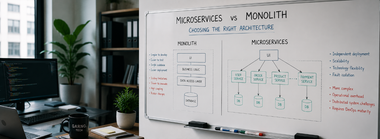
Microservices vs Monolith: Choosing the Right Architecture
Compare monoliths, modular monoliths, and microservices through delivery, domain boundaries, data, reliability, scaling, team ownership, cost, and migration evidence.
8 min read
24 Jul 2026
How DevOps Turns Digital Transformation into Delivery Capability
Use DevOps to turn digital strategy into a measurable operating capability through small releases, automated evidence, cloud platforms, observability, resilience, security, ownership, and learning.

8 min read
24 Jul 2026