
AngularJS to Angular Migration: An Incremental Production Strategy
- AngularJS to Angular migration
- angular
- architecture
- development
An AngularJS-to-Angular migration replaces more than a view framework. It changes bootstrap, component ownership, dependency injection, routing, forms, state, templates, change detection, build and test tooling, third-party libraries, browser behavior, release artifacts, and the skills needed to operate the frontend. Treat it as a product transition with compatible user journeys, not as a repository cleanup.
Start with the business reason and an observable baseline. Measure the effort and risk of ordinary changes, security and dependency exposure, build reliability, defect and incident patterns, performance, accessibility, test confidence, onboarding, browser support, and the product work delayed by the legacy system. Define the target outcome, accountable owner, budget, opportunity cost, review date, and conditions that would stop or reshape the migration.
The goal is not to reproduce every AngularJS pattern in TypeScript. Angular’s component, template, reactive, dependency, and build models reward different boundaries. First learn which legacy behavior users, support teams, integrations, and analytics actually depend on. Then move complete journeys into an architecture the team can safely evolve, while deleting each obsolete path as its replacement earns production trust.
Understand Why AngularJS Becomes Expensive
AngularJS becomes costly because upstream support has ended while the surrounding web platform, browsers, security expectations, build ecosystem, and product continue to change. Old packages may be abandoned or pin incompatible versions. Custom directives and digest-sensitive behavior can make small changes unpredictable. Global scope, implicit dependency, mutable shared state, and controllers that own entire screens increase the number of places an engineer must understand before editing one journey.
The visible framework is only part of the constraint. Legacy build chains, unsupported test runners, obsolete UI libraries, fragile CSS, inaccessible components, undocumented browser workarounds, and backend contracts shaped around old screens may carry more risk than AngularJS itself. Identify the mechanism: slow feedback, production defects, hiring constraint, security exposure, performance ceiling, or inability to deliver a product outcome. A migration without that diagnosis can preserve the expensive parts under a modern package name.
Create a migration hypothesis for one representative journey. State how component isolation, typed contracts, current tooling, controlled state, or supported dependencies will change a measurable outcome. Include the cost of running two frameworks. If the slice does not reduce risk or improve change after the team learns the new model, revisit the architecture rather than accelerating the same mistake.
Choose Rewrite or Incremental Migration by Risk
An incremental migration usually protects product delivery and converts uncertainty into a sequence of small decisions. It can start by componentizing AngularJS, upgrading build and tests, isolating API clients and state, then introducing Angular at a stable shell, route, or feature boundary. Each migrated vertical journey includes UI, state, data access, tests, analytics, accessibility, release, and ownership; completion removes its AngularJS implementation.
A rewrite may fit a small application with understood behavior, little active change, strong automated and manual acceptance evidence, and a short replacement window. It may also be necessary when the old application cannot coexist safely or a new product model intentionally discards most legacy behavior. The organization must still fund continuing legacy fixes, synchronize changing requirements, validate data and journeys, and define the point after which rollback becomes impractical.
Compare options using calendar time, migration and feature capacity, dual-runtime cost, security exposure, customer disruption, training, test evidence, third-party replacement, release frequency, and recovery. Beware the false choice between “rewrite everything” and “leave everything.” Stabilizing the current system, extracting a new route, replacing one capability, or retiring unused behavior may yield the best next step.
Design Hybrid Coexistence as a Temporary Bridge
A hybrid application can run AngularJS and Angular during transition. The official upgrade bridge can bootstrap both runtimes and upgrade or downgrade selected services and components. This is a migration mechanism, not the target architecture. Document who owns bootstrap, routing, error handling, shared dependencies, global styles, change propagation, and teardown. Establish a rule that new product work uses the target architecture unless an explicit exception is approved.
Reduce legacy coupling before crossing the bridge. Convert suitable directives into component-style boundaries with explicit inputs and outputs, move controller logic into owned services or domain functions, eliminate implicit parent-scope communication, isolate DOM manipulation, and define stable API clients. Cross the runtime boundary through narrow contracts. Every upgraded or downgraded dependency increases initialization, change-detection, debugging, and removal complexity.
Measure hybrid cost: bundle size, bootstrap and interaction performance, duplicate libraries, memory, build time, test time, deployment complexity, and developer cognitive load. Maintain a migration ledger of legacy modules, routes, bridges, owners, dependencies, target sequence, and deletion evidence. Set an expiry condition for the bridge. Without a removal plan, coexistence becomes a permanent platform that is harder to operate than either application alone.
Move Components and Routes with Clear Ownership
Inventory AngularJS modules, controllers, directives, templates, filters, services, routes, resolves, guards, forms, validators, UI libraries, global styles, and direct DOM integrations. Map them to user journeys and ownership. Choose components with bounded data flow and limited runtime dependencies first, but ensure the first slice exercises a meaningful interaction, API, form, analytics, and release path rather than proving only that a static widget renders.
For each component, define inputs, outputs, states, accessibility behavior, content, loading and empty conditions, validation, permission, error, and recovery. Preserve automation hooks and analytics semantics deliberately. Replace shared visual primitives through a versioned design system that can serve both runtimes temporarily, avoiding two unrelated component libraries. Visual equivalence is not enough if keyboard, focus, screen-reader, latency, or failure behavior regresses.
Make one router the authority for each URL. Decide how navigation, deep links, redirects, authentication gates, route parameters, query strings, scroll and focus restoration, titles, analytics, lazy loading, and not-found behavior cross the boundary. Prefer whole-route migration when feasible because it reduces runtime crossings and enables independent acceptance and rollback. Remove old route registrations immediately after stable cutover.
Preserve State and API Semantics Across Runtimes
Avoid letting both runtimes mutate the same state graph. Establish sources of truth for identity, permissions, current organization, feature decisions, draft data, notifications, and caches. Share state through a small framework-neutral contract or backend when necessary, with explicit ownership, lifecycle, serialization, and update semantics. Events should describe completed facts, not become an undocumented command bus. Temporary adapters need metrics and a deletion owner.
Preserve backend behavior across old and new clients: authentication and refresh, CSRF, authorization, status and error shapes, pagination, dates, identifiers, localization, idempotency, caching, retry, timeout, file transfer, and version policy. A user may hold multiple tabs or a stale bundle during deployment. Backend changes must tolerate overlapping frontend versions or introduce an explicit versioned boundary.
Do not copy every AngularJS service into a global Angular singleton. Separate domain or application logic from browser and framework details, then expose narrow typed interfaces. Use reactive streams only where a stream models the problem; uncontrolled subscriptions and shared mutable subjects can reproduce the old scope problems. Define cancellation, stale-response handling, concurrency, cleanup, and error ownership for every asynchronous journey.
Test the Transition, Not Only the New Components
Build a layered transition harness. Characterization tests preserve legacy behavior users depend on; unit and component tests protect deterministic logic and states; contract tests verify backend and cross-runtime boundaries; integration tests cover routing, identity, forms, state, and adapters; end-to-end tests protect a small number of critical journeys. Keep targeted manual exploration for visual, accessibility, browser, interruption, and edge behavior that automation does not cover well.
Test hybrid-specific failures: bootstrap order, upgraded and downgraded dependencies, digest and Angular change propagation, navigation between runtimes, session refresh, lazy loading, duplicate requests, event cleanup, browser history, deep links, multiple tabs, stale assets, and partial deployment. Detect memory leaks and duplicated handlers through repeated navigation. Measure bundle, load and interaction performance on representative devices and networks, not only a developer workstation.
Use production-shaped accounts, permissions, languages, content length, data size, error responses, and feature states. Maintain a supported browser and device matrix tied to real users. Add accessibility checks for semantics, focus order, keyboard operation, announcements, contrast, zoom, and motion. A migration that preserves pixels but excludes users or weakens supportability has not preserved the product.
Release Route by Route Without Freezing the Product
Keep product work moving through one prioritized portfolio. Reserve explicit migration capacity, and whenever possible attach modernization to a real product journey rather than rebuilding unused screens. Define “done” as accepted Angular behavior, production telemetry, operational ownership, and deleted AngularJS code, tests, routes, dependencies, bridge entries, and styles. Counting created Angular components rewards addition while hiding unfinished retirement.
Build traceable artifacts through reviewed automation and test representative environments. Release whole routes or cohorts progressively behind explicit controls. Before exposure, agree thresholds for JavaScript errors, failed API calls, latency, interaction performance, journey completion, accessibility defects, support demand, and business outcomes. Segment by runtime, route, version, browser, device, region, and cohort. Name the person who can stop rollout.
Rollback may mean routing a journey back to AngularJS, disabling a feature, restoring compatible backend behavior, or repairing forward. It becomes harder after users create new data or backend contracts change, so define the recovery boundary before release. After stabilization, remove the old path promptly, reconcile emergency changes, update runbooks and ownership, and verify that the next release no longer depends on legacy knowledge.
When Independent Angular Migration Expertise Helps
Independent help is useful when the application has undocumented directives and state, several routers or build systems, fragile authentication, little regression evidence, a critical release calendar, or no recent hybrid Angular migration experience. A focused assessment should return a module and journey inventory, dependency and risk map, migration hypothesis, viable options, representative slice, coexistence rules, sequence, acceptance and rollback thresholds, estimate ranges, ownership, and knowledge-transfer plan.
Evaluate a partner through working evidence: hybrid bootstrap, upgraded and downgraded boundaries, route migration, state isolation, backend compatibility, accessibility, performance, test strategy, deployment controls, telemetry, old-path deletion, and framework upgrades. Confirm that internal engineers participate in design, review, release, and incident work. Success means the client can safely continue modernization and operate the final Angular product without permanent dependency.
- Prove the legacy constraint: connect support, security, change cost, defects, performance, accessibility, or hiring evidence to a measurable migration outcome and owner.
- Choose the smallest responsible strategy: compare stabilization, incremental journeys, and rewrite by product disruption, dual-running cost, evidence, recovery, and total time.
- Bound the hybrid bridge: own bootstrap, routing, dependency crossings, state, styles, errors, performance, telemetry, and deletion; set an expiry condition.
- Migrate complete routes and journeys: move UI, state, API, analytics, accessibility, tests, release, and support together, then remove the legacy registration.
- Give state and APIs one authority: preserve identity, permissions, contracts, idempotency, errors, stale-bundle behavior, and source-of-truth rules across overlapping versions.
- Test and release the transition: cover cross-runtime navigation and lifecycle, real browsers and data, accessibility, performance, progressive exposure, thresholds, rollback, and old-path removal.
Why does AngularJS become expensive to maintain?
Why does AngularJS become expensive to maintain?
Is a full rewrite faster than incremental migration?
Is a full rewrite faster than incremental migration?
How does a hybrid AngularJS and Angular migration work?
How does a hybrid AngularJS and Angular migration work?
What should move first?
What should move first?
How do we keep state and APIs compatible?
How do we keep state and APIs compatible?
Plan an AngularJS Exit That Keeps the Product Moving
Share the AngularJS module, route, state, dependency, and build maps; critical journeys; browser and accessibility needs; backend contracts; test and release evidence; current incidents; team; and product roadmap. GARNO.TECH can define the smallest responsible modernization slice, coexistence rules, sequence, acceptance and rollback thresholds, old-path deletion, ownership, and knowledge transfer.
Publications
Our research
Research and development of AI-powered solutions to optimize business workflows and enhance decision-making processes.
Analysis of machine learning models for predictive analytics in finance, e-commerce, and SaaS platforms.
Exploration of natural language processing and computer vision technologies to strengthen automation, personalization, and customer support.
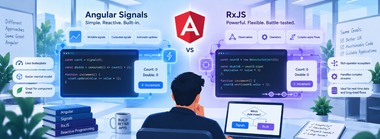
Angular Signals vs RxJS: How to Choose the Right State Model
Choose Angular Signals, RxJS, or a deliberate combination by separating current state from events over time, defining ownership, and testing cancellation, lifecycle, and failure semantics.
9 min read
08 Sep 2026
Azure Cloud Implementation: Architecture, Migration, and Operating Practices
A practical field guide to assessing workloads, designing an Azure landing zone, choosing migration strategies, executing safe cutovers, and operating the platform with security, reliability, and cost control.

11 min read
01 Aug 2026
Scaling Angular Applications as Products and Teams Grow
Scale an Angular product through domain boundaries, deliberate state, performance evidence, accessible design, safe delivery, and routine modernization.

9 min read
04 Aug 2026